The wealthy and fashionable crowds that frequented the hotels at Manhattan and
Brighton Beaches needed diversion and many craved a race track. In those times
most men fancied themselves as expert judges of horse flesh. Every Sunday there
were hundreds of impromptu races along Ocean Parkway and thousands of spectators
crowded around those who were taking bets.
In 1879 William Engeman was the first to meet the public's need when he formed
the Brighton Beach Racing Association. It took him only six weeks to build his
track and grandstand at Brighton Beach. It's sandy track wasn't very good for
setting records when it opened in June 1879. It wasn't the best location either
as it sometimes flooded during heavy rains.
The Coney Island Jockey Club, envying Engeman's success and led by August
Belmont, Jr., William R. Travers, and A. Wright Sanford, began carving out their
Sheepshead Bay track out of a maple and oak forest. When it opened in June 1880,
its judges, W.K. Vanderbilt, J.G. Lawrence and J.H. Bradford were well known
horsemen. It immediately became a successful race track and attracted wealthy
men who thought of it as their playground. Horsemen like Bet-a-Million Gates,
James Buchanan (Diamond Jim) Brady (steel salesman), A.J. Cassatt (railroad
baron), Jesse Lewisohns and Abe Hummel were regulars and owned racehorses.
Brady's colt, Golden Heels was winning every race it entered.
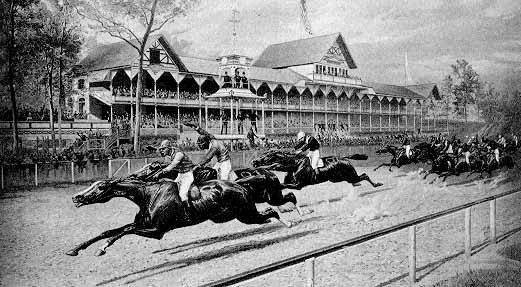
The Futurity at Sheepshead Bay Race Track - 1890's
The whole stretch of shore on the north side of Sheepshead Bay was bought up by
millionaires. They built docks for their yachts, lodges were they could live and
entertain, and stables for their horses. They created three great restaurants;
Tappan's, Villepigue's and Lundy's.
The third race track wasn't built until 1886. It was built by the Brooklyn
Jockey Club, which included some of the same men who had earlier formed the
Coney Island Jockey Club. Noteworthy among them were Phil and Mike Dwyer,
prosperous Brooklyn butchers. The track was built at Gravesend, just off Ocean
Parkway.
For a time there was talk of opening a fourth race track when Tammany leader
Richard Croker considered buying the entire West End of the island. Senator Mike
Norton would have sold, but Croker dropped the idea when Austin Corbin declined
to extend his Long Island Railroad to the Point.
The three race tracks made Coney Island the race track capital of the country.
Their seasons somewhat overlapped so that horse racing fans could find a race
from May through October. Each held high stake races. The crowd would start the
season in the spring with the Brooklyn Handicap at Gravesend, move on to the
Suburban at Brighton, and then to Sheepshead for the Futurity around Labor Day.
During its last fifteen years of Coney's horse racing dominance, the Preakness
became Gravesend's outstanding annual race.
Coney's three race tracks were essential to the development of Coney Island
because they drew to the seaside horse racing fans of all walks of life. The
politicians, easy money men, Wall Street barons and Western railroad men,
society leaders, actors and actresses, the parasites of the rich and large group
of middle class all visited Coney and needed places to sleep, eat and party.
Crowds grew yearly and by the 1905 and 1906 racing seasons 40,000 people would
be on hand to cheer the winners in the Suburban or Futurity races. While the
well-to- do stayed at Manhattan and Brighton Beach's three luxury hotels,
professional gamblers thought nothing of spending $20 a day for a room at
Richard Ravenhall's hotel and bookmakers made their headquarters on the porch of
the Riccadona Hotel, opposite the Brighton Beach Music Hall. Others that
profited from the racing crowd were Risenweber's, the Shelborne Hotel, Pabst's
Hotel and Dick Garm's hotel in the old Sea Beach Terminal.
Betting was considered the lifeblood of the sport, and while it was considered
illegal John Y. McKane turned a blind eye to what was going on. McKane stuck to
his philosophy that those who bet knew what they were doing, and that anyway,
reforms were up to the Jockey Club officials.
The local clubs, however, had McKane's support in a fight against New York
bookmakers who wanted free and immediate information about the races. When high
board fences were erected around the Gravesend track, the New Yorkers put up
still higher poles outside. Telegraph men would perch on top of them to peer
over the fences and describe finishes for the benefit of Manhattan's poolroom
patrons. Since mistakes were costly, the New Yorkers planted men in the stands
to signal to the telegraphers. Once officials caught on, any man that waved his
hands or made any gesture that could be interpreted as a signal was hustled to a
lockup by Pinkerton detectives. Finally the New Yorkers sent agents to leave at
intervals to make reports. The Dwyer brothers countered by closing the track
completely during the running of the races. Regardless of excuses, patrons were
not allowed to leave and were literally prisoners from 2-5 P.M. Eventually the
New Yorkers gave in and agreed to pay several thousand dollars for track
information.
There were many high rollers who were regulars at Coney's race tracks. These
included Joe (the Boy Plunger) Yeager, E.S. Snathers, Lucky Baldwin, Herman
Duryea, Jesse Lewisohn, Mike Dywer, John W (Bet- a-million) Gates and George
Ellsworth Smith, better known as Pittsburgh Phil. The later always shied away
from odds-on favorites and followed a policy of pressing lucky streaks and
waiting out unlucky ones. He had ice water in his veins. His first big killing
came with a colt named King Cadmus. In 1891 after the horse ran miserably in the
$60,000 Futurity, Phil placed a big bet on the horse when it entered the
Sapphire Stake several days later at odds of 10-1. He won $143,000, the largest
amount made up to then on an American horse race. He went down in history as the
only American to make a million by betting on the races, and keep it.
Mike Dwyer, the butcher who helped start the Gravesend track, was a wild better.
He thought nothing of wagering $100,000 in a single day. When he broke up his
racing partnership with his brother in 1892, he was reputed to be worth
$2,000,000. However, he went to England to make a killing in the racing business
and lost most of his winnings there.
While all three tracks were financially successful, they faced legal challenges
by Brooklyn's reformers and its anti-gambling statutes. When preachers
complained, Brooklyn's authorities had to act. First Engeman was arrested and
indicted in 1885, and again in 1886. Then the governors of the Coney Island Club
were served with subpoenas and actually put on trial for permitting gambling at
their track. While everyone knew that there were as many as one hundred
bookmakers operating at each of the three tracks and each paying management $100
/ day for the privilege of handling $15,000,0000 in bets, it was another thing
to convince a twelve man jury that betting on horses was a sin and punishable.
The odds were always in the favor of the accused since several of the men on the
jury were sure to be horse-players themselves.
Crookedness among the racing fraternity was becoming more obvious than ever, and
the public was beginning to show less patience. The worst was at the Brighton
Beach track where several arrests were made that involved taking rivals' horses
from the stables in the dead of night and galloping them almost to exhaustion to
insure their defeat the next day. Disciplinary action was taken against another
of jockeys who pulled their horses to throw a race. Timers and even judges were
accused of conspiracy.
But it wasn't until 1908 that reformers had any real chance to enact legislation
against track betting. When William Randolph Hearst ran for governor that year,
one of his campaign issues was the mortal sin of gambling. His opponent Charles
Evans Hughes, who eventually won the election, assured voters that if he won
gambling wouldn't be an issue. But he immediately double-crossed the voters by
calling a special session of the legislature to enact laws against betting of
horse races. Again arrests reached a peak, but it was nearly impossible to
convict. However, after a two year struggle the horseman finally decided that
they had had a enough. Both the Gravesend and Sheepshead Bay tracks closed in
1910, while Brighton Beach had closed three years earlier.