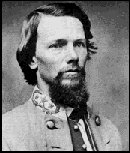
Evander McIver Law was born in Darlington, South Carolina on August 7, 1836. He came from a family that had a military history. Two of his great-grandfathers and his grandfather fought in the American Revolutionary War under guerrilla leader Francis Marion. He attended the South Carolina Military Academy (now the Citadel) in 1856 and became a professor of history at Kings Mountain Military Academy in 1858. He stayed at this post until 1860 when he moved to Alabama to form his own Military High School in Tuskegee.
Soon after the firing on Fort Sumter the state of Alabama seceded from the Union and Law enlisted in the Alabama Militia on April 28, 1861. With his background he was awarded the rank of Captain in the 4th Alabama Infantry. This newly formed unit was made up of the students at his high school and they would become one of the most storied regiments within the Confederate Army. As the summer of 1861 began the regiment was moved to Virginia under the command of Brigadier General Barnard E. Bee and Law was promoted to Lieutenant Colonel. The unit would fight with distinction at the First Battle of Bull Run or First Manassas in June 1861. During the battle, Bee would achieve everlasting fame by giving Thomas J. Jackson the nickname "Stonewall". Bee was killed during the battle, the 4th's colonel was also killed and Law was wounded badly in the arm. Law recovered, although his left arm was stiff and almost useless and for his bravery he was promoted to the rank of Colonel on October 28, 1861. By May 1862 Law assumed command of the Alabama Brigade and the outfit was placed under the command of Major General James Longstreet. Evander Law had been promoted twice within one year but at his new post both he and his new commanding General would be at odds within a few years.

In May of 1862 the Union Army of the Potomac led by General George McClellan had pushed its way up the Virginia Peninsula to the outskirts of Richmond. Joseph Johnston the general commanding the armies defending Richmond would be severely wounded and carried from the field. General Robert E. Lee would replace Johnston and rechristen the force the Army of Northern Virginia. With the the commands of Longstreet and Thomas "Stonewall" Jackson Lee sought to destroy the Army of the Potomac in a series of battles. From June-July 1862 Lee would be successful in his quest in a campaign called the Seven Days Battles.
General Law and the Alabama Brigade would serve valiantly in the Seven Days campaigns especially during the battles of Gaines Mill and Malvern Hill. During the battle of Gaines Mill, Law and fellow brigade commander Brig. Gen. John Bell Hood achieved lasting fame by breaking the center of the Union line. Hood and Law would attack in tandem again during the battle of Malvern Hill. Both generals suffered horrendous causalities in the fight and were decisively defeated. After being promoted so quickly and gaining so much success Evander Law set his sights on becoming a major general. The Army of Northern Virginia made it easy for Law because the casualty rate of the Confederate high command was usually high in every major campaign that it fought.
After Lee's success in the Seven Days Battles Law would make his push for the major generalship in subsequent campaigns. During the Second Battle of Bull Run the Alabama Brigade was among those brigades that General Longstreet chose to attack the Union Army under Maj. Gen. John Pope. The brigade along with five total divisions stormed the Union left flank and nearly destroyed Popes army. General Robert E. Lee again gained another decisive victory over another Union General. Pope retreated and again Brig. Gen. Evander McIver Law had distinguished himself in battle. During the contest the Alabama brigade would suffer 286 casualties (killed & wounded). You can read Law's Second Manassas battle report here.
After the Second Battle of Bull Run, General Lee chose to invade the Maryland in search of a victory that would end the war. During the Maryland Campaign Law would again find himself in a key battle but this time he wasn't making an assault against the Union Army. General George McCellan ordered key attacks on the Confederates who had put themselves in a strong defensive position with the Potomac at their back and in front was a creek called "Antietam". It was September 17, 1862 and it would be known as the bloodiest day in American History. During the Northern assaults the Alabama Brigade defended itself agents the Union attack through the Cornfield. You can read Law's Antietam battle report here. A high level of Law's brigade wouldn't return because 454 men were killed or wounded during the battle.
Due to his gallantry and success in three campaigns, Law was promoted to the rank of Brigadier General on October 15, 1862. During the Fredericksburg campaign in December 1862 Law saw little action and during the in early 1863 Law accompanied Longstreet's Corps to Suffolk Virginia, which prevented any involvement in the Battle of Chancellorsville. The corps would return to the Army of Northern Virginia in time for Lee's second invasion of the north and Brig. Gen. Evander Law would find himself in the most crucial situation of his career.
On the second day of the Battle of Gettysburg, General Hood was among Longstreet's two divisions chosen to attack the Union left. Hood ordered his troops forward after failing to convince General Longstreet to change his battle plans. It seemed obvious to Hood that an assault would cost his division half of its total force because the area that his division would attack was "broken ground". The area that Hood was ordered to attack was covered with woodlots, fenced off farm areas, rocky terrain and a recently-cleared hill called Little Round Top.
Hood arranged his assault based on a two-brigade front which was ideal for the situation that he was about to enter. Union General Dan Sickles 4th Army Corps had the area well defended with cannon and several thousand men. Brigadier General Evander Laws brigade was placed on the farthest right of the Confederate attack and this placed Law in a direct assault path towards the Little Round Top area. General Jerome Robertson's brigade was placed on the left of Law's with Henry Benning and George Anderson's brigades in immediate support of the lead brigades. Hood's entire division faced extraordinary odds but they were an ideal choice because they helped throw back the Yankees at Sharpsburg/Antietam and smashed the Union center at Gaines Mill.
Within minutes of putting his division into action General John Bell Hood was wounded and carried from the field. General Law temporarily assumed division command, a post he would hold for the rest of the battle. Many historians and fellow officers would criticized Law for being indecisive during the battle and this would be the first criticism of Law's leadership abilities. General Law did not write a Gettysburg battle report and if he did no one has located it but without a doubt the division lost something when Hood was wounded. According to historian Stephen Sears Hoods former division lost its "striking power of a crack division which was divided and diluted over the course of the fighting." With that aside, three of Law's Alabama regiments swept towards the Round Tops, W.C. Ward of the 4th Alabama recalled "charges of canister passing over us with the noise of partridges in a fight." Law's other two regiments assaulted a rocky area appropriately known as "Devils Den".
As the 3rd Arkansas and 1st Texas of Robertson's brigade, and the 48th and 44th Alabama of Law's brigade, assailed the Devils Den, General Law wisely sent his five remaining regiments toward Little Round Top. The regiments that attacked Little Round Top consisted of the 15th and 47th Alabama, under Colonel William C. Oates along with the 4th Alabama and the 4th and 5th Texas. The fatigue, intense heat, rocky terrain, and delays by Confederate officers gave the Union troops on Little Round Top a few extra minutes to prepare their defense.
Meanwhile the 44th and 48th Alabama regiments suffered horrendous causalities as they attacked the Devils Den. There assault was so deep and intense that a Union defender yelled "Give them shell! Give them solid shot! Damn them, give them anything!" Meanwhile, the five regiments attacking Little Round Top slammed into the enemy and one of the fiercest fighting of the war ensued. The determined Union defenders led by brigadier commander Colonel Strong Vincent valiantly fought against Law's regiments. After fierce fighting, including a desperate charge by the 20th Maine the Confederates were forced back, Little Round Top was secured and the Union flank was saved.
Perhaps the most infamous moment of the fight wasn't the 20th Maine's counterattack but their struggle for Law's 15th Alabama's flag. The colors were saved after Sergeant Pat O'Connor shoved his bayonet through the head of a Union soldier trying to take them. Meanwhile, Colonel William C. Oates, the 15th Alabama's commander witnessed his brothers one demise at the hands of a Yankee bullet. Law's attack failed because of the timely arrival of the 140th New York, the stiff resistance of the Union regiments stationed on Round Top and a artillery battery commanded by Charles Hazlett As the Confederates retreated the causalities on both sides were horrendous and it wouldn't have been surprising to see a sea of blood flow from the sides of Little Round Top.
Overtime the struggle for Little Round Top was seen as the key turning point of the battle and the war. If that is the case or not both sides suffered heavily and the now secured Union left would never be threatened again at Gettysburg. It was not without cost, the Yankees had four command casualties including Vincent, Hazlett, Colonel Patrick O'Rorke and Brigadier General Stephen Weed. Besides the Northern armies resistance, Lee's aide Walter Taylor concluded "The whole affair was disjoined...no decisive result attended the operations." As Law's brigade licked its wounds the ground of Devils Den and other small gains had very little tactical value when someone looks at the causality list. Confederate Colonel James W. Jackson was wounded and Lt. Col. M.J. Bulger was wounded and captured. Meanwhile the rest of Hood's former division lost fifteen other officers killed, wounded or captured.
Law's involvement at Gettysburg didn't end at Little Round Top. On July 3, 1863 Law's men still remained at the extreme right of the Confederate line and the Army of the Potomac sought to test the weakened morale of Hoods defeated division. Union cavalry under Brig. Gens. Wesley Merritt and Judson Kilpatrick attacked Law's Confederates in a suicidal charge. Turner Vaughan of the 4th Alabama remarked in his diary "Our boys really enjoyed that part of the battle." The Confederates easily repulsed the cavalry charge and Union Brigadier General Elon Farnsworth was killed and the Battle of Gettysburg was over.
As Hood recovered from his wound Law assumed official command of Hood's division temporarily. General Longstreet wanted his protege Brig. Gen. Micah Jenkins to assume command and a rift between Law and Longstreet would begin because of this controversy. With Longstreet's influence Jenkins would assume command over Law even though Evander Law was his senior. After Gettysburg, General Longstreet's Corps was transferred to the Western Theater to join the Army of Tennessee to impede Union troops commanded by Union General William Rosecrans. This campaign climaxed at the Battle of Chickamauga on September 18-20 1863. During the fierce fighting, General Law's brigade recaptured its greatness by charging through a massive gap in the Union center. After capturing six cannon and routing Union forces the Alabama Brigade renewed its prowess as one of General Longstreet's best.
Despite Longstreet's praise for Law's performances in previous battles the rift between them developed with fiascos during the sieges of Knoxville and Chattanooga. The 1st Corps was returned to the Army of Northern Virginia just in time to start the summer campaign of 1864. Most of the dispute between Law and Longstreet involved the before mentioned rivalry between Jenkins and Law in the eyes of their corps commander. The issue became so intense that Law asked to resign and he was placed under arrest for insubordination. Law even request a transfer with his brigade to Alabama and Longstreet retaliated by leaving him in Tennessee as the 1st Corps rejoined the Confederate army in Virginia. General Robert E. Lee intervened and ordered Brigadier General Law to return to the Army of Northern Virginia with the Alabamians.
General U.S. Grant was placed in command of all the Union armies and his sole purpose was to destroy Lee's army, take Richmond and end the rebellion. The campaign became known as the Overland Campaign and pitted the Army of the Potomac against the Army of Northern Virginia once again. In the first battle known as the Wilderness Micah Jenkins was shot and killed by his own troops. Moreover, General James Longstreet was also struck by the same volley. Law was under the before mentioned arrest and had to sit and watch his men repulse assaults during the Battle of the Wilderness. He also sat out the Battle of Spotsylvania even though the Alabama Brigade was heavily engaged. During the Battle of Cold Harbor, Law returned to command his unit but his arrival back as brigade commander would be short lived.
Brigadier General Evander M. Law was wounded when a gunshot fractured his skull and injured his right eye. The Alabama Brigade continued to fight in the Petersburg battles and served faithfully during the Siege of Petersburg. After he recovered, Law was asked to be transferred and was sent to his native South Carolina where he commanded a brigade of cavalry under General Wade Hampton. He would finish the war in this capacity and even led the evacuation of Columbia just before Union General William T. Sherman's troops moved in. The western theatre commander, General Joseph E. Johnston recommended Law for promotion to Major General and Law finally received his most sought after rank on March 20, 1865. As a member of Johnston's staff Law surrendered with the Army of Tennessee in late April 1865.
After the war, Law returned to Alabama and became a jack-of-all-trades as a writer, agriculture specialist, journalist and teacher. First he helped organize the Alabama Grange in 1872 and was associated with the King's Mountain Military Academy until it closed in 1881. At that point, Law relocated to Florida and opened the Southern Florida Military Institute at Bartow. Evander worked at the school until 1903 and in his "spare time" helped edit the Bartow Courier-Informant from 1905-1915. Moreover, from 1912 until his death he served on the Bartow Board of Education. Law was active in Confederate veterans' activities and commanded the Florida Division of the United Confederate Veterens. When he wasn't busy doing these things he wrote several articles about his experiences in the war and historically became the last surviving Confederate Major General. On October 31, 1920 Evander McIvor Law died in Bartow, and is buried there.
My sources for this biography are:
Bowden, Scott., and Ward Bill., Last Chance For Victory: Robert E. Lee and the Gettysburg Campaign, Da Capo Press, 2001.
Eicher, John H., and Eicher, David J., Civil War High Commands, Stanford University Press, 2001, ISBN 0-8047-3641-3.
Sears, Stephen W., Gettysburg, Houghton Mifflin Company, 2003
Tagg, Larry, The Generals of Gettysburg, Savas Publishing, 1998, ISBN 1-882810-30-9.
U.S. War Department, The War of the Rebellion: A Compilation of the Official Records of the Union and Confederate Armies, 127 Volumes, Index and Atlas., Washington D.C. 1880-1901