
Hi Friends
Apparently in the last issue of mine I made a terrible mistake mentioning using the pressure bandage in case of snake bite.
I was fortunately corrected by Ian Simpson a snake expert from abroad. I have included his letter sent to me for you to read as well.
Incase any of you also should notice any discrepancies in any of my newsletter please let me know. I will make sure I correct the mistakes.
I am also including a rather long article I had written about a year ago on the King Cobra. For those of you who live in Goa you might be interested to know that yet another King Cobra has been captured in Goa . This time it is on display in a vivarium at Bondla. It is supposedly a really beautiful specimen.
Rahul
Handling the King
Recent news in Goa on the reptile front concerns an eleven foot King Cobra caught near a school in Mollem (the Taluka enclosing the 240 square kilometre Bhagvan Mahavir Wildlife sanctuary). About a year earlier a fourteen foot King Cobra was also trapped in Mollem. Both were found in peoples' houses!
I am truly surprised to find this sudden emergence of King Cobras in Goa . In all the years gone by I had never heard of any King Cobra sitings in Goa . In fact I wasn't even sure we had any.
What is it that makes the King Cobra a king? Is it its size - which could measure up to eighteen feet? Is it its bite which has enough venom to kill an elephant? Or is it the fact that it feeds solely on other snakes, including the venomous varieties?
But first let me narrate my own experiences with the King.
I first set eyes on the King eight years ago when I was at the Madras Crocodile Bank learning handling of venomous snakes. Snake man Romulus Whitaker was making a movie on the King Cobra for the National Geographic channel and the star cast included sixteen King Cobras procured by Rom from all over India , Malaysia and Thailand . I wasn't allowed to handle them, of course as I could just about manage a crude handling of a common cobra at that time, but I got to view them from very close quarters and my fascination for them dug deep in.
Over the years I have gained experience in handling all kinds of snakes from twelve foot pythons to ten inch saw scaled vipers, but never the King Cobra. So last year I made a trip to Thailand and Malaysia especially to meet with the King which I finally got to at the Bukit Jambul snake park in Malaysia and the Queen Savobha institute in Thailand . The Queen Savobha institute in Thailand is the second oldest snake farm in the world, and their work primarily involves producing antivenin for venomous snakes like the King Cobra, Banded Krait, Pit vipers and Russell's vipers. The institute also breeds King Cobras in an effort to curb depletion of wildlife stock in the search for venom. 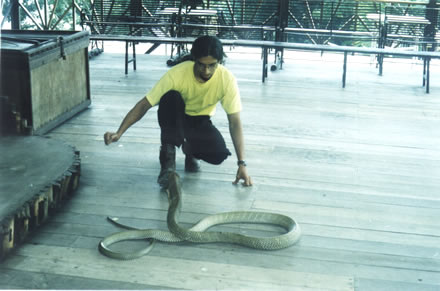
In spite of my insistence that I was a good snake handler; I had a lot of difficulty convincing the directors there to allow me to handle the King. Because though the institute itself produces antivenin, the risk involved is so great that much caution is exercised. Perchance if I was bitten I could be dead in fifteen minutes. Almost all the snake catchers there had been bitten at one time or the other and one of the handlers even had a full index finger missing.
But having come this far I couldn't take no for an answer. And so I bided my time. Everyday I would go to the Institute and from the audience stand, watch intently the snake shows which were held twice a day. Sitting on the tip of my seat I would assiduously watch every move of the King and his handlers, my body tense with excitement as the handler poised his hand behind the giant snake's raised hood, and with one swipe grasp it firmly at the neck. Finally, on my last day in Thailand , moved perhaps by my persistence they relented and gave me one opportunity in the snake enclosure to handle the King.
The snake enclosure was a huge meshed cage probably twenty five meters in length and about five meters in height. Its floor was of soil on which were planted many shrubs and small trees reminding me very much of the scary Raptor cage in Jurassic Park . At irregular intervals on the ground were placed odd looking dome shaped concrete structures. Dirty white in colour and with small rat hole entrances they looked very much like the igloos of the Eskimos, only smaller. The handler accompanying me lifted up one of these to look under and I got a start from the sight exposed. About eight to ten King Cobras lazed peacefully on top of each other, twisted like thick vines on a jungle tree. Even more shocking was the way that the snake catcher handled them. In a most unperturbed way he went about picking them up by their mid bodies like a farmer searching nonchalantly for a lost tool in a big pile of wood logs.
Seemingly satisfied he finally pulled out a relatively large specimen from among them and placed it in front of me. The King Cobra was about four metes long and thicker than I could get my fingers around. Pulled out from his afternoon nap the big King just stared up at me in a mock challenging way. I was now more nervous than ever before. It had not looked so difficult from the audience stand.
With a snake stick that I asked for I fumbled for some minutes with the snake before I realised that a staff nothing short of half a bamboo was going to give me the results I desired. Casting the flimsy thing aside I proceed to distract it with my right hand while carefully manoeuvring my left hand behind it. But instead of grabbing it directly, I decided to try and use one of my own safer techniques first, which is to gently try and push the head down and grasp it once it touched the ground. This I have had a lot of success with common cobras back home. But I should have known that the King was smarter than this, for I had barely touched the top of his head when he snarled angrily upwards at my hand. My hand shot back like a spring. Talk about reflexes!
The handler shook his head. With mutterings in Thai and sign language he tried to convince me to perform the grab. I had seen this seven times before, now was my chance. With my hand barely four inches away from the snake's head I paused steadying myself. Perfectly still and my hand closer now by an inch I froze. The handler and the park director were watching me with bated breath. The King Cobra listening without ears to the tension hanging in the air. Then with one smooth ‘it's now or never' movement I made a grab for the head. As my hand touched the snake's head its hood pushed forward with the force. But luckily my swipe had been precise, and my fingers closed smoothly round the snake's neck. The snake reacted instinctively by opening its mouth to try and bite me, but I had it firmly in my grasp. I tried getting a feel of the handling process with it also after that, but I couldn't convince myself to believe that I had really managed to handle it. The snake was over four meters long, and if it really wanted to it could have nailed me for sure. I would need more than one practice!
A repeat of the above I also performed with a smaller female King Cobra (it is possible to have a female king!). This time however for catching the snake's head I used another technique taught to me by the handler, which was to hold the mid-body of the snake and then gently slide one's hand from under the belly towards the head to grasp it firmly at the neck. I realised that though being gentle, this wasn't a fool proof method and if I should execute it more than often, I too would end up with one finger missing someday!
So my answer to the question of coronation is ‘yes'. I can with no doubt pronounce that the King Cobra truly deserves the title King. Its intelligence surpasses all other snakes, allowing it to even recognize its keepers. Its eyes show no fear, only amusement, thoughtfulness and perhaps a little irritation when that foolish snake handler will try scampering about it.
King Cobras aren't really cobras (Their scientific name reads Ophiophagus hanna (snake eater), where as that of the common cobra is Naja naja . Their hood, different from the common cobra, is more long than broad. This gives the King a kind of preoccupied look, like that of a person who knows how important he is, ignoring the cameras flashing for every movement of his sleek, shiny, graceful body.
King Cobras can move with their hoods up, a feat which common cobras are unable to perform, and they very often strike with their mouths angrily open. This had me perplexed in the beginning, because "mouth open" in snake language means that the snake is at its wit's end and is ready to pump you with every drop of venom it's got. Later I learnt that in case of King Cobras "mouth open" could still mean a fake attack: the King is merely threatening you with dire consequences and hoping you will retreat.
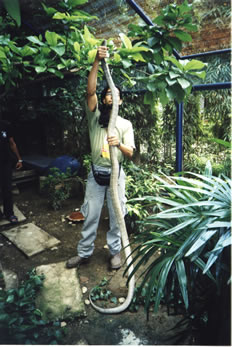
Just like common cobras, King Cobras come in various colours, patterns, shapes and sizes. The ones in India are slender, more feminine and lighter in colour. All along the body they have thin white stripes, with an upside down V marking the hood.
The King Cobras in Thailand however are thicker, more robust and masculine than ours. They have very faint stripes if at all and are normally almost jet black in colour. In fact they are so different from ours that antivenin (yes, the correct word is antivenin and not anti venom as commonly used) produced in Thailand is almost useless against a bite from a King Cobra in India . So death is almost certain if one is bitten by a King Cobra in India .
Now that we have seen two Kings I am pretty sure more of them are going to turn up in the most unexpected places. The more forest lands we open up for development works, the scarcer becomes the deep dark recesses of forest where the Kings normally prefer to inhabit. Disoriented and rendered homeless by our activities, the Kings wander around uncertainly, turning up instead in human habitations.
King Cobras, like the tiger, are at the top of the food chain. Their presence indicates a healthy, balanced forest. We lose them, we lose a lot.
Letter to the editor
Rahul,
We have spoken before about snakebite and you are still making a common mistake!!!
Cobra venom is both neuro AND haemotoxic! Your advice with regards to treatment is incorrect and needs to be corrected. The only time you apply a pressure bandage is in the case of a Krait bite!!
Pressure bandages should not be used in a haemotoxic bite as restricting the venom flow merely increases the concentration in a confined area. This gives a much greater risk of tissue damage and necrosis. The only time a bandage should be applied is if the time to reach medical attention is many many hours and the risk to life is greater than the results of the tissue damage.
It is also not true to say that death from snakebite can only occur after many hours. Any bite that gives intravenous envenomation can be fatal in 15mins!!!
These guidelines come from the WHO and the leading snakebite expert in the world.
You need to update your letter in case of anybody trying to apply your solutions.
Regards
Ian
My Contact Information:
Rahul Alvares, Almeida Vaddo, Parra, Bardez, Goa - 403510
Email: [email protected] [email protected] / [email protected]
Phone:
91-832-2278740 _______________ 0832-3115883
Also, visit my Website: www.geocities.com/rahulsnakesite