The Creepy Times Issue 4 newsletter by Rahul Alvares
Due to the new design of the Creepy Times Newsletter, the last issue went totally out of control and many people didn't receive it and many received it one too many times......apologies." -Website manager
Also Check out the Back Issues:
The Creepy Times Issue #3: Here's the new 'Know your snake. The snake pictured is the Checkered keelback. It get's its name from the prominent spots always marking its body...
The Creepy Times Issue #2:This is a rather long article that I wrote for a magazine called ‘Change’ run by Godrej. But it gives a very general idea of snakes so I thought that it would be a good introduction to the article section.
The Creepy Times Issue #1: To kick start the photograph section what better than the Indian Cobra himself (or herself!).......
Hi friends
It’s been a while since I last sent you a newsletter issue. I am having quite some problems with sending the mails to all of you. The last issue with the Checkered keelback many of you failed to receive. It was a yellow coloured newsletter. If you haven’ received it please, please let me know and I’ll mail it to you. I wouldn’t want to send the same email to every one else again. I’ll also set the links for you so that you can access them directly.
This issue we feature Nitin Naik. Nitin has agreed to send me some amazing pictures of birds which we will run regularly as a column called ‘Know your Birds!’ I thank Nitin immensely for his help and participation.
Rahul Alvares
Know your Birds by Nitin Naik
Coppersmith Barbet
Have you ever heard tuk…tuk…..call
coming form back of your garden. You wonder sometime whether it is coming
form Bombax tree in front of your house or that drumstick tree in your
garden .and suddenly you see a red spot smoothly making its way in the
tree branches .And you see a small little bird. ……….that’s
your Coppersmith Barbet
It is a heavy billed grass-green barbet with crimson breast and forehead.
It has yellow throat and green streaked yellowish underparts. Its tail
is short truncated, distinctly triangular in flight silhouette. Both the
sexes are alike. 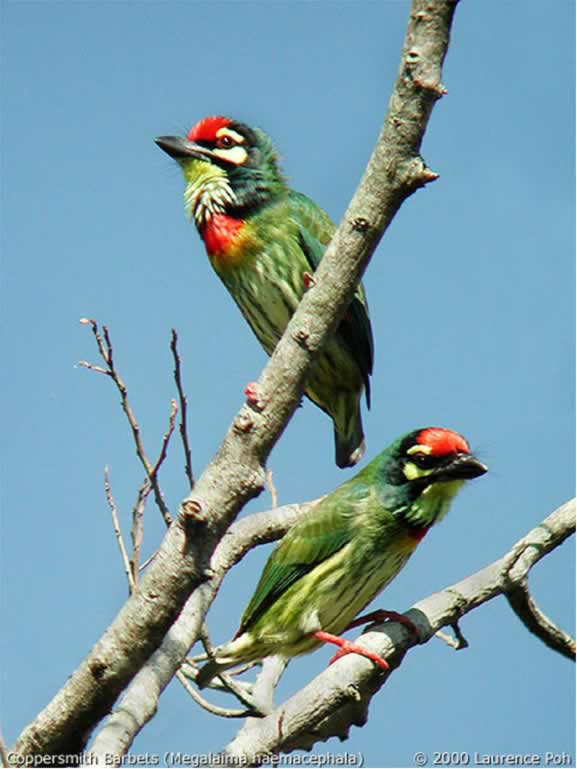
It can be seen singly or in loose parties on banyan trees, bombax trees
(Silk cotton tree with red flowers), light forests, city gardens, and
groves. It is arboreal .It can be found wherever there are fruiting trees,
especially the various species wild fig. Its nesting season is from January
to June. Its nest is a hole excavated in a snag of a dead softwood branch
such as of the Coral or drumstick trees at moderate heights.Often spends
early morning sunning on bare branches. Noisy between December and end
of April.
Its eggs are glossless white in colour.
Its one of the beautiful birds found in Western Ghats
Nitin Naik