
Hi Friends!
My damned computer broke down again. I have therefore been out of circulation for a while. What's motivating however is that many of my subscribers say that they enjoy the issues. Some of them say 'Yeah I love getting your issues don't really read them but still like receiving them thanks!' I don't know what that's supposed to mean but great, if you enjoy receiving them I'll keep bringing out more and more! In this issue I am carrying a lot of material contributed by Ian Simpson and I have to thank him immensely for it. Ian has been very enthusiastic about sharing information on snake bites and that's most......um...great. Also carried is a small article I wrote last year on the festival of Nag Panchami. A little late though since I missed the date.
Rahul
Myths and Snakebites
by Ian Simpson
In the last issue of the 'Creepy Times' Rahul produced an article on the Russell's viper and in particular drew attention to the ancient myth that the Russell's viper causes rotting of the flesh. Rahul's conclusions were that the myth was partially correct in that Russell's viper venom causes damage to blood cells and untreated bites can lead to gangrene.
In actual fact, the ancient myth is entirely correct and Russell's viper venom does in fact caused rotting of the flesh and I would like to use this example to talk about snake venom and particularly about treatment of snake bites which is a particular area of interest of mine.
In general terms it is usual to consider venomous snakes under two categories: neurotoxic and haemotoxic. Neurotoxic is usually interpreted as those snakes whose venom will attack the nervous system whereas haemotoxic are those snakes with venom that attacks the blood system. This classification although useful can lead to a major problem. In the case of neurotoxic envenomation a pressure bandage can be applied to slow down the action of the venom. In the case of haemotoxic venom, pressure bandages must not be applied because instead of preserving life they give a greater risk of serious tissue damage resulting from the bite.
In the case of a bite by a Cobra which is largely regarded as a neurotoxic venom, it would seem sensible to apply a pressure bandage. However Asian cobra venom contains an element that causes necrosis or local tissue damage. Pressure bandages should not therefore be used in a cobra bite, and cobra bite should be treated in the same way as viper bites.
A new and perhaps more useful way of considering venomous snakes is to look at them in three ways. Firstly snake venom causes local tissue damage at the bite site. Secondly the purpose of the venom apart from digesting the prey is in fact to be lethal. It achieves this in two ways firstly by destroying the respiratory system or secondly by destroying the cardiovascular system. Therefore when we look at snake venom it is important to see that they have three potential effects local, respiratory and cardiovascular.
Local effects
Three elements are of interest in the local effects of venom:
1) Enzymes
These enzymes are concerned with protein degradation and tissue breakdown and marks the start of the digestion process.
2) Myotoxins
Myotoxins contain a number of elements but the most important is Phosholipase A2. These toxins cause necrosis at the bite site i.e. that tissue starts to die which takes us back to the article and myth Russell's viper venom contains myotoxins As you are probably aware the word 'necrosis' is derived from its Greek root ‘nekros' meaning a dead body.
3) Haemorrhagic Toxins
These toxins cause rapid bleeding at the bite site but also contain the ability to digest fibrinogen and therefore make the blood unclottable.
Respiratory effects
Snake venom attacks the respiratory system in effectively three ways and it is necessary to have a basic understanding of the neurological system to understand how this works. Most people know that muscular activity is controlled by electrical impulses being sent from the brain to the muscle concerned.
If you imagine that the nerve fulfils the function of a wire between the brain and the muscle it is obvious that if it was a continuous wire, pulses would constantly be being sent down the wire and therefore muscular activity would be uncontrolled. The way the body copes with this, is every so often there is a break in the wire called a synapse and the synapse makes sure that no electrical charge is made unless certain circumstances are fulfilled. If the brain sends an impulse down the nerve it reaches one side of the synapse or gap and then a special transmitter chemical called acetylcholine is released which crosses the membrane and binds to a receptor on the other side of the synapse and allows the electrical charge to continue.
Anything that on the brain side of the gap including acetylcholine transmission is regarded as presynaptic, anything on the receptor site is regarded as postsynaptic .
Presynaptic toxins
These toxins cause a rapid and uncontrolled release of acetylcholine which is often the cause of muscle spasms in the bite victim as huge amounts of action triggers are sent down the nerve to the muscle. In addition they breakdown the body's ability to reduce the action of acetylcholine once the nerve impulse has taken place.
Postsynaptic toxins
These toxins have the ability to imitate acetylcholine and therefore to bind to the receptor on the other side of the synapse thus stopping acetylcholine from blinding and sending the transmission. By reducing the ability of the impulse to cross the gap paralysis ensues and it's easy to imagine the effect on the heart and lungs if this toxin has its effect.
Cardiotoxins
Cardiotoxins, as the name suggests, target the heart muscle itself. We are not entirely sure how it does this but we are aware that they can reduce the electrical polarity of the heart muscle and therefore making it beat out of sequence.
In addition some cardiotoxins called Sarafotoxins cause rapid and massive constriction of the coronary artery thus inducing heart failure.
Cardiovascular effects
The main cause of death following viper and pit viper bites is circulatory shock.The first major component causes a massive drop in blood pressure, resulting from tissue breakdown and destruction of the vessel wall. Huge amounts of blood loss into the tissue cause a pressure reduction and massive swelling. The second component attacks the wall of the blood vessel. The remaining components cause aggregation of platelets within the blood, cause a rapid clotting of the blood by the release of prothrombin and finally by destroying the body's ability to cause clotting and thus leading to uncontrolled bleeding.
This last factor is one of the principal reasons why it's not a good idea to keep a store of anti-venom at one's home address, ready for self administration in the case of a bite. The mere act of sticking a needle into your tissue can cause un-controlled breeding and oedema. This is why anti-venom should be administered by a doctor in a hospital.
Conclusion
We started this article talking about the ancient myth that Russell's viper venom can cause rotting of the flesh. We have now seen that the ancient myth is correct in that Russell's viper venom does have a very potent local effect of necrosis.
It is worth noting that that the Cobra also has a local effect similar to the Russell's viper. What conclusions can we draw about snakebite treatment?
Treatment should take the following plan:
- Reassure the patient
- If the bite is on the hand or the arm, the arm should be put in a triangular sling and hospital treatment sought as a matter of urgency
- If the bite is on the leg then a splint should be used and again the bite immobilized and hospital treatment sought
- The patient should be encouraged to move as little as possible.
- Anti-venom treatment should be applied in the case of a venomous snake at a doctor's or in hospital and measure should be taken in case the patient develops an allergic reaction to the anti-venom. It should be remembered that 20 per cent of all people who are given anti-venom treatment develop some kind of allergic reaction.
Don'ts
- Wash the wound, the act of washing leads to moving the venom around the body
- Cut the wounds, burn the wound attempt to suck the venom out of the wound
- Apply a tourniquet or pressure bandage (the only time a pressure bandage should be considered is if the snake concerned is definitely 100 per cent a Krait and the journey to hospital is going to take several hours. If the journey is only going to take up to a couple of hours the same treatment should be given as that for every other bite)
- Give anything by mouth except in the case of dehydration
- Self-administer anti-venom, this is particularly dangerous without the ability to cope with any allergic reaction, which has the ability to kill far quicker than any snake bite.
The mere act of sticking a needle into your tissue can cause un-controlled breeding and oedema. This is why anti-venom should be administered by a doctor in hospital!
Many of the ancient myths about snakebite are based on fact. The people who developed them could not possibly understand the science behind what they were describing. Even today, there are large elements we do not understand. However these myths can often be the starting point of fascinating research.
Featured article:
NAG PANCHAMI
Nag Panchami this year was held on the second of August. This is the day corresponding with the lunar month of Shravan - on which the snake god is worshipped. And I should add, killed.
I have very nostalgic memories of Nag Panchami. I began snake handling at fifteen years of age. But before that my head too was bursting with superstitions about snakes, all fed to me by my neighbors along with numerous ghost stories told in those balcao (veranda)sessions at night.
For instance, they alleged that the green whip snake with its arrow shaped head could bore into a person's head through the ears and then eat up the brains once inside and my neighbor swears that she actually pulled out one from her husband's ear just before it had found his brain. Impossible of course! Whip snakes neither peck out eyeballs nor do they have any use for human brains.
On Nag Panchami day, I would rush early morning to my neighbor's house when the idol of the snake was brought in. The figure would be that of a crimson, orange - yellow or pinkish cobra, with its hood flared out, marked all along the body and face with black spots and glitter, making the snake look as colourful as a new bride.
We would eat a sumptuous lunch at their place and thereafter my neighbor would take the idol to the cow shed. Here the snake will come alive and talk to the cows, she'd say to me. And I, gullible as a gull, would swallow her fairy tale hook, line and sinker without ever bothering to question as to how a mud idol could not only come alive but talk to the cows as well.
In my area there were rarely any live cobras brought for worship. But in some other parts of Goa and Maharashtra particularly, live snakes are invariably used for rituals on this day.
Snake charmers carry snakes, cobras especially, from door to door for worship. At every house the snake's mouth is forced open and some milk poured down its throat. Milk is not snake food. It is more like a poison for them; it has adverse effects on them, choking them, causing lung infections and finally death. Thousands of snakes routinely die during Nag Panchami.
I find it amazing that adults who pride themselves on their capacity for rational thought, blindly accept such practices followed by snake charmers. Where in the wild would a snake get milk to drink? Snakes do not produce milk. They do not feed milk to their young ones. Yet the entire Indian population is firmly mired in the belief that snakes must be fed milk!
The snakes, of course, can be abused in this way because they have been rendered totally harmless by their keepers. Cobras and other poisonous snakes have their fangs pulled out and their mouths bruised and smashed beyond repair. These snakes die soon after Nag Panchami.
I ask people not to take part in these activities that inflict countless cruelties on snakes. Please therefore do not patronize or lend money to snake charmers. Also remember using snakes for entertainment or rituals is against the wildlife law. If you are really concerned, inform the forest department and have the snake charmer dissuaded from his occupation.
Wildlife Celebrity
IAN SIMPSON
My interest in snakes started 40 years ago when my Grandmother bought me Kipling's story 'Rikki Tikki Tavi' concerning the struggle between a young Mongoose and two Cobras. From that moment I was hooked, the problem was that I live in a country with only three species of snake.
I used every holiday period, my time in the Army and my International travels when I worked for multi-nationals to seek out any snakes I could find. I handled Rattlers in USA , Gaboon Vipers and Mamba in Africa and various species in Arabia .
It was inevitable I guess that, after Rikki Tikki Tavi, I would eventually come to India . I met Harvey D'souza via my wife who is a bird watcher and he introduced me to some of the wonderful species in the Goa area.
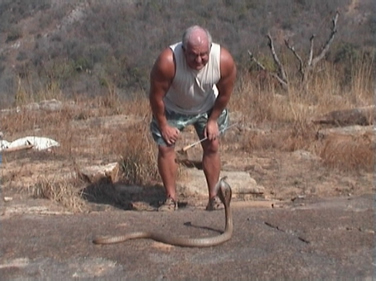
Interestingly, the day I handled my first Cobra, when we had finished and released the snake, a family of Mongoose ran along a wall behind us. It seemed like fate that I had met the famous protagonists for the first time on the same day!!
Since then I have travelled widely in India, I worked in Karnataka with a hugely busy snake conservationist and visited Tamil Nadu where I spent some time learning tracking with the Irula Tribals.
In October I am coming to India for a year to continue my snakes studies. I have two main projects:
1. To visit an area of 50 rural villages where they have a snake problem to carry out some research.
2. To study Pit Vipers, my favourite snake, to establish their medical significance. Snakebite is an area of special interest for me and I have been lucky enough to strike up a relationship with the two leading experts on bites and venom, one of whom is assisting my work.
The moral of this story is, I suppose, be careful what books you buy your children, they can have a life changing effect!
Ian can be contacted at [email protected]