Search Rahuls Website

Search The Web


Search for:
Search from:


Computer Programming


Computer programming (often shortened to programming or coding) is the process of writing, testing, and maintaining the source code of computer programs. The source code is written in a programming language. This code may be a modification of existing source or something completely new. The process of writing source code requires expertise in many different subjects, including knowledge of the application domain and algorithms to implement the desired behavior. Within software engineering, programming (the implementation) is regarded as one phase in a software development process.

There is an ongoing debate on the extent to which the writing of programs is an art or an engineering discipline

Another ongoing debate is the extent to which the programming language used in writing programs affects the form that the final program takes. This debate is analogous to that surrounding the Sapir Whorf hypothesis in linguistics.

In Matrix, there has been said.. " Programs hacking programs" . Can You imagine about this progam with A.I. which is hacking programs..

History of Programming


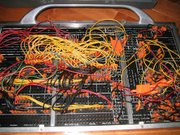
The earliest programmable machine (that is, a machine that can adjust its capabilities based upon changing its "program") can be said to be the Jacquard Loom, which was developed in 1801. The machine used a series of pasteboard cards with holes punched in them. The hole pattern represented the pattern that the loom had to follow in weaving cloth. The loom could produce entirely different weaves using different sets of cards. This innovation was later refined by Herman Hollerith of IBM in the development of the famous IBM punch card. These were used with a variety of machines called unit record equipment to perform data processing tasks. The unit record equipment were programmed by changing the wiring of plug-boards. Early computers used similar programming methods.

N Queens Problem

The queen of problems. N queens problem. If you are a computer science student, you must have heard about n queens problem and probably solved that too .. and this C programme does that.. but.. this programme does it in quick time.. and for the rest.. just look at the code :) ..

int v,i,j,k,l,s,a[99];
main()
{
for(scanf(”%d”,&s);
*a-s;v=a[j*=v]-a[i],
k=i ” #Q”[l^v?(l^j)&1:2])&&++
l||a[i] &&!(l%=s),v||(i==j?
a[i+=k]=0:++a[i])
>=s*k&&++a[–i]);
printf(”\n\n”);
}

1000+ Programs (C/C++/Java/TCL/Prolog) Here.
Here are few programs, mainly practicals in UPTU. Hope you find your program here. Just Download the Archive.


1. Computer Networks (TCL & C)
  1. Introduction to TCL
  2. A TCL Script to show a simple topology with two nodes that are connected by a link.
  3. To create following nodes, links and establish a protocol between 1-1 & 2-2
  4. Program to implement Error Detection and Correction using HAMMING CODE in C.
  5. Program to implement CRC (Cyclic Redundancy Check) Error Detecting Code Algorithm in C.
  6. Program to implement Dijkstra's algorithm in C.
  7. A TCL Script to show an example for a dynamic network where the routing adjusts to a link failure.
  8. To study different network topologies.
Click here to download the zip file containing all programs.


2. Artificial Intelligence (Prolog)
  1. To develop a simple program in prolog to illustrate Rules in prolog.
  2. Program to implement define by rules in Prolog.
  3. To develop program to solve Tower of Hanoi in Prolog
  4. To develop a program in prolog to calculate the factorial.
  5. To solve N Queens Problem in Prolog.
Click here to download the zip file containing all programs.


3. Operating System (C)
  1. Different C.P.U. Scheduling Techniques.
  2. Program to implement First-Come, First-Serve Scheduling Algorithm in C.
  3. To implement Shortest-Job-First-Scheduling Algorithm in C.
  4. Program to implement Priority Scheduling Algorithm in C.
  5. Program to implement Round Robin Scheduling Algorithm in C.
  6. Program to implement multiprogramming in C.
Click here to download the zip file containing all programs.


4. DATA Structure Programs ( in C )

Click here to download the zip file containing all programs.


5. C.B.N.S.T. - Computer Based Numerical Techniques Programs ( in C )
  1. Program to implement BESSELS INTERPOLATION FORMULA in C.
  2. Program to implement Bisection FORMULA in C.
  3. Program to Implement BISECTION METHOD(EQN -> x^3-4x-9 = 0)
  4. Program to implement GAUSS' BACKWARD INTERPOLATION FORMULA.
  5. Program to implement GAUSS' FORWARD INTERPOLATION FORMULA.
  6. Program to Implement ITERATION METHOD
  7. Program to implement LANGRANGE'S INTERPOLATION FORMULA in C.
  8. Program to implement LAPLACE - EVERETT'S INTERPOLATION FORMULA in C
  9. Program to implement MULLER'S METHOD of finding roots.
  10. Program to implement NEWTON'S BACKWARD METHOD OF INTEROLATION.
  11. Program to implementNEWTON'S FORWARD METHOD OF INTEROLATION.
  12. Program to Implement NEWTON RAPHSON METHOD to solve eqn.
  13. Program to Implement REGULAR FALSI (FALSE POSITION) METHOD.
Click here to download the zip file containing all programs.


6. Computer Graphics Programs ( in C++ )
  1. Program to implement DDA Line Drawing Algorithm in C++.
  2. Program to implement Bresenhems Line Drwawing Algorithm in C++.
  3. Program to implement Bresenhems Circle Drwawing Algorithm in C++.
  4. Program to implement MID-POINT Circle Drwawing Algorithm in C++.
  5. Program to rotate a line in C++ about a point.
  6. Program to rotate a rectangle in C++ about a point
  7. Program to SCALE A RECTANGLE in C++.
  8. Program to Tanspose A RECTANGLE in C++.
  9. Program to implement MID POINT LINE ALGORITHM in C++.
Click here to download the zip file containing all programs.


7. Compiler Construction Programs ( in C & C - GCC )
  1. Program to Convert Base from One base to another.
  2. Program to Seperate Tokens from a given Expression.
  3. Program to check the syantax of 'IF' Statement.
  4. Program to check the sytax of 'FOR' Statement.
  5. Program to remove duplicate elemts in an array.
  6. Program to generate the Three Addres Code TABLE.
  7. Program to remove left recursion.
  8. Program to make a calculator(LEX tool)
  9. Program to make a calculator(YACC tool)
Click here to download the zip file containing all programs.


8. Design Algotith & Analysis (in C - GCC)
  1. Program to Sort an Array by any sortin Technique(Selection, Insertion,Bubble, Quick,....).
  2. Program to implement the Least Common Subsequence.
  3. Program to implement the Matrix Chain Multiplication.
  4. Program to implement Kruskal Algorithm
  5. Program to implement Prims Algorithm.
  6. Program to implement Djkstras Algorithm.
  7. Program to implement Bellman Ford Algorithm.
  8. Program to implement Flloyd Warshalls Algorithm.
  9. Program to implement BDS/BFS Algorithm.
  10. Program to implement Eight Queen Problem
  11. Program to implement HEAP SORT.
  12. LIST VArious LINUX COMMANDS.
Click here to download the zip file containing all programs.


9. Object Oriented Programming (in JAVA)
  • Contains general programs illustrating the concept of OOPS
Click here to download the zip file containing all programs.


10. Some General Programs (in C & C++)
  1. To display nth programs and their sum.
  2. BUBBLE SORTING in an array.
  3. SHELL SORTING in an array.
  4. MERGE SORTING in an array.
  5. INSERTION SORTING in an array.
  6. Program to implement LINK LIST in C.
  7. Program to create a TREE.
  8. Program to Implement DOUBLY LINK LIST.
  9. Program to perform any operation on LINK LIST in C.
  10. To Multiply Matrix of any orders.
  11. Program to convert one no. to another with all sort of possibilities.
  12. Progam to print without using semicolon.
  13. Program to implement TOWER OF HANOI PROBLEM.
Click here to download the zip file containing all programs.


Creator of C++


Bjarne Stroustrup

Programs in C & C++


The time now is :


All times are GMT + 5.5 Hours

Most Read Topics
» Tips to make your password more secure...
Make it Difficult for hackers!

» What is ETHICAL HACKING ?
Know exactly what it means!

» How to CRACK Windows XP Administrator Password!
Heard about SAM File!

» FLASH Menus and Websites, their advantages and disadvantages..
Know more about FLASH on the web

» PHP The latest and widely used programming language.
Know more about it!

What is C++ ?
Released in 1985, C++ is an object-oriented programming language created by Bjarne Stroustrup. C++ maintains almost all aspects of the C language, while simplifying memory management and adding several features - including a new datatype known as a class (you will learn more about these later) - to allow object-oriented programming. C++ maintains the features of C which allowed for low-level memory access but also gives the programmer new tools to simplify memory management.

What is C++ used for?
C++ is a powerful general-purpose programming language. It can be used to create small programs or large applications. It can be used to make CGI scripts or console-only DOS programs. C++ allows you to create programs to do almost anything you need to do. The creator of C++, Bjarne Stroustrup, has put together a partial list of applications written in C++.

C & C++
C++ is the evolved version of C. C++ supports OOPS concept, but still C has its advantage. It is considerd one of the most powerful languages. The pointer is so well handeled that it has great advantages but if some mistake occur, then there may be a blunder mistake. Still C questions are asked in interviews because, its the fundamental language and every programer must know it!

Big companies hire C programmers, be it shell programming or software development it can be used anywhere.

How Do SEARCH ENGINES Work?
Search Engines for the general web (like all those listed above) do not really search the World Wide Web directly. Each one searches a database of the full text of web pages selected from the billions of web pages out there residing on servers. When you search the web using a search engine, you are always searching a somewhat stale copy of the real web page. When you click on links provided in a search engine's search results, you retrieve from the server the current version of the page.

Search engine databases are selected and built by computer robot programs called spiders. Although it is said they "crawl" the web in their hunt for pages to include, in truth they stay in one place. They find the pages for potential inclusion by following the links in the pages they already have in their database (i.e., already "know about"). They cannot think or type a URL or use judgment to "decide" to go look something up and see what's on the web about it.

If a web page is never linked to in any other page, search engine spiders cannot find it. The only way a brand new page - one that no other page has ever linked to - can get into a search engine is for its URL to be sent by some human to the search engine companies as a request that the new page be included. All search engine companies offer ways to do this.

After spiders find pages, they pass them on to another computer program for "indexing." This program identifies the text, links, and other content in the page and stores it in the search engine database's files so that the database can be searched by keyword and whatever more advanced approaches are offered, and the page will be found if your search matches its content.


Website Designed & Maintained By RAHUL SINGH
© 2007 RAHUL SINGH.

Note :- This is a Personal Website and its contents are all copyrighted
Use of any part of it for the distribution is strictly prohibited.
Hosted by www.Geocities.ws

1