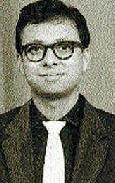
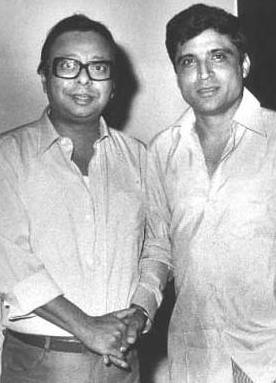
R. D. Burman
Some of the gems
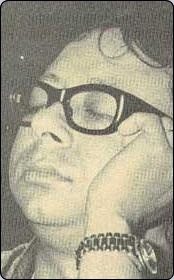 Born
on 27th June, 1939 in Calcutta, Rahul Deb Burman (RD) was the
only child of Sachin Deb Burman and Mira Deb
Burman. He was brought up in Calcutta. S D Burman
was used to live in Ballygunge area in south
Calcutta and was a popular
Bengali singer and musician. Born
on 27th June, 1939 in Calcutta, Rahul Deb Burman (RD) was the
only child of Sachin Deb Burman and Mira Deb
Burman. He was brought up in Calcutta. S D Burman
was used to live in Ballygunge area in south
Calcutta and was a popular
Bengali singer and musician.
His family moved to Mumbai and RD started learning
sitar under legendary sitar player Ali Akbar Khan.
[ The very first film that
came Pancham’s way was Raaz, offered to him by
Guru Dutt, in 1958. Pancham was only 19. The film
was shelved midway. He got his real break three
years later, when Mehmood offered him Chote
Nawab(1961). Pancham’s first song was sung by Lata
Mangeshkar(Ghar aaja Ghir aayee).
Pancham’s career spanned
331 films, 5 TV serials, 164 non film songs(134
Bengali, 30 Hindi) and 5 languages. ]
Rahul Deb Burman's first film at the age of 22, Chhote
Nawab, was a Mahmood production. In those days, the
bespectacled young Burman was known more as S.D.
Burman's son than as himself, a tag that was to
last another ten years. After Chhote Nawab, R.D.
drew a blank in 1962, '63 and '64. Chhote Nawab
had some excellent songs, like: matvali ankhon
vale (Lata, Rafi), llahi too sun le (Rafi),
aam
chhum laam chhum (Rafi and chorus), yet R.D.
Burman's talent went unnoticed.
For the next few years, he continued to assist his
father. Nicknamed Pancham after his
rhythm-oriented musical inclinations, RD surfaced
again in 1965 with Mahmood's next, Bhoot Bungla
and another film, Teesra Kaun. Manna Dey
and chorus sang the former and Lata rendered the
latter for Bhoot Bungla.
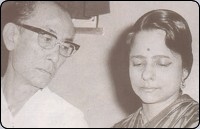 Singing
achha sanam(Teesra Kaun), Asha Bhosle typified what was to
emerge as Pancham's swinging, up-beat style.
Mukesh and Lata sang an innocent, romantic duet
that went pyar ka fasaanaa banaa le dil
deevaanaa.
Suddenly, the world sat back and took notice. Singing
achha sanam(Teesra Kaun), Asha Bhosle typified what was to
emerge as Pancham's swinging, up-beat style.
Mukesh and Lata sang an innocent, romantic duet
that went pyar ka fasaanaa banaa le dil
deevaanaa.
Suddenly, the world sat back and took notice.
[ He is a master composer.
Nobody, nobody in Indian cinema has used music in
all its form and range quite like him. If SD
Burman was the purist, then his son Rahul Deb
Burman was the maverick - the risk taker, the dare
devil, who knew how to make symphony even out of a
sock! ]
Mahmood nurtured him further, with Pati Patni
(1966). Two songs distinguished the film’s score.
In one of them, actor-singer Surendra returned to
the microphone after a long absence to give
playback to Om Prakash. The other song, Kajre
badarvaa re (Lata) was a gem of a tune. But the film that catapulted
RD into big time was Nasir Husain's Teesri
Manzil. Nasir had already acquired fame as the
maker of a string of musical hits, from Tumsa
Nahin Dekha (1957) to Phir Wohi Dil Laya
Hoon
(1963).  Having worked with such giants as O.P.
Nayyar and Shankar Jaikishan (the latter gave
music in Nasir's Jab Pyar Kisise Hota Hai
(1961), Nasir Husain reposed great faith in the
little known 'Burman Junior' by signing him for
not one but two films. Baharon Ke Sapne(1967)
was to follow Teesri Manzil. It was as if
RD had made a five-year plan and at the
end of his gestation, he would reap his rewards.
After 1961, 1966 became the most important year
for him. Teesri Manzil was the talk of the
(music) town. o haseena zulfon vali(Rafi,
Asha), o mere sona(Rafi,Asha) Tumne mujhe
dekha(Rafi)
and Deevana mujhsa naheen(Rafi) were heard in
every street and occupied a lot of airtime over
Radio Ceylon. Baharon Ke Sapne did not emulate
the success of Teesri Manzil. Its box-office
failure affected its music too, though many felt
that at least musically, Baharon Ke Sapne was
outstanding. RD showed remarkable range while
composing Chunri sambhaal gori (Manna, Lata and
chorus), Kya jaanoon sajan(Lata) and Zamaane
ne maare javaan kaise kaise(Rafi). Aajaa piya
tohe pyar doon(Lata) was a unique blend of
simple tune and measured orchestration. Having worked with such giants as O.P.
Nayyar and Shankar Jaikishan (the latter gave
music in Nasir's Jab Pyar Kisise Hota Hai
(1961), Nasir Husain reposed great faith in the
little known 'Burman Junior' by signing him for
not one but two films. Baharon Ke Sapne(1967)
was to follow Teesri Manzil. It was as if
RD had made a five-year plan and at the
end of his gestation, he would reap his rewards.
After 1961, 1966 became the most important year
for him. Teesri Manzil was the talk of the
(music) town. o haseena zulfon vali(Rafi,
Asha), o mere sona(Rafi,Asha) Tumne mujhe
dekha(Rafi)
and Deevana mujhsa naheen(Rafi) were heard in
every street and occupied a lot of airtime over
Radio Ceylon. Baharon Ke Sapne did not emulate
the success of Teesri Manzil. Its box-office
failure affected its music too, though many felt
that at least musically, Baharon Ke Sapne was
outstanding. RD showed remarkable range while
composing Chunri sambhaal gori (Manna, Lata and
chorus), Kya jaanoon sajan(Lata) and Zamaane
ne maare javaan kaise kaise(Rafi). Aajaa piya
tohe pyar doon(Lata) was a unique blend of
simple tune and measured orchestration. With Padosan and Abhilasha (both made in 1968),
RD emerged from the shadow of his
illustrious father. As his second five-year plan
progressed, RD bagged films like Pyar Ka
Mausam, Waris (both 1969) and Kati Patang and
Raaton Ka Raja (both 1970). And then
came 1971 - the year of Rahul Deb Burman. Adhikar,
Buddha Mil Gaya, Caravan, Ehsan, Lakhon Mein Ek,
Lagan, Mela, Pyar Ki Kahani and The Train - all had
RD's name as music
director. His tenth film in that one eventful year
was Hare Rama Hare Krishna, which made it to the
top in Binaca Geetmala through Dum maro dum. The
son had carved out a place for himself in the sun.
Rahul Deb Burman emerged from the daunting shadow
of Sachinda to become one of the topmost composers
in Hindustani films. Looking at 1972, we find his
name associated with Apna Desh, Bombay To Goa,
Dil Ka Raja, Do Chor, Garam Masala, Gomti
Ke Kinare, Jawani Diwani, Mere Jeevan Saathi,
Parchhaiyan, Parichay, Rakhi Aur Hathkadi, Rampur Ka
Lakshman, Rani Mera Naam, Samadhi, Sanjog, Savera,
and Shehzada.
That makes sixteen films in one year !
With Padosan and Abhilasha (both made in 1968),
RD emerged from the shadow of his
illustrious father. As his second five-year plan
progressed, RD bagged films like Pyar Ka
Mausam, Waris (both 1969) and Kati Patang and
Raaton Ka Raja (both 1970). And then
came 1971 - the year of Rahul Deb Burman. Adhikar,
Buddha Mil Gaya, Caravan, Ehsan, Lakhon Mein Ek,
Lagan, Mela, Pyar Ki Kahani and The Train - all had
RD's name as music
director. His tenth film in that one eventful year
was Hare Rama Hare Krishna, which made it to the
top in Binaca Geetmala through Dum maro dum. The
son had carved out a place for himself in the sun.
Rahul Deb Burman emerged from the daunting shadow
of Sachinda to become one of the topmost composers
in Hindustani films. Looking at 1972, we find his
name associated with Apna Desh, Bombay To Goa,
Dil Ka Raja, Do Chor, Garam Masala, Gomti
Ke Kinare, Jawani Diwani, Mere Jeevan Saathi,
Parchhaiyan, Parichay, Rakhi Aur Hathkadi, Rampur Ka
Lakshman, Rani Mera Naam, Samadhi, Sanjog, Savera,
and Shehzada.
That makes sixteen films in one year !
Lasting associations is RD's forte. From
Teesri Manzil to Zabardast (1985), every film of
director Nasir Husain had his music. With Ramesh
Behl (Apne Apne 1986), the team dates back to
Jawani Diwani. After Hare Rama Hare
Krishna, all but
two or three films of Dev Anand were adorned
 with Pancham's tunes. Dubbed 'strange' in the early
seventies, the RD - Gulzar combine has
consistently yielded musical hits in the Parichay
tradition. Majrooh and Anand Bakshi were his
favorite poets for over twenty years. Every
film of actor - director - producer Mahmood just
had to have Pancham's music. All four of Ramesh
Sippy's films, beginning, with Sholay (1975),
have had their score composed by him. Saagar
(1985) was among the top twenty-five musical films
six months after its release. Earlier, for many
weeks, it was among the top three. Sholay earned
the country's first platinum disc and Sippy's Shaan,
a commercial disaster, had some catchy songs,
thanks to RD. with Pancham's tunes. Dubbed 'strange' in the early
seventies, the RD - Gulzar combine has
consistently yielded musical hits in the Parichay
tradition. Majrooh and Anand Bakshi were his
favorite poets for over twenty years. Every
film of actor - director - producer Mahmood just
had to have Pancham's music. All four of Ramesh
Sippy's films, beginning, with Sholay (1975),
have had their score composed by him. Saagar
(1985) was among the top twenty-five musical films
six months after its release. Earlier, for many
weeks, it was among the top three. Sholay earned
the country's first platinum disc and Sippy's Shaan,
a commercial disaster, had some catchy songs,
thanks to RD.
Quite obviously, RD has shown a marked
preference for Kishore Kumar among male singers
and Asha Bhosle among the female voices. Kishore
probably suited his boisterous antic-gimmick-calisthenic
style more than any other singer. Kishore is at
his 'best' singing Naheen naheen abhi naheen
(Jawani Diwani -1972), Jaise ko taisa
mila (Jaise Ko Taisa - 1973), 0
hansini -(Zehreela Insaan - 1974), Main shair
badnaam (Namak Haram - 1973), Cham
cheekee chiki bam cheeki chiki (Kahtey Hain
Mujhko Raja - 1975), Mere naina (Mehbooba
-
1976) and 0 manjhi re (Kinara -1977). But that
does not negate the RD-Rafi masterpieces, like Sunder ho
aisee (Dil Ka Raja - 1972), Chura
liya hai (Yaadon Ki Baaraat - 1973) , Aa raat
jaatee hai (Benaam - 1974 - both duets with
Lata), Naghma hamaara (Bundalbaaz - 1975),
Kya hua
tera vada and Chand mera dil (both from
Hum
Kisise Kum Naheen - 1977), (the first with a few
lines by Sushama Shrestha) and dozens of songs
from his sixties's films.
Asha Bhosle was more than a
singer to him. Eventually, she became his (second)
wife. RD further moulded her vocal nuances,
nuances that had been created and shaped by O.P.
Nayyar and S.D. Burman. The cabaret-night
club-discotheque genre of film music is studded
with a number of R.D.-Asha 'floor shows'. Some are
listed here: Mera naam hai Shabnam (Kati Patang
- 1970), Piya too ab to aa jaa (Caravan -
1971), Aa jaa o mere raja (Apna Desh - 1972),
Aaj kee raat (Anamika - 1973), Teri meri
yaari badi purani (Charitraheen-1974), Sapna
mera toot gayaa (Khel Khel Mein -1975), Do pal
kee hai yeh zindaganee (Chala Murari Hero Banne
- 1977), Mera pyar, Shalimar (Shalimar -
1978), Kya ghazab
karte ho jee (Love Story -1980), Jaan-e-jaan
(Sanam Teri Kasam - 1981) and Dharkan pal pal
(Arjun - 1985).
Piya too ab to aa jaa (Caravan -
1971), Aa jaa o mere raja (Apna Desh - 1972),
Aaj kee raat (Anamika - 1973), Teri meri
yaari badi purani (Charitraheen-1974), Sapna
mera toot gayaa (Khel Khel Mein -1975), Do pal
kee hai yeh zindaganee (Chala Murari Hero Banne
- 1977), Mera pyar, Shalimar (Shalimar -
1978), Kya ghazab
karte ho jee (Love Story -1980), Jaan-e-jaan
(Sanam Teri Kasam - 1981) and Dharkan pal pal
(Arjun - 1985).
Besides doing bit roles in Bhoot Bungla and
Pyar
Ka Mausam, Pancham has sung a number of songs,
self-tuned. Most of them have been hits: Duniya
mein (Apna Desh), Dhanno ki aankhon men (Kitaab)
and Mehbooba mehbooba (Sholay). Often dubbed a
plagiarist, RD has proved his mettle time
and again for twenty-five tuneful years from
film to film, song to song.
Courtesy: from an article published in 1986 in
"Playback"
Gulzar remembering RD
We knew each other from the moment we were
hopefuls. We were assistants--he to his father and
me to Bimal Roy. When SD would come with his
compositions, his son would come carrying a
"dagga". He'd be wearing shorts the way kids wear
Bermudas today.
My first lyric for Sachinda was Mora gora ang lai
le. Pancham would be there. Shailendra did the
other lyrics for BANDINI. And Pancham would
encourage me--go meet baba, go and talk to him.
He'd invite me to their apartment in the
one-storey building, 'Jet', on Linking Road. Today
there's a tall building over that one-storey
structure. I don't know who stays there now,
Sachinda was there till his end.
Pancham was three-four years younger than me. He
was always a kid, he remained one. He was fond of
pranks, of colorful clothes and especially of the
color red. He had a nickname for me--'safed kavva'.
He'd phone, if I wasn't at home he'd leave a
message, "Tell 'safed kavva' that 'lal kavva' had
called."
His sense of humor was his very own. He knew Asha
Bhonsle was very particular about keeping the
house clean; so he sent her a gift--two big brooms
in bright wrapping paper.
One of his passions, besides music, was cooking.
He grew chillies in his terrace garden--as many as
40 varieties, cross-breeding them to get new
exotic tastes. Ashaji now wonders, "Who'll look
after his plants? He's gone."
If a friend was going abroad, he'd ask him to get
back some soup packets. Like he asked Rahi
Sabarwal of Air India to bring him some soup
packets which you can only find in Hong Kong. Pancham
even sent him a telegram, "Don't forget my soup."
The telegram was signed Soup Lover.
As young men in our 20s, we shared many common
interests--interests in home-cooked food and in
sports. He was a soccer fanatic, he was a true
Mohan Baganian, he'd get into heated arguments
with (director) Gogi Anand over soccer. Yet Gogi
remained Pancham's friend till the end.
Pancham married Jyoti. It was a love marriage, but
I think it didn't work out because they were two
very different people. He was immersed into films
and music; he'd spend long hours away from home in
the recording studio of Film Centre. He was so
obsessed with his work that he had little time for
any other love in his life.
Pancham was a terrific mouth-organ player; he
played the organ in his father's orchestra. And he
was an outstanding sarod player too; he had
trained under Ustad Ali Akbar Khan.
Pancham would have his differences with his
father. But he was Sachinda's only child, he was
the pampered one. And he could get pretty
possessive about his father. They hailed from a
royal family; for them it was a matter of pride
that they had carved out their own little kingdoms
with their music.
There'd be good-natured bantering between them.
"Baba," Pancham would pout, "you don't give me
enough pocket money." And Sachinda would laugh
back, "Oi Pancham, when are you going to
contribute to the kitchen expenses?" Whenever the
son would try to shuffle out quietly from the
music room, Sachinda would say, "Jao jao, I know
you want to smoke a cigarette."
Pancham would frequently compose his tunes in the
course of car drives. He'd hum, we'd reach Film
Centre and he'd say, "OK, you go home now, I've
got the tune in my head. I'll try it out with the
musicians." If he was especially excited about a
tune, he'd scream with joy. He never kept his
happiness within himself, he shared the moments of
ecstasy with others.
Pancham would keep the actor's face in mind while
working on a composition. He'd tell me that, at
times, he thought of my face while conjuring a
tune--which I thought was a great compliment.
We first worked together on PARICHAY. It was
important for me to sit with him on the music
sessions. He inspired certain moments which I
picturised later, his music was that visual...I
went to Rajkamal studio where he was recording a
background score for another film. I gave him the
mukhDa--Musafir hun yaaro/Na ghar he na thikaana--and
I left. That night he woke me up at 1 a.m. and
said, "Come, come down with me to the car." He'd
recorded the tune on a cassette already. He
started driving through the empty streets of
Bandra, he played the beat on the dashboard. It
was my first song as a director with him.
By the time he composed Saare ke saare, he had
shifted from home--he was in the process of
acquiring a new flat--to Caesar's Palace Hotel.
The most beautiful song in the film--Beeti na
bitaai raina--was also composed in the hotel
room. It was based on a classical 'bandish'; it
fetched Lata and Bhupendra National Awards for
best playback singers.
In all, we did eight films together, as a
composer-director team. Besides PARICHAY, there
were: KHUSHBOO, KINARA, AANDHI, KITAAB, NAMKEEN,
LIBAAS and IJAAZAT. How did Tere bina zindagi se
koi shikwa to nahin(AANDHI) come about? He was
recording Bengali songs for Durga puja around that
time. The lyrics were by the renowned Gauri
Prasanna Majumdar. I liked the tune that Pancham
was composing; I filled it up with Hindi words and
said, "Look, I'm going to use this for AANDHI."
As for Is moD pe jaate haiN, kuCH sust qadam
raste, I gave him the words from one of my poems.
He composed the tune instantly. He never took
time. Spontaneity was his specialty. If he
struggled over a song, he would prefer to abandon
it. For instance, Ek hi khwab kai baar yuhi dekha
hai maine(KINARA) exasperated him. He found that
metre a bit difficult, but two months later I put
it before him again. He caught the scanning, and
the song was finally recorded.
When I gave him Mera kuCH saamaaan tumhare paas
paDa hai(IJAAZAT), he waved the lyric aside and
said, "Huh, tomorrow you'll bring me the front
page of *The Times of India* and expect me to
compose a tune around it. What is this blank verse
you're giving me!" Ashaji was sitting there, she
started humming the phrase, Mujhe lauta do. He
grasped it immediately;
from that one phrase he developed the song, which
was quite a feat! This time Ashaji and I got
National Awards. Poor fellow, he did all the work
and we enjoyed the 'kheer'.
Ashaji's and his was a superb creative
companionship. He used the potential in her voice
to maximum effect. No other composer ever placed
Ashaji's voice above his music the way he did. We
recorded the non-film ), album DIL PADOSI HAI, and
the variations from semi-classical and ghazal to
pop and jazz, were a valuable experience for each
one of us. There was a three-way harmony of voice,
music and lyrics.
album DIL PADOSI HAI, and
the variations from semi-classical and ghazal to
pop and jazz, were a valuable experience for each
one of us. There was a three-way harmony of voice,
music and lyrics.
After his heart ailment, Pancham did feel that
producers were sidelining him. He did feel hurt.
He would laugh, with a touch of bitterness, at the
new music composers who copy his tunes and make a
mess of them. They would even imitate his singing
style which was unmistakably his. Mehbooba
mehbooba (SHOLAY) and Dhanno ki aankhon meiN (KITAAB)
were his creations,
but others tried to clone his style, only to sound
like amateurs.
My last meeting with Pancham was on December 30
[1993]. He went to Sahara recording studio in
Goregaon. Ashaji was recording a song for G.V.
Iyer's VIVEKANANDA. Salil Chowdhry had composed
the music. Pancham and I had gone along with
Ashaji. At the end of the evening, he said in his
customary manner, "Milte hain."
We never did.
Gulzar remmembering RD. Courtesy: different web sites.
|