
Hybrid Cars: The Future of Transportation
For years, environmentalists have been warning us about the dangers of automobile emissions. The risks are real. Global warming, the depleting ozone layer, and a decreasing air quality are just some of the negative impacts that can be seen worldwide. We are being encouraged to use public transit, carpool, etc. But let's face it. Cars are convenient.
But have you pulled up to the pump lately? Have you noticed the soaring gas prices? It seems that neither can we avoid using a car, nor can we avoid the gas prices. However, there is a way you can make a difference. Instead of changing your lifestyle, why don't you reduce the amount of emissions from your automobile(s)? For years, we have been hearing about hybrid cars- cars that consume less gasoline. Here is some information about hybrid cars and how they can work for you. Click on the links to browse through the topics, or just scroll down.
What is a hybrid?
Basically, a hybrid is any type of vehicle that combines 2 or more sources of power. For example, the early mo-peds (bicycles that combine gasoline power with the pedal power of the rider) were hybrids. We see many hybrid vehicles around us today. Many trains, streetcars, submarines, trucks, and buses are hybrids because they combine two or more sources of power (eg. nuclear, gasoline, electric). A car that combines gasoline power with electrical power to run is also called a hybrid car, and this is the type that we are focusing on.
The two types of hybrid cars:Parallel hybrids, which are cars that simply combine the gasoline power generated and the electric power from the battery to power the transmission.
Series hybrids, which use gasoline to turn the generator which generates electric energy to power the transmission.
The Inside Story...
So what goes on inside a hybrid car? What makes it different from a standard car? In this section, you will learn how the different parts inside a hybrid car work together to give you optimum performance, great mileage, and keep emissions low.
Generally, hybrid cars have an engine, an electric motor, a transmission, batteries, and a fuel tank. However, a series hybrid also has a generator. For a detailed view and a video of the inner parts of a hybrid car and more information on hybrid cars, visit: http://www.howstuffworks.com/hybrid-car3.htm.
Gasoline engine: to power the car, directly or indirectly. It is smaller and more efficient than in most cars.
Fuel tank: stores gasoline which holds energy at a much higher density than the batteries
Batteries: powers the electric motor
Electric motor: uses energy from batteries to power the car, and can also recover kinetic energy while the car is braking and return it to the battery
Generator: similar to the electric motor, but only produces power
Transmission: basically the same as a transmission in a conventional car
Why Choose a Hybrid Over a Gasoline-Powered Car?
Generally, we expect a car to meet certain requirements: the distance it can drive before being refueled (gas mileage), keep up with other traffic/cruising speed and acceleration, and to be refueled quickly/easily. Gasoline cars are becoming more and more gas-ineffective by increasing the ability for acceleration. More acceleration and more speed requires a more powerful engine, which uses up gas much quicker, and makes for a shorter gas mileage.
Hybrid cars use smaller engines than most gasoline-powered cars: smaller engines have their benefits. By reducing a cylinder, the parts are lighter and the engine will be closer to its maximum load, which won't waste power. The bigger the engine is, the more energy is wasted dragging the large engine.
Comparing the hybrid car "A" (with a small engine) with a standard car "B" (with a large, powerful engine) will prove the hybrid's performance as well as efficiency. Driving on a highway will require a lot more energy from car B, while car A will use significantly less. When going up a hill, car B will have no problem going up. Car A, however, will need more power. That extra power comes from its battery power, and therefore car A will go up the hill efficiently, while using significantly less gasoline power compared to car B. Now, you can see that the Hybrid car's performance is optimum compared to a standard gasoline-powered vehicle.
Of course, a hybrid car reduces greenhouse gas emissions, and that is vital in today's society because of the depleting ozone layer and the horrific effects of global warming. Believe it or not, using a hybrid car can actually save you money in the long run compared to a gasoline powered car. You end up paying less money on gas prices, even though the initial payment for the car itself may be higher. The long term and short term benefits (including savings) outweigh the short term costs.
Even though buying a hybrid car will most likely save you a great deal of money in the 5-year or 10-year period after buying them, some people are turned off from buying a hybrid car just by the high initial cost. Some car companies and other groups have begun a campaign in the United States and Canada for a tax break for those who purchase hybrid cars. The idea is still being presented to the government, and buyers are still waiting for the tax break before they buy the car.
To extract every last kilometer out of a liter of gasoline, hybrid cars have a few extra features, which include:
Recovering energy while braking: the electric motor captures the energy that is released when the car brakes and puts the energy back into the batteries.
The gas engine can sometimes be turned off, and the car can rely solely on the electric motor to power the car.
Hybrid cars use lighter materials and lighter parts so that less energy is wasted dragging around heavy parts.
Most hybrid cars have a system that integrates different ratios of the two types of power in the three main steps of driving: starting, accelerating, and cruising. When starting, the battery power is used. For a strong acceleration, the car uses mostly the battery power and a little bit of the gasoline power. When cruising, the car relies solely on the gasoline engine.
...DID YOU
KNOW?... Famous Hollywood celebrities, such as
Leonardo di Caprio and Cameron Diaz own hybrid cars.
Hybrids Available on
the Market Today
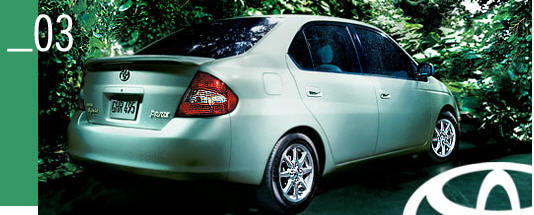
There are two main hybrid cars available in Canada currently: the Toyota Prius and the Honda Civic Hybrid. These cars have been successful on the market so far, and many more hybrid cars are soon to come. In fact, within the next five years, General Motors plans to release a few hybrid cars on to the market.
Above: Toyota Prius, 2003 ; Honda Civic Hybrid, 2003
The Prius and the Civic Hybrid may cost more than a conventional car, but much more money will be saved on gas consumption annually by driving either of these hybrids. These hybrid cars have all the features of conventional cars, and, as you read above, are more energy-efficient. You can pick up a pamphlet for either of these models at Toyota and Honda dealerships, and they will provide you with information regarding their specific model. You will find that the Hybrid cars have an excellent combination of convenience, mechanical aspects, and interior/exterior features. (For more information on either of these models, or on the company itself, visit the links listed below).
According to a CNN.com online article (01/06/03), General Motors Corp. plans to release a series of hybrid cars within the next four years, many of which will be available for commercial fleets as well as retail consumers. Ford Motors Co. and Daimler-Chrysler AG's Chrysler Group also plan to release hybrid models, but no dates have been released.
Links
Ontario Drive Clean Program- reducing automobile emissions in Ontario through standardized auto testing
EFOA: The European Fuel Oxygenates Association- information on auto emissions impact
HowStuffWorks.com: Hybrid Cars- an in-depth view of how hybrid cars work with great features
Toyota.ca- the official Toyota Canada website with all you need to know about Toyota Canada
The Toyota Prius- information and pictures of the Toyota Prius 2003 and its features
Honda.com- the official Honda website, with all you need to know about Honda
Honda Civic Hybrid- information and pictures of the Honda Civic Hybrid 2003 and its features
About This Site
Created: January 13, 2003
Last Modified: March 24, 2003
This site was created by Rahul B. as part of a Science project. Many thanks to Ms. N. Clarke.
Questions? Comments? Suggestions? Please e-mail me at [email protected].
You are visitor #
Thank you for visiting.