REMOTE ACCESIBLE FIELD TRIP
for purposes of firsthand observation
Urbi et Orbi -
Roman life and influence
[back] V/XII [next]
| Hadrianswall,
römischer Grenzwall (Limes) im nördlichen Britannien. Er erstreckte sich ursprünglich über 117 Kilometer vom Solway Firth im Westen bis zur Mündung der Tyne im Osten. Sein Zweck war der Schutz der nördlichen Grenze des römischen Britannien vor feindlichen Stämmen. Er markierte auch die Grenze der römischen Zivilrechtsprechung. |
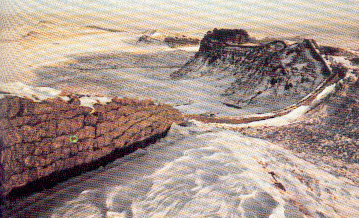 |
HADRIAN'S WALL
is the most important monument built by the Romans in Britain. It is the best known frontier in the entire Roman Empire and stands as a reminder of past glories of one of the world's greatest civilisations. Designated a World Heritage Site in 1987, Hadrian's Wall ranks alongside the Taj Mahal and other treasures of the great wonders of the world. |
| Ausgedehnte Thermen-Anlagen (von griechisch thermos: warm, also Warmbäder), die zu den aufwendigsten Baukomplexen der Antike gehören und nicht nur dem eigentlichen Bad, sondern auch dem sportlichen Training und der Kontaktpflege, Entspannung und Erholung dienten, sind erst aus der Römerzeit bekannt. Sie wurden von Männern und Frauen getrennt genutzt, bis später auch separate Anlagen für beide Geschlechter entstanden. |
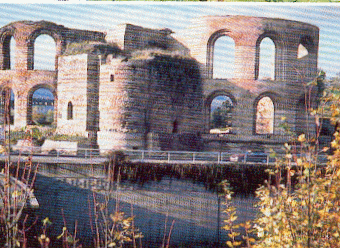 |
Roman Imperial Baths in Trier, one of the largest
bathing establishments of Roman Imperial times.
Besides the construction of an Imperial Palace (Elector's Palace), the building of palatial Imperial baths was another ambitious project within the enormous building programme of the Imperial Roman period during the first half of the 4th century, and the Thermae of Trier counted among the most spacious in the whole Roman Empire. The planning and general lay-out of its available space was guided by and based upon only two principles: size and symmetry. The hot-water baths (Caldarium), a hall containing a huge semicircular pool on the long east wall of the rectangular building, and two smaller pools along the shorter wall are the best preserved part of the Thermae. The far-spreading network of corridors in the builing's basement, almost as intricate as a labyrinth - they are now reexcavated and can be entered - were necessary for the maintenance of the heating system and also, for the drainage of the waste-water from the baths, while at the same time providing access to the stairtowers and lightshafts. The many finds made in the Thermae give ample proof of the display of luxury in connection with the Thermae's interior decoration: of walls panelled with marble, of mosaics and sculptures in profusion. |
| Die aufwendigsten Thermenanlagen entstanden in der Kaiserzeit zwischen dem 1. und dem 4. Jahrhundert n. Chr. in Rom selbst und anderen Teilen des Römischen Reiches. So sind beispielsweise von den Titus-, den Caracalla- und den Diokletiansthermen in Rom oder von den Kaiserthermen in Trier noch Überreste erhalten. |
 |
Main Entry: therm
Pronunciation: 'th&rm Function: noun Etymology: Greek thermE heat, from thermos hot; akin to Latin formus warm, Sanskrit gharma heat Date: 1888 : a unit used to measure quantity of heat that equals 100,000 British thermal units |
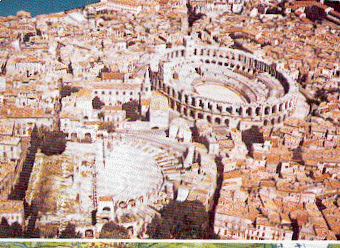
Amphitheater (Arles)