HUSBANDRY OF HORNED FROGS CERATOPHRYS CRANWELLI AND CERATOPHRYS ORNATA
By Richard Farndell
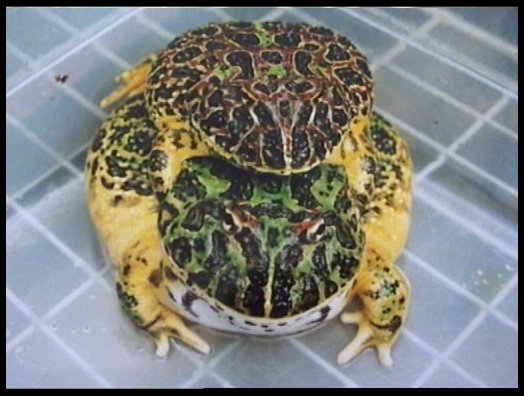
Adult horned fogs are capable of reaching an overall snout to vent length of 5.5 inches and are usually as wide as they are long if not wider. The ventral colour is usually white with a certain amount of yellow extending to the flanks where it blends with the dorsal colouring. Scattered over the back is a dark pattern of patches, which can be brown, dark green, orange, or red in colour. These patches vary in size and position but generally have a distinctive set pattern.
Ceratophrys ornata
The background colour of Ceratophrys ornata is generally green with a small scattering of red between the dark dorsal patches.
Ceratophrys cranwelli
Ceratophrys cranwelli has a much more varied range of colours and a huge variation in the amount of dorsal patterning. . The dorsal colouring ranges from lime green to dark brown with varying amounts of red, orange, or yellow. Some specimens have an extremely reduce dorsal pattern and are almost entirely lime green. An albino form of Ceratophrys cranwelli has also been bred. These albino horned frogs have a very attractive yellow and orange coloration.
Top
GROWTH
Horned frogs start their lives as 2 millimetre blobs of jelly, which quickly develop into tadpoles. The tadpole grows rapidly to 3.5 inches and within only a few weeks, three to four, turns into a froglet of about 1.25 inches. This growth is phenomenal and seems very impressive, until you see the froglet feed and grow. A horned frog is designed to grow at an accelerated rate, and is capable of reaching adult size in as little as 6 months.
Horned frogs are best maintained at a temperature of between 78 F to 86 F, with juveniles being kept at the higher range. The easiest way of providing heat is to use a heat mat designed for vivarium usage. Heat mats can be placed under one end of the enclosure and adjusted to the correct temperature by using a suitable thermostat. Alternatively the entire room the cage is in can be heated to the right temperature.
FEEDING
As already mentioned horned frogs are carnivorous and their main diet consists of what ever they can get into their mouths, including fingers! They have a reputation of being very cannibalistic. This can be true, although juveniles are more cannibalistic than adults are. If you intend to raise them in-groups keep them well fed otherwise some of the smaller frogs will end up as another's lunch. For this reason it is recommended to keep one horned frog to each cage.
What to feed is not a problem; as they will take dead as well as live animals (dead ones need to be wriggled a bit). They require to be feed whole animals as these provide a more balanced diet. The most convenient food item is dead defrosted rodents such as mice or rat pups. A well balanced diet should also contain invertebrates of a suitable size. Locusts, crickets, and earthworms are all useful items to as food for horned frogs. It is recommended to use tongs for feeding as they help to stop the food from picking up any of the cages substrate so the frog does not ingest it and most importantly they prevent you from getting bitten. Horned frogs have in their upper and lower jaws razor sharp bony projections, which act as gripping teeth. If you get bitten it is going to be a very painful experience, especially if you do not like the site of your own blood.
The size of the food will depend on the size of the frog you are feeding. Only feed food items that are no larger than approximately half the size of the frog. Otherwise the food is likely to decompose faster then the frog can digest it, making the frog bloat up putting great pressure on the internal organs and can be fatal.
The time between feedings depends on the age and the size of the frog. Growth rate is linked to the availability of food, the more food a horned frog receives the faster it grows. In as little as 6 to 8 months you could have your self an adult frog, but it is much healthier to reducing feeding to lengthen this to 12 to 18 months. If you feed your frog too often it is more likely to put weight on as fat instead of as muscle and bone.
Newly metamorphosed froglets will need to be fed on day old mice or on small guppies and fed every two days. As the frog grows the size of the food can be increased along with the length of time between feeds.
Adult horned frogs can be successfully maintained on a feeding schedule of one mouse every 7 to 14 days depending on the season. Do not worry if an adult frog goes off its feed for a few weeks, as some animals naturally need a rest period and should resume feeding in time. So long as the frog looks healthy there is no need for concern.
Vitamin supplements should be used, although most frogs refuse to take food if it is covered with vitamin powder. The best thing to do is to only coat the last upper half of the food that the frog is going to eat, so that it does not find the powder until it is too late. Most food only needs supplement on every three to four feeds, but insects should be dusted with vitamin powder at every feed. It is possible to raise horned frogs without supplements but it is best to provide vitamins to prevent the possibility of any deformities due to the lack of calcium or vitamin D3. Vitamin D3 is formed by ultra violet light reacting with fat under the skin changing it to D3. Without vitamin D3 it is impossible to absorb calcium through the stomach wall.
At the correct temperature the food you have just feed will be quickly digested and processed in to what is one of the most foul and polluting substances any one could think of. This will be the main thing to consider in our next subject.
HOUSING
The size of the enclosure needed to keep a horned frog in need not be very large. Horned frogs do well with floor area of approximately six to eight times the size of the square that the frog occupies when at rest. It is best to have a lid to any horned frog housing, if only to stop children or other pet from getting bitten.
The first time you clean out your frog you will appreciate the need for simplicity of its enclosure. The simplest housing is glass or preferably a plastic tank with water, which will need changing daily. An easier method is to keep them on moist moss peat, which will only need changing on a weekly basis. Peat has the advantage of neutralising some of the polluting waste, which the frogs produce. The only drawback with peat is you will end up with a dark red or brown frog. Keeping your frog on a light coloured surface will produce a light coloured adult. For a more attractive set-up you can use small pea gravel sloped with water at one end. This is not advised because if the gravel is ingested it can cause problems if it get stuck in the frogs stomach.
Keep furnishings to a bare minimum, as this will help in the time it takes to maintain the enclosure. If you decide to use plants in the enclosure opt for the more robust species that root easily and can be grown without soil and washed with ease.
Being amphibians, horned frogs need access to water at all times, whether this is in a bowl or as part of the overall set-up. Tap water is usually fine so long as it does not smell heavily of chlorine or tastes odd, if it does leave it to stand for at least 24 hours or bottled mineral water instead. I have raised horned frog successfully using London tap water, which has a pH level of approximately 8.0. The main consideration is to keep the water as clean as possible, changing it if it looks or smells dirty, even if you have just done so. If you do not, your frog is at risk from kidney failure from the toxins, which can not be seen in the water.
When cleaning out your horned frog always remember to leave the frog in some fresh water for a few minutes so it has a chance to soak up as much fresh water as it can.
The main things to consider when housing horned frogs are they must have access to clean water, which must remain free from the polluting waste that they produce in vast quantities, and be cleaned out on a regular basis. Never leave it too later as this is bad practice and harmful to your animal. Remember it is relying on you for its every need.
top
SEXING
Adult male horned frogs only grow to about 4.5 inches, and have nuptial pads (raised dark areas on the insides of the thumbs) and a dark loose throat (which is the males vocal sac). If none of these are present and the animal is of a large size it is likely to be a female. Adult female horned frogs can grow to 6.5 inches.
BREEDING
If you believe some people the only way to breed horned frogs is to inject them with hormones. Although this can be done, if your frogs need to be injected to breed it is a sure sign that there is something wrong in their husbandry preventing them from completing their natural cycle.
I must warn you that breeding any animal puts a great amount of stress on it. Do not try to breed from a much-loved pet. Horned frogs have a knack of being very distressed at any breeding attempts and rebel by bloating up with water and drowning them selves, or will sit under water and forgetting to come up to breath. Either way breeding horned frogs is risking their lives. If all goes well and they breed a second attempt may prove fatal, so be warned.
Before any breeding attempts are to be made, you must first be sure you have at least one frog of each sex (that's one male and one female for anyone that didn't know). Having established that, the next thing to do is to raise the temperature your are keeping the frogs at and increase feeding to once every 4 or 5 days. This should be maintained for approximately 4 weeks prior to any attempt at breeding.
Once the frogs are primed they will have to be exposed to some form of tropical rainstorm. To do this, construct a rain chamber from an aquarium power filter, a large fish tank and a series of spray bars. The water in the tank needs to be heated to 82 F and to be chlorine free. You then have to expose your frog to several nights of rain, from 6 p.m. to 12 midnight. After a period of about 24 hours it should be obvious whether the frogs have any intention of breeding. You will know this by the fact that the male will be calling in a deafening two-tone whistle and by neighbours knocking on your door to complaining about the noise.
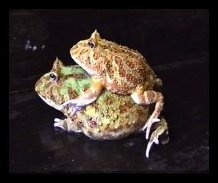
Females generally need to be exposed to several nights of this calling before they are ready for amplexus. She will show her readiness by running into the nearest male and sitting as upright on all fours as she can. Then she will let the male mount her by climbing onto her back and he will push his forearms hard into her sides hooking them under her hard bony plate above her shoulders. The male will then proceed to beat out a rhythm with his head upon the female's back. This pattern is necessary to synchronise the pair so they release both the sperm and the eggs at the same time. If all goes well and the male stays in amplexus, they have this habit of falling off, within a couple of days the pair will spawn.
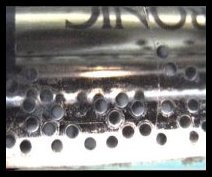
Spawning is proceeded by the female's body contorting with massive contractions, which proceed the eggs leaving the ovaries in readiness for laying. The eggs are usually laid only a matter of hours after this has happened. Spawning usually takes place in the middle of the night or early morning. Up to 2,000 small black and white eggs can be laid. It is best to turn off the rain chamber then remove the adults and add a small filter to the tank. This will not only help keep the water clear but also oxygenate it as well. If the eggs are fertile they will hatch in 24 - 48 hours.
It is possible to tell if the eggs are good by watching them carefully and any which have the black part expand in a crisp line to completely engulf the white half will be viable. After a short while the black part has grown to cover the entire egg the embryo will start to take shape. When the tadpole is half way developed the embryo will start to spin. The speed of spinning depends on the temperature of the water, the nearer the egg is to the heater the faster the rate of spin. When the eggs hatch the tadpoles will sit dormant for the next 24 to 48 hours while they absorb all the remaining yoke and grow skin around their gills. The tadpole is now ready to pursue it carnivorous existence.
top
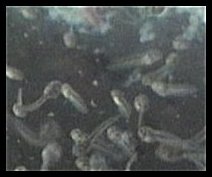
Assuming you have got this far, you are now going to need a great deal of space and a lot of water. Horned frog tadpoles are just as carnivorous as the adults and will need to be fed great quantities of tubifex or bloodworms. If food is not available at all times they are quite capable of eating each other and they do. Feeding on tubifex the tadpoles are going to need frequent water changes and a good filtration system. Once the tadpoles are feeding remove them to larger aquariums kept at the same temperature as the rain chamber. Your main problem is going to be maintaining the water quality. Their water will soon become fouled and a need 25 - 50 % of the water changed each day. Filtration is essential but will be difficult to maintain in the quantity necessary. The system I use is to keep the tadpoles in is a series of fish vats with 1,000 gallon pond filters with ultra-violet sterilisers. The pond filters have been matured at the temperature are to be used at .If not matured they will only remove the solid waste particles not the chemical contaminates. With an efficient filter it is not necessary to change the water as often. As the water needs to be aged for at least 24 hours, it is an advantage to keep water changes to a minimum.
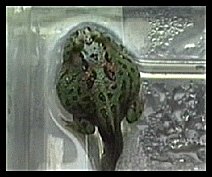
When raised under ideal conditions the tadpoles will grow rapidly to 3.5 inches in as little as three to four weeks. At this stage they have grown their back legs and started to get their froglet coloration ready to complete metamorphosis. The front legs grow under the skin and must brake through before the frog can leave the water. To help in this the skin dissolves a hole just large enough for hand and leg to fit through. Next it will shed it tadpole beak and form its frog's mouth. The frog is now ready to reabsorb its tail and leave the water. After a few days the newly emerged frog will be fulfilling its basic function, to eat and eat and eat so it can grow up big and strong to breed and produce the next generation of frogs.
Top
END NOTE
If using information or picture obtained from this website please quote as obtained from Richard Farndell and include the website address http://www.geocities.com/rafarndell/husbandry.html

Back to Horned frog breeder page