Now we remove the insulation from the tips of the wire, and from the small loops we made every 5 turns (these loops are called 'taps'). If you are using enameled wire, you can use sandpaper to remove the insulation. You can also use a strong paint remover on a small cloth, although this can be messy and smelly. Don't remove the insulation from the bulk of the coil, just from the wire ends and the small loops. If you are using vinyl coated wire, the insulation comes off easily with a sharp knife.
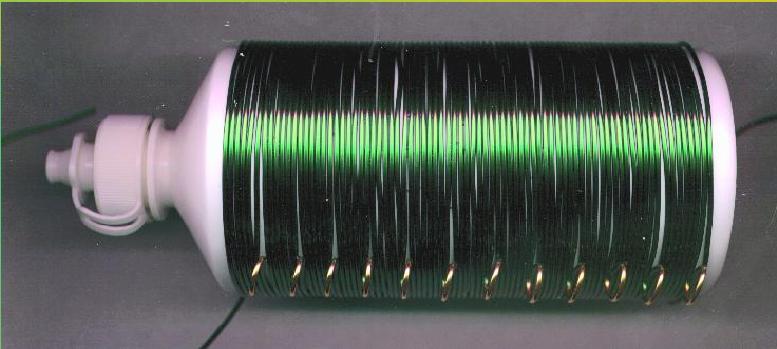
Next we attach the Germanium diode to the wire at the bottom of the bottle. It is best to solder this connection, although you can also just twist the wires together and tape them, or you can use aligator jumpers (Radio Shack part number 278-1156) if you are really in a hurry.
Cut one end off of the handset cord to remove one of the modular telephone connectors. There will be four wires inside. If you are lucky, they will be color coded, and we will use the yellow and black wires. If you are not lucky, the wires will be all one color, or one will be red and the others will be white. To find the right wires, first strip off the insulation from the last half inch of each wire. Then take a battery such as a C, D, or AA cell, and touch the wires to the battery terminals (one wire to plus and another to minus) until you hear a clicking sound in the handset earphone. When you hear the click, the two wires touching the battery are the two that go to the earphone, and these are the ones we want.
The 'wires' in the handset cord are usually fragile copper foil wrapped around some plastic threads. This foil breaks easily, sometimes invisibly, while the plastic threads hold the parts together making it look like there is still a connection. I recommend carefully soldering the handset wires to some sturdier wire, then taping the connection so nothing pulls hard on the copper foil.
Attach one handset wire to the free end of the Germanium diode. Solder it if you can.
Attach the other wire to the wire from the top of the bottle. Soldering this connection is a good idea, but it is not necessary.
Now clip an alligator jumper to the antenna. Clip the other end to one of the taps on the coil.
Clip another alligator lead to the wire coming from the top of the bottle. This is our 'ground' wire, and should be connected to a cold water pipe or some other metal object or wire that has a good connection to the earth.
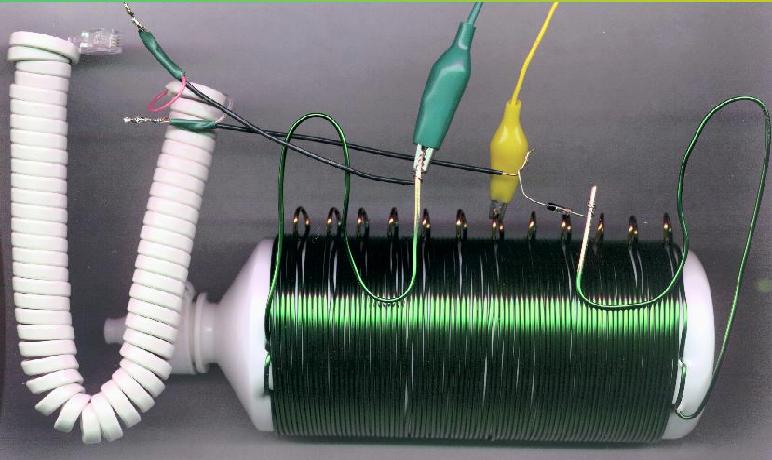
At this point, if all went well, you should be able to hear radio stations in the telephone handset. To select different stations, clip the alligator jumper to different taps on the coil. In some places, you will hear two or more stations at once. The longer the antenna is, the louder the signal will be. Also, the higher you can get the antenna the better.
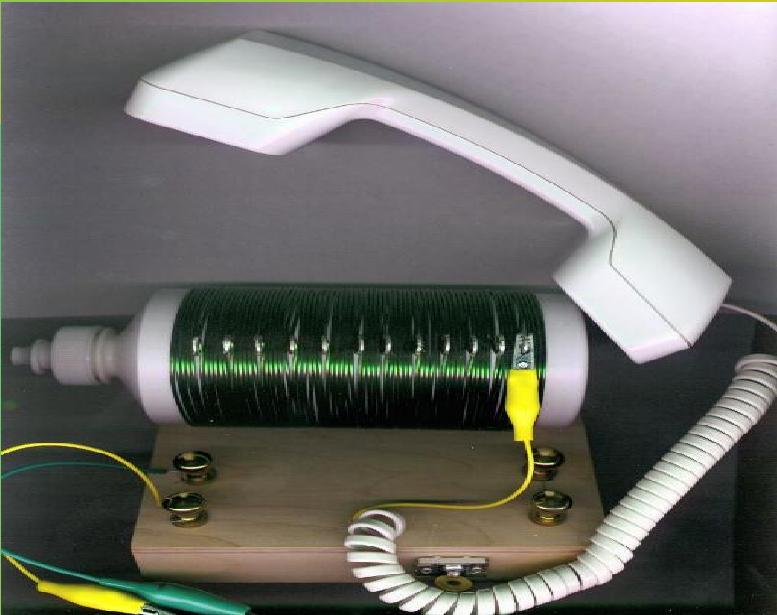
Now that your radio works, you can make it look better and be sturdier by mounting it on a board or in a wooden box. Machine screws can be stuck into holes drilled in the wood to act at places to attach the wires instead of soldering them. A radio finished this way looks like the following photo. Note the nice little touch of using brass drawer pulls on the machine screws to hold the wire.
What do I do if my radio doesn't work?
Some things that might have gone wrong:
1 - You may have a low impedance earphone. This means that the number of windings in its coil is too small, and it looks like a short circuit to the radio.
You can replace it with a high impedance earphone, or you can use an impedance matching transformer to match the radio to your earphone.
An impedance matching transformer has one side with lots of turns on its coil, and another with fewer. You connect the side with lots of turns (an impedance of 1000 or 2000 ohms) to the radio in place of the earphone.
You then connect the earphone to the side with fewer turns (between 4 ohms and 32 ohms).
2 - You may not have a long enough antenna. Anything less than 30 meters is probably inadequate.
If space is a problem, you can try winding the antenna around the room in a big coil, but having the antenna outdoors, and as high up as you can get it, will be best.
3 - You may not have a good ground connection.
A cold water pipe is usually used, since one end of it is usually buried (not so for hot water pipes). Yours may be plastic where it is buried, which would not be good.
You may not have a good ground connection. Try finding some metal that is buried at one end, and connect the ground of the radio to that.
4 - You may be far away from a strong radio station. If so, you will need a larger antenna.
If you have access to an amplifier, such as a stereo system with a phonograph input, try connecting the phonograph input of the amplifier instead of the earphones, so you can amplify any signal you get.
If you still get no signal, then the problem is NOT your earphone or your antenna, and may be your connections or your diode.
If you are having trouble finding good diodes, try using any two wires from a three wire transistor.
5 - Check your wiring carefully against the schematic diagram, making sure that all your connections are making good contact