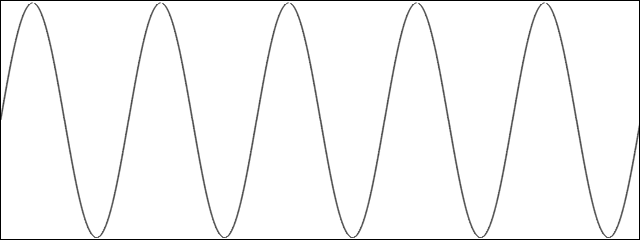
In our transmitter, the sound source is connected to the transformer instead of to a speaker.
The transformer is connected to the power supply of the oscillator. The sound source causes the transformer to add and subtract power from the oscillator, just as it would have pushed and pulled on the speaker.
As the power to the oscillator goes up and down, the power of the electricity in the antenna goes up and down also. The voltage is no longer simply 9 volts. It is now varying between 0 volts and 10 volts, because the power from the transformer adds and subtracts from the power of the battery

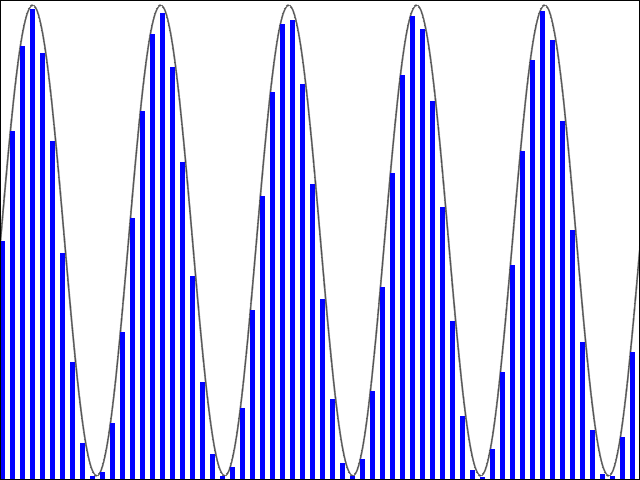
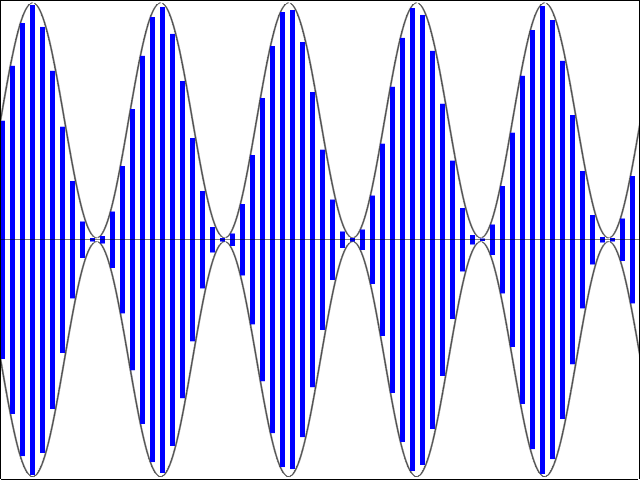
The varying power in the antenna causes radio waves to be emitted. The radio waves follow the same curves as the waves in the antenna. However, because the transmitter and the receiver are not connected, the receiver does not know what the transmitter is using for the value of zero. All the receiver sees is a radio wave whose amplitude is varying. In the receiver, zero is the average power of the wave. This makes the wave look like this
If we sent this wave to the earphone, we would hear nothing, because the average power is zero. This is why our crystal radio has a diode.
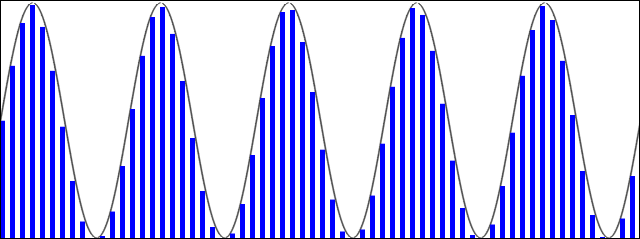
The diode does a neat little trick. A diode only lets electricity flow in one direction. This means that the part of the graph where the power is rising up from zero can get through the diode, but the part where the power is going down from zero is blocked
All those little peaks of power happening a million times per second are too fast for human ears, and too fast for the earphone to reproduce. But since they are all pushing on the earphone diaphragm, all those little pushes add up, and the earphone moves. Since some of the little pushes are stronger than others (taller blue bars in the illustration) they move the earphone more than the weaker ones. We hear this variation as sound.
The sound is a faithful reproduction of the original sound wave at the transmitter.