How does it do that?
At this point in the book, if you have been reading from the beginning of the chapter, you probably already know most of the science behind how this radio receiver works, since it is very similar to a crystal radio.
Like a crystal radio, this is a "Tuned Radio Frequency" receiver. That means it listens to the radio signal directly. It does not contain an oscillator like some other radio circuit designs (such as superheterodyne and regenerative radios).
The main difference between this radio and a crystal radio is that the integrated circuit in this radio not only has the crystal inside it, but it has amplifiers and an Automatic Gain Control.
The antenna coil (the little coil with the ferrite rod inside) generates tiny amounts of electricity as the radio waves wash over it. An amplifier is a circuit that uses that tiny amount of electricity to control a much larger flow of electricity from the battery. It is like using the water from a garden hose to move the nozzle of a firehose, putting a huge amount of water anywhere you wanted it, using only a little water from the garden hose.
The Automatic Gain Control circuit controls how much amplification is used. It turns up the volume on weak stations, so they sound as loud as strong stations do. This is why we don't need a volume control on our radio -- all the stations are close to the same loudness (no AGC circuit is perfect -- you can still tell which stations are powerful nearby stations and which ones are far away or weak).
In the radio shown in the photos, we use a 1.5 volt battery (in this case a small "N" cell, but you could use a "D", "C", "AA", or "AAA" cell just as easily).
The radio will work with battery voltages as low as 1.1 volts, or as high as 1.8 volts. The current needed is very small -- only 3 milliamps. This tiny amount of electricity is easily obtained from homemade batteries, or small commercial solar cells.
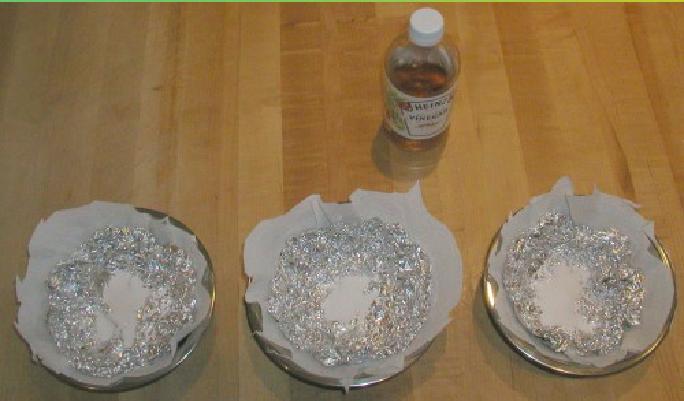
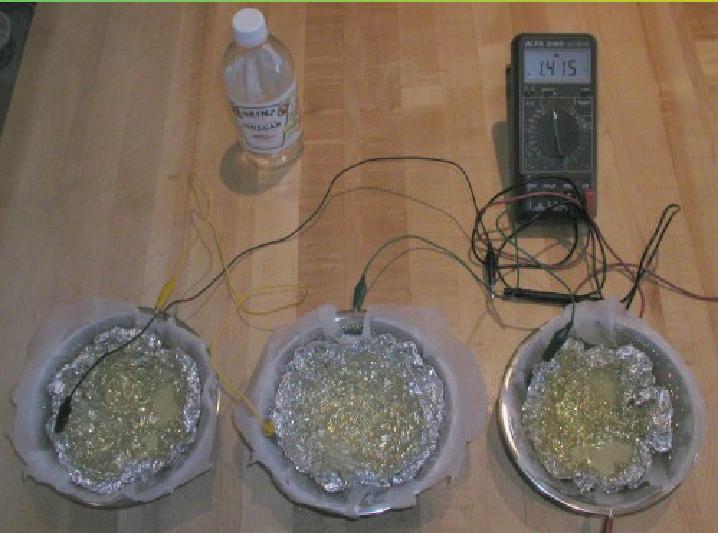
The stainless steel bowl and aluminum foil must not touch one another. You can get higher voltage by connecting the bowl of one battery to the aluminum foil of the other battery (this is a series connection).
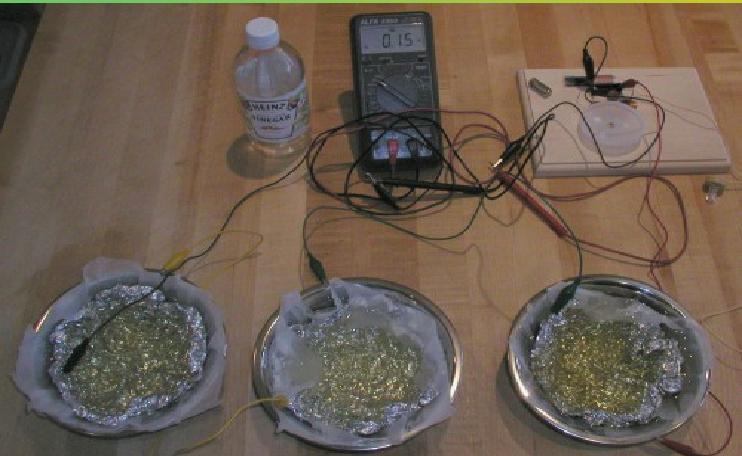
The radio needs between 1.1 volts and 1.8 volts to operate. But it also needs at least 0.1 mulliamps of current. The specifications say it needs 3 milliamps, but as you can see in the photo, we are using only 0.15 milliamps, and the radio has very nice volume.
The voltage is determined by how many bowls you have. The current is determined by how much surface area the bowls and aluminum foil have. Using bigger bowls and more foil will produce more current
The bowl is the positive wire, and connects to the radio where the red wire from the battery holder went. The aluminum foil is the negative side of the battery, and connects where the black wire from the battery holder connected.
You can see the alligator clips attached to the battery holder if you look at the larger photo (click on the small photo).
You can try soft drinks, or lemonade instead of the vinegar. The salt usually helps a lot though. Some people power their radios with beer. Depending on the beer, you may need more than three bowls. Adding salt to the beer will keep it from disappearing into curious bystanders