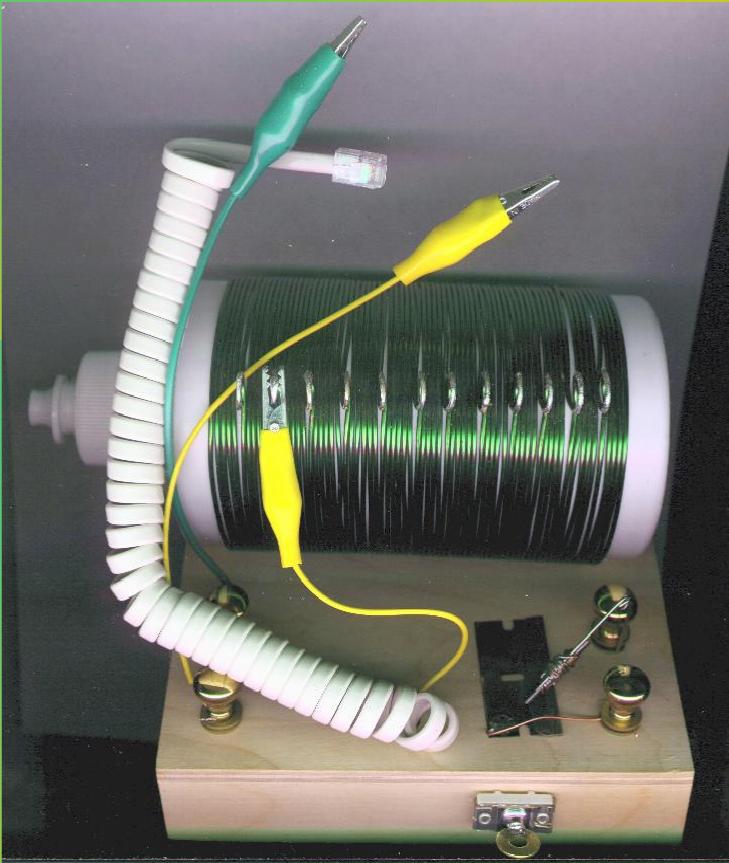
Building a crystal radio out of household items.
                           Building your own diodes


During World War I, soldiers in the field made their own radios to listen to programs for entertainment and news. They had access to wire from broken down vehicles, and telephone receivers, but they did not have modern solid state diodes in little glass tubes.


However, it is surprising to find out just how many ordinary objects can act as a diode, letting current flow one way better than another.


The soldiers found that an old rusty razor blade and a pencil lead worked just fine. By lightly touching the pencil lead to spots of blue on the blade, or to spots of rust, they formed what is called a point contact diode.


We can replace our store-bought diode with a homemade point contact diode and compare the results. The parts can be attached to the circuit with clip leads, or they can be soldered, as in the photo below. The pencil lead is attached to a safety pin by wrapping it with bare copper wire and soldering it.
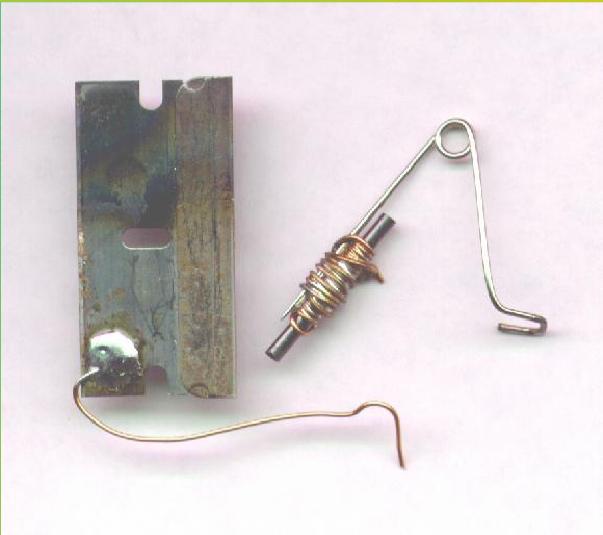
The safety pin acts as a spring to lightly press the pencil lead onto the razor. If the pressure is too hard or not hard enough, the diode will not work, so experiment. The exact spot on the razor is also critical, since some spots will have too much or too little oxide on them to make the diode. Move the pencil lead around on the razor until the sound is loudest, or the meter (if you have attached one) reads highest.
In the photo above, you can see how handy the brass drawer pulls are when we want to attach new types of diodes.


If you don't have a rusty razor blade lying around, you can try other bits of rusty metal. The blade shown above was clean and new, so I put a little salt and water on it, and held it in the flame of a gas stove until parts of it were blue and purple.


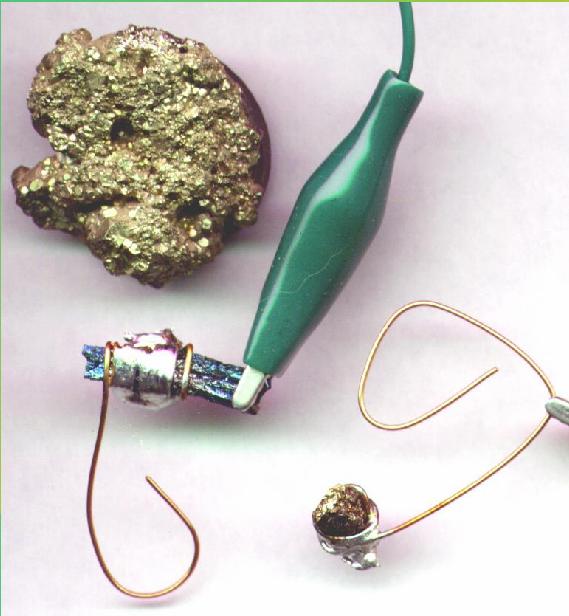
You might have other things around the house that can act as diodes. In my rock collection, I found some iron pyrite (fool's gold) and some carborundum (silicon carbide, the blue stone in the photo below). The carborundum works well with a strong pressure, so I simply wrapped some bare copper wire around it, soldered the wire, and then let the jaws of a clip lead supply the pressure. It works quite well. The pyrite needs a gentle touch, so I used the point of a safety pin to gently probe until I found a spot on the pyrite that gave good volume in the radio.
Hosted by www.Geocities.ws

1