|
|
DiodesWarning, electricity can be dangerous, as can the signals generated by some devices.To young children and young adultsIf you want to learn about electronic or electrical devices, a good place to start is with your parents advice and supervision. I suggest buying some kits to build from your local electronics store. Some school classes like Automotive Practices, Physics, Chemistry and Electronics are good places to learn about this topic too. The topics covered here require an education level of year 11 or more to understand, although some students may have attended one of the above classes and might find the information here interesting. Mathematics is very handy in understanding electronics and electrical theory. Purpose of this web pageThe information presented here is intended to make the reader aware that electronic devices can have models applied to them. This document is intended to cause the reader to become interested in seeking out further information in formal text books and kits about the subject of electronics and electrical design. It is my intention to point such a reader in the correct direction of thought on this subject by using a simple but key example. This document is not intended to act as a basis for practical designs or to override the advice of texts; specifications; and kits (purchased at the electronics stores). IntroductionDiodes are fascinating devices. In the past they looked similar to a light bulb! Now days you can find small solid ones made out of glass, solid packaging or plastic. The plastic ones are often made into a diode called Light Emitting Diodes (LED’s). These were used in indicators (like when you switched something on, a little light would go on ) and even for older model clocks and calculators. In today's modern world liquid crystal displays tend to be used instead. You can think of the liquid crystal screen on your calculator for digital clock as being made out of a material that can become like sunglasses at will. This is achieved by re-aligning crystals so that light is diffused or absorbed making an area on the display appear dark. Diodes can be made very small. They are often found on silicon chips. These electronic devices might be the size of a letter on this page and contain nearly all the circuitry for an entire radio. Diodes on a silicon chip are very small, considering that single letter on this page could hold over 1000 diodes. The DiodeWe will keep this discussion on the topic of larger sized diodes, although the model introduced later works for smaller diodes too. Bigger diodes are easier to experiment with. Your local electronics store will probably sell hobby kits or discrete components if you know what you are doing. A diode will probably look something like this:
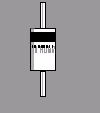
Figure 1, a picture of a diode One use of diodes is to convert one type of voltage (AC) into another type of voltage (DC). Diodes used in this way are said to be part of a rectifier. Since rectifiers supply DC power to a device, the diodes designed for this purpose are called power diodes. Diodes can also:
The Diode has other useful characteristicsThe Diode also has certain characteristics that make it useful for other applications. I will discuss two here, but there are other properties that I do not want to cover in this document. Photodiodes and Ohm’s LawSome diodes are sensitive to light instead of emitting it. That means if light shines on them they allow current to flow. Such diodes can be used for light controlled devices. One common use is night lights. This is achieved by a control circuit that recognizes that no light is shining on the diode. The darkness causes the diode to no longer pass current. Also, the voltage across the diode has suddenly increased because the diodes resistance has increases (Ohm’s Law: V = I * R, V-Voltage; I-Current; R-Resistance; and * means multiplication). This kind of diode is called photosensitive diode or photodiode. Zenner DiodesI mentioned that you can place a diode in the reverse direction so that it has a very large resistance. Unlike a resistor, the diode can break down and eventually allow current to flow when it is reversed and tries to behave like a large resistor. Some diodes are designed to do this at very low voltages. Such diodes are used for voltage reference because once they break down in the reverse direction they maintain a constant voltage across them. Diodes of this type are called Zenner Diodes. A symbol of the Diode
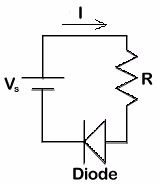
Figure 2 Ohms Law RevisitedAny diode can be drawn with the symbol shown and labelled above in figure 2. The picture next to the diagram is an example or what that symbol might represent. The tip of the arrow of the diode symbol represents the black band on the actual diode, as I explained above with Ohm’s Law:
Similarity between the equation of a line and Ohm’s Law.The equation V =I * R is much like the equation you may have learned in school. Let’s see, it went something like this, I think, Y = m* X where ‘m’ was the gradient; x was the independent variable and y was the dependent variable. ‘m’ is ‘almost similar’ to ‘R’ in this case because ‘R’ is a circuit component and does not usually vary. In electronics V or I can be the independent variable. The model of a diodeYou might say that a diode can not use Ohm’s Law since it is not a resistor or a battery (voltage supply); If you said that you would be correct. The symbol needs more work to make it part of the circuit. To do this, people produced a thing called a model of a diode. Because models are not real diodes, they make assumptions. An assumption might be: light does not effect the diode; the diode has no reverse break down voltage and the diode has no capacitance. I will not be discussing capacitance here.
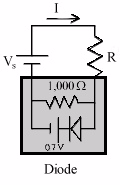
Figure 3 If the diode were like a light switch you could turn on and offYou can think of an ideal diode is like a light switch. If the arrow (or black band on the component) is pointing towards the negative side of the battery, then you switch the light switch on and current can flow. If the arrow faces the positive side of the DC battery then you switch the light off and no current can flow. Diodes are similar to valves in the blood systemFor those budding biologists out there, a device like a diode exists in the body's blood system. They are called valves and sit inside the blood vessels and heart. Your heart pumps blood around the body, by using a system of valves located all around the body that prevent blood flowing in the wrong direction. The 0.7V battery in the diode modelYou will also notice that a small battery of 0.7V is included in the model. That is the small symbol with two parallel lines ( one of the lines being shorter than the other ). This represents an obstacle the battery must overcome in addition to the fact that the ‘ideal diode’ has to be in the forward "on" direction. Some models may use a different voltage. This battery represents a barrier to getting current to flow in the forward direction. You can not use the models battery to act as a power source. The 0.7V battery and a drinking strawThe models battery is similar to drinking from a straw, because you need to apply the force of suction to make that soft drink flow through the straw. Energy can never be created or destroyed... (most of the time).Another electrical and electronics law, is Kirchhoff’s Voltage Law. This law is related to the fact that energy can never be created or destroyed. Okay the physicists and cosmologists know that there are exceptions to that law. It works in most places not situated inside atomic explosions; the local nuclear reactor; inside the sun; particle accelerators; black holes and spontaneous matter creation destruction cycles. Since work is done whenever electrical energy is transferred though a circuit, we can use the equation of P = V * I, where P is power (Watts), V is voltage and I is current. Power is simply a measure of the rate of work or rate of delivering energy. We also know from Ohm's Law that V = I * R. Kirchhoff's Voltage Law depends on energy never being created or destroyed because of the interrelation of the equations. To put this in simple words, the energy supplied by the battery is equal to the energy consumed by the circuit. The most common consumption of energy is into the conversion of that energy into heat. Let us use Kirchhoff’s Voltage Law now to find out the current through the circuit.
Figure 4 Using Kirchhoff’s Current Law, the current through the diode and 0.7 V battery must be 43-0.7= 42.3 mA. The internal resistor is much larger usuallyIn reality, the internal resistor is more in the magnitude of around 100M.ohm or 100,000,000ohm , When it is that large it can be ignored. However we will calculate the current through a 100M.ohm resistor for completeness. I = 0.7/100,000,000 = 0.000000007A or 0.000007 mA, thus the current through the leg with the 0.7V battery and ideal diode is 43-0.000007 = 42.999993 mA and this is approximately equal to 43 mA. Thus we can ignore the 100M.ohm internal resistor when the diode is connected in the forward direction in this case. The load diagramAnother way to figure out this answer, when we ignore the internal resistance is by using the load line method. This is a graphic method of solving the above mathematics.
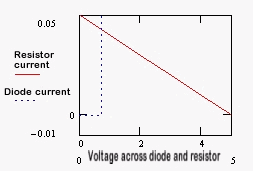
Figure 5 Building the load line (or the resistor current line )Using Kirchhoff’s Voltage LawVs=I* R+Voltage_across_diode => I = - Voltage_across_diode/R + Vs/R notice the similarity to y= -m* x + c m = 1/R = 1/100 = 0.01 c = Vs/R = 5/100 = 0.05 Thus the load line is similar to y = -0.01* x + 0.05. The actual load line equation is I = -0.01* Voltage_across_diode + 0.05 When Voltage_across_diode = 0V, I = 0.05A When Voltage_across_diode = 5V, I = 0 A These values correspond to the intersection of the line and the axis. Since the only mystery on the graph is the value of the Voltage_across_diode, we can draw the graph of all values the diode can have for various voltages. For the ideal diode this is easy (remember the diode is orientated in the forward "on" direction) any voltage above 0.7V will cause the diode to turn on and conduct as much current as required. From the figure 5, you can see that diode current swings straight up at 0.7V. The resistor causes the current to be limited (via the load line ) to 43 mA as the intersections of the two lines show. Load lines are useful for examining what might happen if the source had an AC signal on it. The reason for this is that we can visualize it by moving the load line up and down in response to the AC signal. Load lines can also be used in the examination of non-linear elements like transistors. You have seen that diodes use models because they behave in non linear ways. You will not be surprised to learn that transistors can also be mathematically analyzed by using their very own models. If the diode is in the reverse "off direction" the ideal diode will behave like an open circuit. That means the current must flow through the models internal resistance to complete the circuit. In this case the Kirchhoff’s Voltage Law states:
Using the original model resistance of 1000ohmVs=R* I+1000* I => Vs=(R+1000) * I => I = Vs/(R+1000) We know Vs = 5V and R = 100ohm . Substituting these values in gives I = 5/(100+1000) = 0.004545 = 4.545 mA
Using the more realistic model resistance of 100* 106 ohmVs=R* I+100* 106 * I => Vs=(R+100* 106) * I => I = Vs/(R+100* 106) We know Vs = 5V and R = 100ohm . Substituting these values in gives I = 5/(100+100* 106) = 49.99995 * 10-9 Amps or 0.05 micro Amps As you can see, using a more realistic model, resistance makes the diode in reverse "off" orientation behave more like an ideal diode. 0.05 micro Amps is close enough to the circuit not conducting any electricity. In the forward on direction we found that the current was 43 mA. If the diode had not been in the circuit, the resistor ‘R’ that equaled 100ohm would have conducted I=5/100 = 0.05 = 50 mA. 43mA is fairly close to that value and so the diode was acting as if it were simply an open switch that allowed current to flow. A Diode Acting As An Open SwitchThis simple property of a diode acting as a simple switch is more useful then you would initially think. This device can be used in digital electronics, wave shaping and for control applications. Digital ElectronicsThe simple diode is one of the parts that are used to make logic circuits. Because the diode is not ideal, it has some problems associated with its' non linear aspects. Wave ShapingThe diode can be used for shaping signals. The simplest example of this is where AC waves are converted to DC (actually pulsating waves) by using diodes set up in a pattern we commonly call a rectifier. Control ApplicationsA diode is kind of like a hammer. A diode tends to turn on very abruptly. This type of signal is called a impulse signal. In control this signal is given the formal name of a unit step or unit impulse. Engineers often insert control devices or test a system with a ideal device to see how the system reacts to the worst case scenario of being initially switched on. There is a special diode called a Shockley diode. This diode is very fast at changing from one state to another and is often used to square up waves that have ended up with distortions. The diode has the very ideal mathematical characteristics that a control engineer could find very useful. Choosing your very own diodeManufacturers usually give the maximum forward current and maximum reverse voltage. Also the speed of switching from one state to another and the diodes capacitance may be important for signal processing. Because diodes have so many applications there is often additional information also supplied by a manufacturer. You will find that signal diodes have small containers while power diodes are big and bulky to dissipate any heat. Other ApplicationsI have already discussed the other type of applications for the diode above. ReferencesB.Grob,Basic Electronics, 4th Ed., McGraw-Hill, Tokyo [1977]. T.F.Bogart, Electronic Devices and Circuits, Merrill, Ohio [1986]. J.Millman, Microelectronics, Digital and Analog Circuits and Systems, McGraw-Hill, Tokyo [1979].
While every effort is made to ensure the information contained in this web page is accurate and up to date, the author can take no responsibility for any use not specified within the web page. I suggest you follow your kits instructions or seek additional references before making any practical design decisions.
|
|
|