|
|
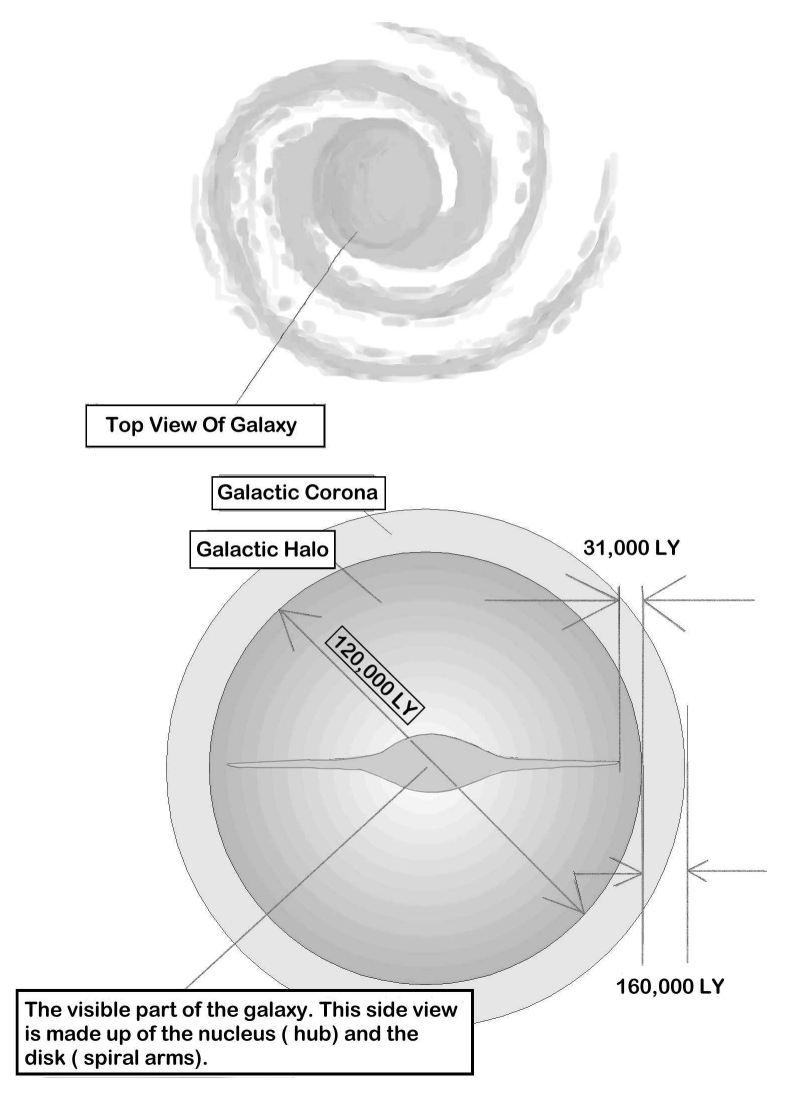
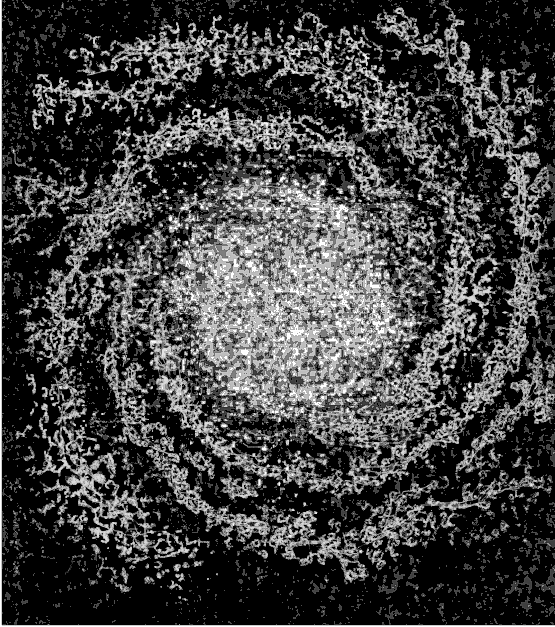
Including New planets/minor-bodies discovered at the edge of our solar system.They are called: Meanwhile Plutos' status as a planet is comming into question as is the ortiginal classification of KBO's. It is likly that some KBO's will be reclassified into minor planets. These include objects that are in the asteroid belt. These planets seem to have been given the name Plutinos. Charion -plutos moon previously- has also been reclassified into a plutino. Black holes come in several sizes! A new gas arm is added to our own galaxies structure, see more on this below. Also my research may shed light on why a shock zone may be preventing stars forming in this gas arm. I hope to learn more about the gas arm soon! Dark matter is proved to exist. The evidence came from the merging of two galaxies. Our galaxy is thought to be a bar galaxy and we are located near one of the bars ends. The effect of our solar system being located here is that stars are slung out towards our solar system but they will not reach us apparently. I think it has something to do with dark matter, but all the changes in astronomy are really spinning me out. The standard texts still have not updated to a nice summary of the new information coming out every day. It is now suspected that some of the stars that were once suspected as being part of smaller galaxies that is being devoured by the milky way may in actual fact be the result of stars ejected by the bar structure. In the mean time it is suspected that our bar galaxy should be stable, but scientist have not yet come up with a model to proved this. It is now suspected that extremely high energy cosmic radiation that has been accelerated for a unknown period of time in magnetic fields may have enough energy to create tiny black holes in our atmosphere (that may mean some jet passengers may have had black holes go through their bodies) but the life span of these tiny black holes is short as they decay quickly. Scientists want to test the resultant particles to see if these tiny black holes behave as models suggest or if they might form worm holes for example. Since dark matter and dark energy makes up most of the matter in our universe, I would certainly like to learn more about it, but scientists may take some time to unravel its properties. I believe dark matter will certainly have a major effect on how we describe our galaxy. There is even some question of what will happen if dark matter and dark energy is stretched too far by the expanding universe. Expanding dark matter (and dark energy) may spell the end of the normal matter (that means us, earth, the solar system and the galaxy). The way we view our universe may be in for a real rough ride in the next decade as scientist discover more information!!!!! Since out galaxy is a rarer bar type galaxy, it may have a major effect on the calculation on the probability of finding intelligent life in the galaxy. On the other hand there increasing proof that planets orbiting other stars are much more common then first thought and that might increase the likelihood of intelligent life in our universe. I think scientists are still puzzled by why we have not been contacted by alien life forms yet since it seems that there must be quite a few civilizations out there! Perhaps our galaxy being a bar galaxy will give them some reasonable explanation as to why life is less common in our universe. Feel fee to look up the equations used to calculate the probability of lifeforms in our galaxy using your favorite search engine if you want to know more information on this. No I do not think aliens have visited earth yet by the way if you happen to be wondering. Shown below are some pictures of a galaxy that I have developed from references listed within this document. Galaxies are enormous and have many shapes, yet they have similarities in their basic structure. The Galaxy shown here may apply to a great number of galaxy structures throughout our universe.
Figure 1: A Galaxy’s Structure (not to scale) It is known that galaxies can collide. I am uncertain how the galactic structure would be altered because of a collision. A collision between galaxies rarely causes any of the stars to be damaged because stars are separated by very large distances. The GalaxyGalaxies are not only made up of stars but also dust clouds, free gas, particles ( including ionized atoms and free electrons) and mysterious material [Atkinson, Page 74 to 77]. Describing the structuresI will now describe the structures shown in figure 1. For those unfamiliar with astronomy, a lot of these descriptions may sound technical. If you enjoy astronomy, the technical terms will become as familiar as the various names of snow types are to Eskimos. You will also realize that an interest in astronomy is something all people of the world can participate in. For these reasons the quantities like billion, million and ways of measuring things may differ between places in the world. " Apart from the Disk" and hub , "the Milky Way has two other components that drastically increase its overall size:
There are billions (1x 10⁹) of different galaxies in our universe, but ours is the larger than most. It contains at least 200 billion ( 200 x 109) stars ... [Atkinson, page 74]." The Galactic Corona is not explained by [Atkinson], but we can compare the word Corona with the meaning it has for the sun. The sun's corona [EOAA, Page 51] is caused by scattered light from
A small part of the corona is also caused by extremely hot highly Ionized atoms. Further [EOAA, Page 130 to 132], The milky way is described as having a
Additional InformationAs Bills and Acts made by a process of parliament, science can have its own modification or clarification of various scientific laws and the information we currently posses about our universe. One source of change is instruments that present us with new information. Often such information can cause the scientific community to gasp in surprise and begin to debate what new information really means. In terms of parliament, this is like the committee stage of examining bills before they are eventually accepted as Acts. In the case of the scientific community, scientific laws and data may be changed or added to. These changes may even cause all the school text books in the entire world to be altered to reflect this new scientific understanding. It can take up to five or ten years to move new information into text books! Searching through various reference books can bring information that indirectly supports my understanding of the corona.Instruments that can detect X-rays and Ultraviolet light, have given us new information during the period of 1978- 1980. The description of what the instrument showed us is described below. Recent discoveries, around the 1980’s have given an indication as to the nature of the Galactic Halo:
From this we can conclude that the Galactic Halo gives out electromagnetic radiation because of hot gas that exist there. This is similar to the way (although at lower temperatures) that a fluorescent lamp light up when it is energized by electricity. This X-ray and ultraviolet information confirms that the galaxy's corona is indeed similar to the definition of the sun's corona. See the definition of the sun's corona above. Thus there is a connection between the halo and corona, the hot gases of the halo would cause the corona to exist. Recent Discovery that Milky Way has an extra arm
The half a century old map of the galaxy may have to change as Australian astronomers discover that the galaxy has a huge out-flung arm made out of a arc of hydrogen gas. The scientists are amazed that the huge structure that sweeps around the four main arms of our galaxy has not been discovered earlier. The arm is 77, 000 light years long and several thousand light years thick. Because the arm contains no stars, it can not be seen by standard telescopes that use the visible part of the light spectrum. Scientists have instead used radio waves to see the hydrogen arm. It is speculated that the arm ( as yet un-named ) was a long tendril that was once joined to one of the existing spiral arms but became detached for some reason. One of my own curiosities about this "gas arm" is why it can not form stars. If we examine figure 1, we can see that the gas arm of our galaxy is located between the galatic halo and the mass of our own galaxy. It is very likly the forces in this region will prevent star formation.
Step 1, The Central Black hole In Our GalaxyBlack Holes That Might Of Formed At The Beginning Of The Big BangSome scientists have mentioned that the constants that form part of the physical universe may have varied from the beginning of the big bang up to now. It should be noted that black holes are theoretical. One might wonder if this central black hole is older than the galaxy itself or if it was formed at around the same time as the galaxy. If the black hole formed before the galaxy, then one might ask if the physical law in the universe was the same at the formation of the black hole. Could this black hole contain fragments from the very early stages of our universes creation? If the black hole does contain fragments from the very early stages of the universe, we might conclude that the physics of that stage of the universe was different in some way. The thought of the possibility of having several different laws of physics in one place is certainly something that is very hard to imagine. This is part of astronomy I like, the formulation of ideas that could be totally wrong, yet the only solution is to search thought the scientific literature to see if scientists have published something that supports or opposes your idea. Step 2, Having looked at the alternative arguments, make a decision if your own theories or ideas still hold?Galaxies Formed Earlier Then Previously ThoughtMy most recent research has indicated that the galaxies formed earlier then previously thought. This may indeed start to form the basis for the variance of the physical constants we know today. Black Holes Formed Early In The Big Bang Should Evaporate TheoreticallyOn the down side, I have also discovered that if black holes were to form in the early universe (close to the begining of the big bang ) with the current laws of physics, then they would have evaporated by now. I assume this is some sort of relavistic consideration included in this calculation due to rapid expansion at high speed. For the common person the theory of relativity is a little scary, so I suggest you look above at my discussion on Mercury, the ancient Greek messenger (amusing, he must have been fast!!!) and a planet of our solar system. I promise you the discussion will not be that scary. Quantum Theory Could Cause Physical Laws To Not Be Different In A Black HoleFor some of you the following stuff might be a little scary. What I am about to say below is "stuff can evaporate out of a black hole, so perhaps it is impossible for several different laws of physics to exist in the black hole as I have suggested." While theory says that nothing can escape a black holes gravity when it falls into the event horizon, recent research into quantum theory has indicated that physics allows for a sort of random situation near the event horizon that can create particles that can indeed pop out of the no return region of the event horizon (if those are the correct words) and back into our side of the universe. Assuming the black hole does not swallow anything for a while, then this theory would mean that the black hole will evaporate eventually. From what I am proposing here, it would seem if the interface between our universe and the zone behind the event horizon is not absolute, then I would be inclined to think that the same process might prevent more then one law of physics existing within a black hole, that is, a black hole may not have several alternative constants within its borders. I am saying that because quantum theory has a thing called uncertainty. Basically it allows stuff to leak because you can never exactly tell what place the matter or energy will be. In a black hole the matter and/or energy (physics blurs the line between matter and energy) might be very compact and these quantum effects would become very significant. The alternative theories of what lies behind the event horizon is that it is a sort of gateway to other universes. Obviously then alternative physical laws would exist by definition. Quantum theory in our world would be like reaching for a cup of coffee and finding that you can't grab the cup because it kind of seems like it is everywhere at once, but it's exact physical location is unknown to you. You are even unsure if more then one copy of the single cup exists. See, quantum theory is strange. Oh, and while your cup being all over the place would involve relativity on our scale, in the quantum scale it does not use the theory of relativity. I think this has to do with the strange way things can convert into various forms on the quantum including bits of stuff that does not normally exist in our universe (or does so for a very, very tiny fraction of time). Does My Theory Hold Against These Attacks To Its IntegrityCool, isn't it. It is kind of like the old debating team at school. I put up one theory and then read stuff that rebuts my idea. The question is can I still make a argument? Of course I can! To a scientist, the question is when should I quit a theory, not "Gee, the other side have a good point there." If you like a theory you created, there is no reason for you to give it up. Put the theory in a drawer, labeled "Alternate Theory" if you loose faith in the theory you propose. My current argument after my investigations would be: "A black hole is a place that is thought to be a single point in space containing infinitely dense matter. The theory of relativity would mean that the in falling material would to us (the external observer or the black hole) take forever to reach its' "resting place" at the centre of the black hole. Thus by this definition a black hole would have layering, and that layering could have matter with differing physical constants (varying physical laws). To me it is questionable if quantum effects would come into play in this exotic region of space that is behind the event horizon. I don't think alternative theories about one or more universes existing behind a black hole will invalidate my argument either. By definition each of these universes would have differing physical laws and physical constants. I would then ask: what happens to matter ( with differing physical constants ) that travels into a black hole from our universe? Finally, the suggestions that black holes will evaporate if they formed near the big bang. If the physical constants of the universe were different and thus the physics of the universe near the big bang were different, then I might conclude that perhaps if black holes could form, then the differing physics of that time period of the universe might also prevented the black holes from evaporating. I would also like to stress, that I use the word time loosely here. The exact way time was represented at the big bang or shortly afterwards is questionable to me. If the physical laws remained the same from the big bang to now, then I would assume that if a black hole were caught up in the big bang explosion, it would be traveling very fast indeed and time would slow for it, thus even if it were tempted to evaporate it would not do, because to the black hole, the clocks would stop or slow considerably till much later when matter would start to form. When that happened, I would assume the densely packed matter would end up sucked in by the black hole. This brings about another question: ' might there be black holes that are made up of antimatter or some other exotic materials?' " Now that I have looked at the opposing arguments and countered any theories I have read or talked about, I then go on to read more to see if my theory is supported or dismissed. Your own particular theory or ideaYour own particular theory or idea would probably go through the same process as above and you would end up with having to extend a simple theory or idea into a much longer form as you work at countering various arguments. My own interests have allowed me to get to know my topic well, you do not have ponder complex ideas to support your own idea or theory. You are quite free to support your theory or idea by:
You should also be careful on some how separating the theory that you design from your own thoughts and that taken from your references. This is not only for the people that read your work or listen to what you have to say, but to assist you in keeping track of who said what and to help you remember where your opinion lies in all the twists and turns of a serious debate. Next time you read an article on your topic of interest, your records of who said what will also assist you in understanding: "this writer is basing an argument on theories and ideas put forward by this person (or people). Feedback: "why take an interest in Astronomy, cosmology or the galaxy, it does not affect me?"This question asks a very dangerous combination of questions for a scientist. It asks the horrid question " are your results tainted by your passion for a particular answer?" If the scientist answers no, then the question follows " so why study something that has no effect on you?" The very same person that asks these questions will happily go down to a casino or buy a ticket-to-win-something. I hate to tell people that hope to stump me on this line of questioning:
Some of you may have heard of black holes producing jets. These jets are powerful enough to literally act as the drives for an entire galaxy, altering the normal behaviour of galactic gases as they are flooded with energy. Thus a central black hole can have a effect that is quite far reaching on a galactic scale. From what I understand, if the earth were caught in one of these jets, all life would be destroyed. I put that in because I have has some critics of my work that ask " why study Astronomy and cosmology, it has no effect on our lives?" Astronomy and cosmology has contributed to our spirituality and the everyday physical world we live in today. In the name of spirituality and ideas of the physical universe, there have been many historical dramas including deaths, wars, disease, slavery and even an impact on everyone's idea of this world when it was viewed as a sphere floating alone in space. We live on this tiny rock in space, how powerful is that, how powerful is astronomy. As a scientist you need to be detached from your results, to prevent you for trying to see something that may not exist (such as the world is flat or we are the centre of the universe ). As a person you need to have drive and reason for doing things. My drive for looking into the nature of the universe is one of a beach-comber, I just might find something interesting, yes (shock, horror...), I don't think of it as work and I even find it fun. Just like the beach-comber I have no attachment to the search or the search pattern. My joy is the entertainment and joy from stumbling across something that is of interest or personal reward to me. Like a beach-comber I do not go out looking for a particular thing, but I do have some ideas of what I might possibly find, but they are usually only guesses. To the person who gambles on tickets-to-win-something I suggest you might be equally entertained by chasing leprechauns at the end of the rainbow, either way you got about the same probability of winning some gold (that is about zero if you don't get the pun)! To the scientist, I say that adventure has its dangers, you could discover something that is shattering to you as a person. I know I have. I can offer the following advice:
My Choice Of ReferencesAlthough some of my references are quite technical, I included Stuart Atkinson because astronomy is a very visual subject. He deals with complex subjects and technical words by making them appear like they are simply a part of a everyday tour or journey. From such a start, more complex text books with lots of technical words start to make sense.
End Notes And References
|
|
|