|
|
|
China
China has in the past made laws that restricted the number of children a couple could have. This has apparently led to a increase in the ratio of males to females in China. The national minorities have generally been excluded from this policy to allow non-Han peoples a maximum of cultural independence. Introduction to ChinaI grew up with little notion of my nearest neighbors size or importance in the world. China was seemingly insignificant when compared to Australia, England, America and many other countries I got to learn about in school. In fact I can remember Egypt getting a fair focus of my attention in history classes. China, and the Chinese people are not only a part of Australian history but of many other countries. The Chinese people have left historic marks in Australia's gold rush days and right up to this day. That is not entirely surprising because China is immense in size and population. China has a rich history to match Egypt and France. China is now growing into a country that could match or exceed the United Stated in economic power in the near future as it modernizes. The speed that China has grown has amazed me. I spoke to a lady on the internet about her country and she told me that her large city had all the fast food outlets that I would find in the standard Australian city. While the Australian news channels inform us of the lack of political freedom in China, I found the lady I spoke to was educated and free thinking, she gave me the feeling that the people of China felt they had a right to influence how the country was run as she told me that she personally felt that each person in China should have the right to vote for their government and local government officials. To me that seems to be a much more free China then the one the media has handed over to me. Whatever the political future of China is, there is no doubt that there has been a growth in the divisions between rich and poor that will continue and government officials will need to find some way to balance the power of those who are rich and have the ability to sway the officials against the larger number of those who are not rich and may be irritated by some of decisions made. Irritation of things like deaths because of unsafe workplaces, sickness due to pollution and even anger when short term profits are put in front of the wellbeing of the long term future of the country they love. While I may seem critical of China, the problems it faces are problems the west also faces or has faced in the past. The purpose of this document is to speak of what china is and a little of what its’ near future holds. I intend to focus on simple geography and background articles that I have read on the state of China. The material is unfamiliar to me as it may be to you. I hope by the end of reading this article you will have a physical grasp of what China looks like and some of the fundamental things going on there. Why look at China?I believe that China will be as powerful if not more powerful then the USA. China is still a little mysterious to many of us. China is a very big country with a large population of around 1, 294,629,600 (2004 estimate). I have to admit that there were a few other countries that I think would be interesting to research. They include:
There also countless cities, places and regions of the earth surface and undersea that interest me too. So much is happening in the world today and I get to hear about it, I actually feel disappointed that I can not give more time to researching these topics. On the deep sea front, creatures of the deeper regions of the seas and oceans are being discovered and researched. That alone would be a very interesting topic to talk about. I suppose I chose China because I had to start some place. Actually looking at all the stuff I could write about, I might end up stuck on this topic for some time. I am very tempted to give this topic a separate web site of its' own. How is China different form a place like AustraliaTo decide what topics should be discussed here, we can look at what things we might want to know. Actually China has many things that are similar to Australia. China is also an old world country that has a complex and long history. So lets take a look at Australia and then use these examples to look at China. Australia has hundreds of Aboriginal tribes that have their own rich culture. We also have people that have settled here from all over the world. In ancient times I am told that people lived together and there was no concept of country or borders. Today we protect our borders and country. The current political system is "we are all part of this country but we are going to do it my way." We apparently get to vote for the person or persons that tell us: "we do it my way." So who's way is "my way"? "My way" is determined by politics. I am sure we have all dealt with local or national political decisions that seem absurd or wrong. We have also seen that while we may be multicultural, every culture ( or economic and political class for that matter ) may not always be treated equally. I think Australians have in the past at least, tried to treat everyone equally because it has been part of our way of doing things. Still we are considering putting non-sniff-able petrol in the country-regions of Australia as an example. The question we should be asking is: why are these people and communities driven to such practices that cause harm to themselves in the first place??? My own feelings on this matter is that as a country, we find it hard to cater for groups that have a range of differences in:
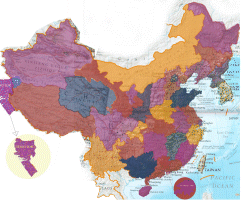
We have for instance, managed for some time to ignore the aboriginal issue. We all know that our laws once assumed that there was no one here when Australia was discovered. China on the other hand could not place such a law into its' own legal system because it is so large and many different cultures make up the nation as a whole. Also China evolved its' political system and views over time just as Rome, England and Spain would have. China is a historians dream come true. However my work here is not to cover volumes of information of the history of China, it is to get a rough picture of who it is today. From an Australian point of view there are still Aboriginal nations that own and run parts of the Chinese country. China too, has its' own idea of borders, country and politics (" we are all part of this country, so let's do it my way" ). I feel that to get a picture of who China is, we need to take a good look at China as a nation and the majority and minority groups that make up that country. Finally we need to see exactly who is standing up and saying "... so lets do it my way." Australian politics has seemingly remained much the same for some time. Chinese politics seems to be undergoing large changes as it becomes industrialized. From an Australian point of view we are seeing a country that is opening its' borders up, Its' people are saying stuff we would have thought they would be forbidden to say. We are also seeing a country that is struggling because of the sudden industrial growth. People are suffering, working in dangerous environments, the divide between rich and poor is growing. These are all signs of a economy that is booming and in rapid growth. New cities and regions in China are playing more important roles in China's economy. While Hong Kong may remain as a sort reference point for tourists or information seekers to start examining China, many other Chinese cities are starting to grow in economic significance that easily rivals Hong Kong ( now called Xianggang ). So it would seem critical that I also talk about what cities are becoming important in China and how things that are familiar to us like Hong Kong may be changing. China also has it share of controversy. We in Australia do not always hear of the constant struggles over border disputes or disagreements of how a region should be run. While I can sit here and type stuff about this here, it should be noted that these disputes are very serious and people are often killed, hurt , demoted, imprisoned and/or suffer economic loss. China's obvious disputes are seemingly along its border regions. Taiwan, Tibet, Aksai Chin, Arunachal Pradesh, Jammu and Kashmir. Thus, to even talk about China can result in controversy. So if I upset a couple of million people by accident, I'll say ahead of time: "Sorry, I didn't mean to do that." I have to limit my coverage of China to the topic I want to discuss here (as mentioned above). Minority Group Names In ChinaThe names chosen for minorities has apparently a long history of contempt that has just recently been relaxed as these minorities are able to choose their own official names. Some might say the list of minority groups I will talk about later on in this article is conservative. Never the less, these people will also give clues to who China is in today's world. How China is divided into smaller partsChina is divided up into provinces, autonomous regions, special municipalities and special administrative regions. Provinces are sort of like states, shires or counties. Autonomous regions were originally designated as such if they had a majority non-Chinese populations. Special administrative regions were established to allow two different systems to run simultaneously. In this case capitalism and communism. Municipalities are directly run by the central government. A civil war in China, caused the loosing side to flee to Taiwan. China considers Taiwan as it's 23 province but Taiwan feels differently and has remained a separatist government. The current statistics given with the maps below are for around the year of 2001. 22 provinces:Five autonomous regions:Four special municipalitiesTwo special administrative regions of china (S.A.R.)The Word "Major Cities"The definition of what is considered a major city in China is still a little mysterious to me. I suspect a major city in China is related to politics rather then population. A major city in China could mean any thing from a influential population area or where important officials live. Having said that, the sheer size of the Chinese population makes even the cities listed as small on the mapping scale, large cities on the scale of the typical Australian city! Since it seems a mapping convention in the west to list cities by the size of their population I will stick to this convention for now. Population of course is a sensitive issue in China as there is laws governing how many children a couple may have. Minority GroupsThe Chinese population is approximately 93% ethnic, or Han, Chinese. The main differences between these people are in linguistic variation. 7% of the Minority population has settled 60% of Chinas area. These non-Han peoples of China have a significance that may not be suggested by their numbers. China serves as a home for 56 official ethnic groups. List of Chinese Ethnic Minority GroupsBased on Census of July 1, 1990.
HanThe Han are largely of Mongolian stock and are differentiated not by ethnic as by linguistic variation. They make up 93% of the population. HuiChinese Muslims Manchu'sDecedents of a group that conquered China in the 17'th centaury and established the Qing, or Manchu dynasty. They are almost indistinguishable from the Han Chinese. MiaoAboriginal UygurTurkic speaking YiAboriginal (but largely assimilated) ZhuangThai-related Things that mystify the western nations...The Fulan Gong, who are they???"Falun Dafa & Falun Gong" China has according to my reference, a long history of religious repression and Fa Lun Gong is another practice that has joined this long list. Falun Gong is taught as a way of life and is based on:
From having listened to discussions of this topic from several sources it would seem that the Chinese government classed Falun Gong as a religion and proceeded to discriminate against the people that practiced it. When the government officials and people that practiced Falun Gong reacted to this discrimination with protests, the government used this as a excuse to openly persecute the people who practiced what they felt was a religion or sect. Because Falun Gong seem to be a way to practice living ones life rather then a religion, the western people find it very hard to understand why china sees the organization as a religion and is willing to persecute the people that are practicing what seems to be very similar to practices like yoga or meditation, practices that are both common and exist peacefully in the west.
References
Please NoteWhile every effort has been made to ensure that all web pages are accurate and as up to date as possible the author can not guarantee that these pages will be accurate or correct. You use the information contained in this web site at your own risk. The author is not writing this on behalf of any interested parties and the views reflected here are a mixture of the authors own views and that of the references that he was able to find on the subject. If any new material comes to notice the author may reflect on the material and change the contents appropriate. This web site may change without notice, usually to add to, or correct information. |
|
|