Supersonic Cruise Missile
The SCM was designed to serve as a replacement for the AGM-84 series (Harpoon and SLAM), AGM-69A SRAM, and possibly (with an increase in length) the AGM-86 ALCM and BGM-109 Tomahawk.
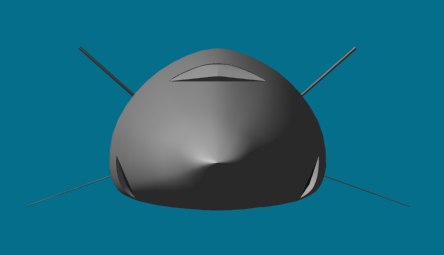
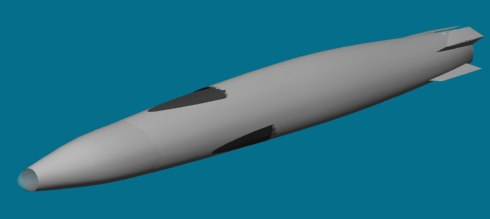
Rounded triangle section and inlets apparent in this view.

The missile itself is designed for launch from an aircraft, ship, or submarine, with a minimum amount of change to the design. The body cross-section is a rounded triangle. Four fins, unequally sized and arranged in an "X" pattern at the aft end provide steering. Three inlets on the "corners" of the triangle feed a ramjet engine. The fins fold to provide greater clearance before launch, and to allow the missile to fit in a 21-inch canister for submarine launch.
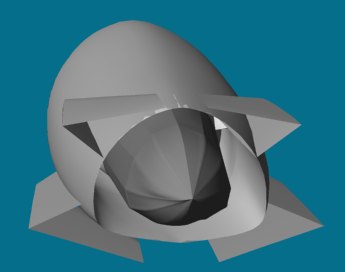
View from rear, showing folding guidance fins.
The missile's guidance system is unique in that it is easily interchanged. The forward part of the missile contains all of the computers, sensors, and electronics to control the missile. There are several advantages to this:
1: Greater commonality/interchangeability between aircraft and ship-launched variants.
2: In case of faliure, the entire nose can be removed and replaced with another package. The faulty component can then be worked on more easily and without holding up operations.
3: Missile guidance systems can be changed quickly, allowing more flexibility in mission planning.
4: Eliminates need for guidance computers to have the characteristics of different nose profiles in memory.
Several seekers can equip the SCM. Among them:
Solid nose:
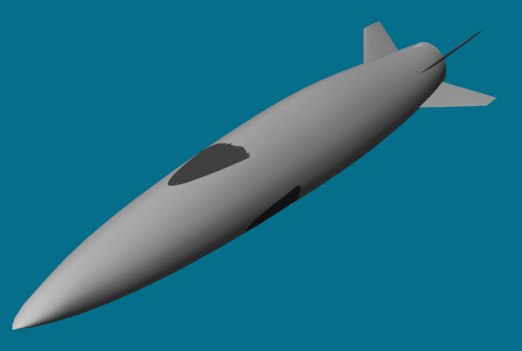
Active radar: Used in antiship roles
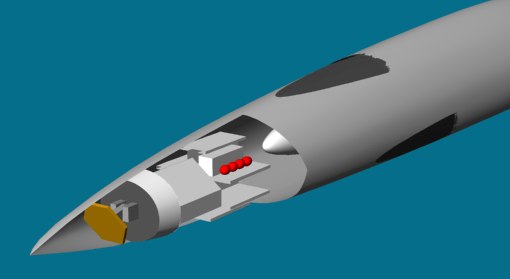
Guidance equipment in the radar version
Passive radar: Standoff strikes against air defenses. If possible, this would be integrated with the active seeker.
Inertial/TERCOM: Similar to Tomahawk guidance; cheaper than other guidance heads.
Glazed nose:
Imaging Infrared (IIR): Copied from SLAM-ER.
Laser homing: Homes in on reflected laser light, like LGB's. Can be used in conjunction with SPECOPS teams for more precise strikes/last minute targeting. Least common.
All models can be equipped with a datalink to allow updates to the course or target, or to allow a man to take over the controls (as in the Walleye or GBU-15, for example). This could also possibly allow the use of the missile as a recon platform or offboard sensor, in a pinch.