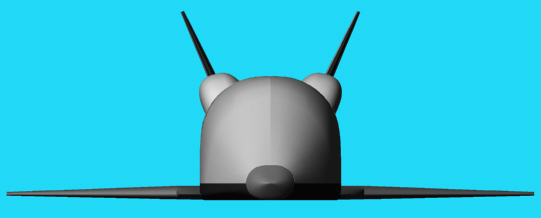
Reuseable Launch Vehicle
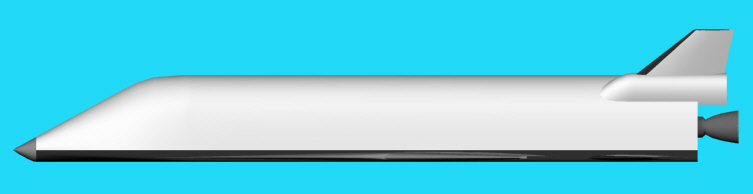
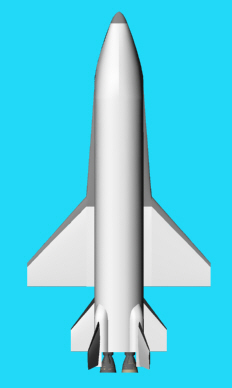
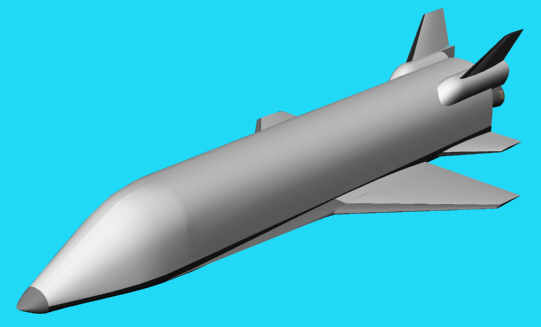
The RLV is designed to be carried under the wing or fuselage of a converted transport or airliner, similar to the Pegasus launch vehicle currently in use and the now cancelled X-34.. For launch, two additional solid rocket boosters are attached under the fuselage. The boosters are of minimal complexity to save weight and money, with only enough equipment to ensure reliability. Unlike the boosters used by the space shuttle, they are jettisoned when spent and allowed to burn up due to their extremely low cost. The spacecraft glides to an airplane-style landing on a runway, and can be flown either by computer or remote control.
The vehicle itself is capable of launching satellites, carrying and maintaining experimental cargoes (such as for plant-growth studies, crystal formation experiments, etc), resupply of space shuttles and stations, and possibly satellite retrieval. In an emergency, a pressurized passenger module could be fitted to allow for the rescue of crewmembers from a stricken spacecraft.
The design itself bears a strong resemblance to the proven STS, as well as to the X-34. However, the RLV has separate horizontal stabilizers, and a different engine configuration. The payload bay, enclosed by 2 doors, is located in the forward fuselage. Heat dissipating material covers the entire ship, resembling that of the space shuttle. Two main (liquid-fueled) engines provide the thrust for ascent, while 2 smaller engines and several thrusters are used for orbital changes and maneuvering.