
The aircraft was designed as an alternative Joint Strike Fighter (JSF) proposal. There are three main variants:
Land-based (A) single seat shown


STOVL (B)

Lift fan closed

Fan open
Carrier-based (C), twin-seat shown

Features:
Stealth technology and design: The aircraft incorporates design features from several aircraft. The forward fuselage and wing planform resembles that of an F-22, while the STOVL lift design and weapons bay location is based on the X-35. The V arrangement of the tail surfaces is from the YF-23, and landing gear from the X-32.
The single-seat land- and carrier-based aircraft are basically identical except for some structural changes and the addition of a larger tailhook and strengthened nosegear. The twin-seat subvariants have a reprofiled forward section, which adds 2 feet to the overall length.
The STOVL variant uses the same nose profile as the twin-seat aircraft, but the aft cockpit is faired over and replaced with a shaft-driven lift fan. The main engine is also able to divert its thrust through another nozzle on the bottom of the aircraft. There is no two-seat STOVL variant, though the lift fan could be removed and additional equipment installed in its place (possibly EW equipment; the fan drive shaft could provide plenty of power).
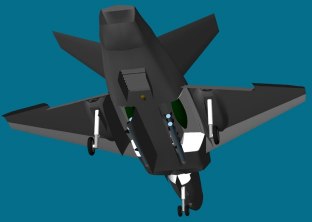
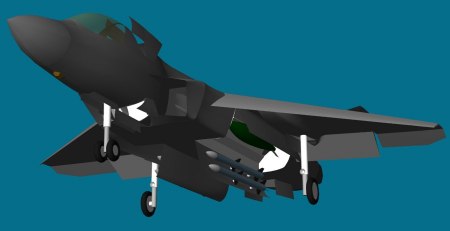
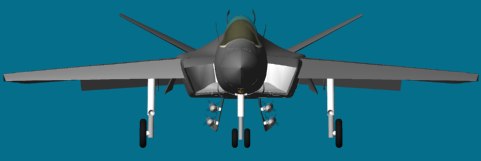
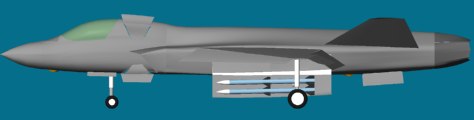
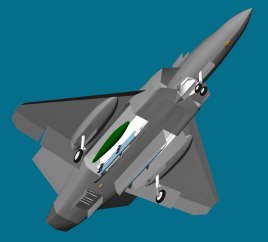
The weapons bays are normally open during VSTOL operations to serve as lift improvement devices (LIDs). Similar to the strakes or gunpods on the Harrier, the doors trap a cushion of air under the fighter when it is close to the ground, improving the effective lift in a low hover. Also demonstrated are the wing control surfaces. The trailing edge flaps also serve as ailerons, with the outboard one being used first, and the inboard boosting the roll as needed. The flaps can also deploy in a "crow" and serve as an airbrake, as shown.

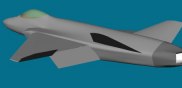
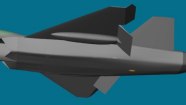
Armament: There is a large weapons bay on each side of the aircraft, on the bottom corner of the fuselage. Each bay is enclosed by two doors. Inside, there is a single attachment point for heavy ordinance, such as bombs, or an AMRAAM. Two missile rails are attached to the bottom door for AMRAAM carriage, and the outboard rail can carry a sidewinder. An additional AMRAAM/Sidewinder rail is attached to the other door, though this rail cannot be fitted when the bay is carrying most A/G stores.. Two different auxiliary fuel tanks can be fitted in the weapons bays, one of which allows the carriage of an AMRAAM on the door rail.
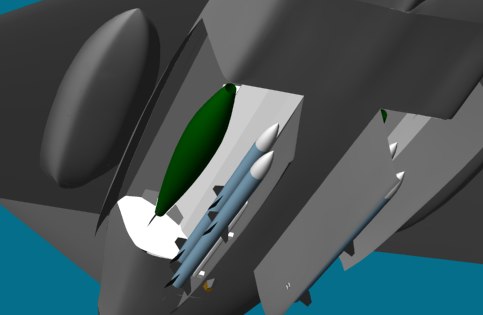
Weapons bay carrying 1 JDAM and 2 AIM-120C. Bulge on bottom of wing is main gear fairing.
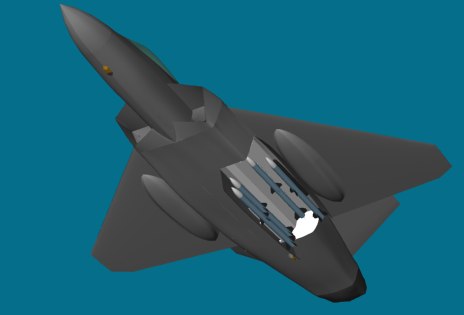
Bay with 4 AIM-120C
Four underwing pylons can be fitted for use when stealth is not required. The pylons can carry almost any weapon in the inventory, as well as fuel tanks on the inboard mounts. The pylons may be jettisoned in-flight to regain stealth. There are also removable wingtip rails capable of carrying AMRAAMs or Sidewinders, though these are not jettisonable and therefore can only be removed on the ground.
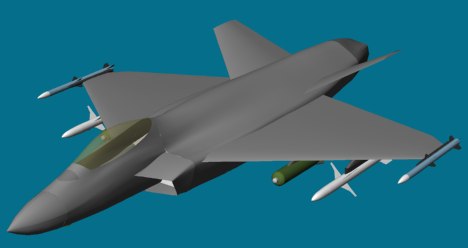
External weapons fit of 2 CBU-87, 2 AGM-88, and 2 AIM-120C.
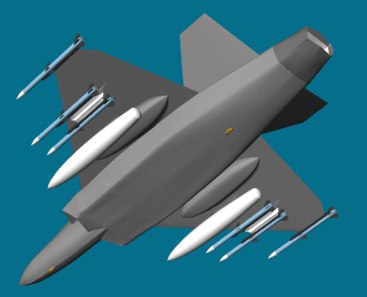
Another view, showing a full air to air loadout.. The sensor gondolas are clearly visible as small orange domes.
Sensors/avionics: The fire control radar uses an active electronically-scanned array (AESA) design on a backwards-sloped array. A large, long-ranged IRST turret is mounted beneath a window just forward of the cockpit. It combines the functions of IRST and laser rangefinding (similar to the equipment on the MiG-29 and Su-27), long-range target identification (TCS on the F-14), and when not used in those roles, as a FLIR sensor for night navigation. Sensor gondolas under the nose and tail contain laser-designator systems. All sensor data (including passive electronic sensors like RWR) is fully fused and can be combined on a tactical display for the pilot.
Propulsion: A slightly modified F-119 engine (the same engine used on the F-22) powers the aircraft. It exhausts through a thrust-vectoring nozzle at the back of the aircraft. The nozzle vectors the thrust using guide vanes instead of conventional "turkey feathers."
Cockpit: Tentative cockpit design, to be finalized later, incorporates a wide-field heads-up display, at least five color MFD's, and a sidesitck controller. The pilot would be seated on a reclined ejection seat as in the F-16, and enclosed by a one-piece canopy.
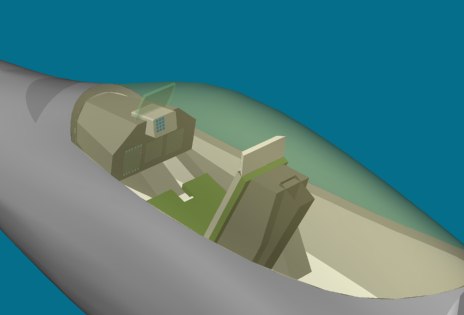
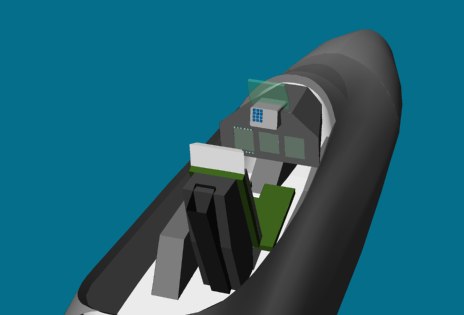
Two views of the cockpit, still in early design.

AJSF dropping flares during an exercise.