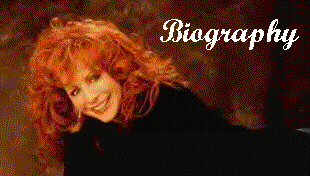
Reba Nell McEntire was born on March 28th, 1955 in McAlester, Oklahoma. She
was the third of four children born to Jacqueline and Clark Vincent
McEntire. Reba's older-sister is Alice Lynn Foran and her only brother, who
is also older, is Del Stanley McEntire (aka Pake). Her younger sister is
Martha Susan Luchsinger (aka Susie).
Born into a life of cattle ranching and rodeo, the McEntire children learned
early on, how demanding such a lifestyle could be. They would be up on
horses before daylight and until after dark gathering cattle with their
father. Reba was six when she first began gathering cattle, and she would
continue to help her father through high school and into her college years.
Rodeo was also in the blood of the McEntire family. Reba's father and his
father were well known in the rodeo world. Her father is a former three-time
world champion tie-down steer roper and her grandfather made a name for
himself in a touring Wild West Show. Following in the McEntire tradition,
Reba started competing in the Rodeo (as a barrel racer) at the age of
eleven. She would continue to compete in the rodeo until she was twenty-one.
Reba and her siblings were exposed to singing at a very young age also.
Their mother, Jacqueline, was a wonderful singer when she was young and had
never been given much encouragement to pursue her dream. She enjoyed singing
and would use the singing for fun while playing with the kids. She would
also have the children sing on the rodeo road trips to keep them occupied.
Reba's mother had instilled in her children an interest in music and singing
that would follow them into adulthood. Reba's brother and sisters have all
sung as adults at various functions and events. In the first grade, Reba got
her first chance at the entertainment business (first time to sing behind a
microphone). She sang Away in a Manger at a school Christmas program. The
basic singing skills that she had learned from her mother helped her land
many singing parts in the school plays and programs. It was in the fifth
grade when Reba was really bitten by the show biz bug. She won a talent
contest for her division, and then knew that she wanted to be an
entertainer.
Pake, Susie, and Reba were singing more and more together as Reba reached
junior high school. Pake and Reba played and sang together in the newly
formed Kiowa High School Cowboy Band, and Susie was to join them later when
she reached junior high school. This band played at the school lunch breaks,
at the school football games, and occasionally at a few honky tonks and
dance halls. The band broke up just after Pake finished high school. Some of
Reba's first formal music training came while she attended Kiowa High
School. She was taught by Clark Ryhne, an old family friend who was a
teacher at the school, and a professional musician.
Reba finished high school, and then attended college in Durant, at
Southeastern Oklahoma State University. Her major was in elementary
education and her minor was in music. She did receive her bachelor's degree,
but she has never taught school. While in college, Reba's duties as a
rancher never ceased. She still helped her father with 200-300 steers on
some land that he had leased near the college. She was closer to the ranch
than the others and so she agreed to do it for her father. Reba also
continued to sing and ride in the rodeos while attending SOSU. She became a
member of the Chorvettes, a singing and dancing group that performed on
campus and in neighboring towns.
Although Reba's father did not want any of his kids to rodeo, it was the
rodeo and her family's acquaintances within the rodeo world that would
ultimately give Reba her first big break. Reba was in her sophomore year at
SOSU and had intended to go to the 1974 National Finals Rodeo in Oklahoma
City. Her father had suggested for her to get a job at the finals as a
singer of the National Anthem. Reba contacted Clem McSpadden, a rodeo
announcer her family had known for years, and with his help she was hired to
sing. During National Finals Rodeo Week, Reba was introduced to Red
Steagall. He was a longtime favorite on the rodeo circuit and he also
recorded several top ten songs. Reba would not see Red until later in the
week, and this time, her mother, her father, and her brother would attend a
party at the motel where the rodeo contestants were staying. Several of the
people at the party were singing and passing the guitar around for others to
sing. Reba was finally asked to sing and she sang a song a cappella. Red
Steagall was rather impressed. Later that evening, Reba's mother asked Red
if he could help get a recording contract for the singing McEntires (Pake,
Susie, and Reba), and told her he did not think there was a place for a trio
in country music.
In January of 1975, Red called the McEntires and told Reba's mother he
couldn't take all three, but he could take Reba. Red was asking Reba to come
to Nashville to record a demonstration tape. Through a little prodding from
her mother, Reba and her mother traveled to Nashville to record the
demonstration tape. Reba and her mother returned home while Red approached
many of the country music executives and presidents in an attempt to get
Reba a contract. The country music establishment of the 1970s was the same
as it had always been. It was totally dominated by male singing acts because
the female performers did not sell as well. Red was told on numerous
occasions by the executives, "We do not need another woman singer". Red
still persisted and finally landed Reba a contract with Phonogram-Mercury on
November 11, 1975.
It was, also, through the rodeo that Reba would meet the man that would
eventually become her first husband. His name was Charlie Battles, a world
champion steer wrestler in the International Rodeo Association in
1970,1971,and 1972. She had seen him around the rodeos and was, somewhat,
impressed with the stature he held amongst the cowboys and cowgirls on the
circuit. Reba knew Charlie was married and had two children so she never
really considered that Charlie could ever have a romantic interest in her.
Charlie would eventually divorce and it would be a while before he and Reba
would get together. They saw each other for a little over a year before they
would wed. They married on June 21st, 1976. Charlie and Reba did not have
much, but it seemed to be enough. They would maintain a small amount of
cattle, while Charlie-pursued his rodeo career and Reba her singing.
Reba's singing career developed rather slowly in the early years, but
Mercury never gave up on her nor did she give up on herself. She would stay
with Mercury for eight years, recording 70 songs, and six albums. She had
two # 1 hits with Mercury, and her first # 1 hit was Can't Even Get The
Blues. She also made her first appearance on the Grand Old Opry while under
the Mercury label. Her first appearance was on September 17th, 1977. During
Reba's final years with Mercury (early 1980s), she began to realize that she
needed to get a little more serious about her career. She decided to be more
selective as to where she and her band would entertain. She also wanted to
have a higher degree of professionalism in every aspect of her show and
crew. Along with that, she decided to get herself an agent. Shortly
thereafter, she signed with William Morris. Reba was not a big seller with
Mercury, but she also felt that Mercury had not pushed her music hard
enough. She decided to go with what she felt in her heart and chose to go
with another label. It wasn't long before she had signed a contract with
MCA. She made several other changes in the early years with MCA and they
also appeared to pay off. She chose to sing a clear, pure, old-fashioned,
and sentimental, style of country music vice the newer style of crossover
music that most the artists were pursuing. Upon a suggestion from Jimmy
Bowen, president of MCA's Nashville division, Reba would also choose all the
songs that she really wanted to sing, instead of having someone else pick
songs that Reba had no interest in.
On her second album with MCA, Reba had two #1 hits. The album, My Kind of
Country (1984) would forever change her billing status. She now made more
money on her shows and would also serve as the opening act for some of the
well-known male stars. It really gave her more exposure. Later that year,
Reba won the CMA Female Vocalist of the Year award. She would follow that
with three more consecutive CMA Female Vocalist of the Year Awards for the
years 1985, 1986, and 1987. The CMA also awarded her the Entertainer of the
Year award in 1986.
As Reba's career blossomed, Reba and Charlie appeared to be drifting farther
and farther apart. Even though Reba had attempted to allow Charlie to assist
in her career, nothing seemed to be going right for them. They were having
some difficulties in, both, their personal and professional lives. Their
differences had no solutions, and they opted for divorce. The judge granted
the divorce in November 1987, and he awarded Charlie a sizeable settlement.
They had been married for eleven years.
Just after Reba's divorce, she chose to make another important career
decision. She would move to Nashville. Upon moving to Nashville, she opted
for a change in managers. Bill Carter, her manager of four years, left the
team, and Reba asked Narvel Blackstock to become her manager. Earlier in
Reba's career (11980) she had hired Narvel as a steel guitar player for her
band. He had been an insurance agent and played music on the side. He had
now been with Reba for eight years and was her present road manager. Reba
had grown to respect Narvels innovative ways and particularly his drive to
always do better. He also had good instincts and was attentive to
everything. Narvel accepted the job and became the manager in May of 1988.
When Narvel started working for Reba in 1980, he had been a married man with
three children. He also had some difficulties in his marriage over the
years, and divorced in October of 1987.
Reba had a lot of respect and admiration for Narvel and many of their
thoughts and ideas seemed to be in sync. That closeness would grow and they
would eventually become romantically involved in 1988 and marry on June 3,
1989. Reba and Charlie never had any children of their own and at this point
in Reba's life, she really had the urge to have a child. Narvel and Reba
decided to have a child and Reba gave birth to her first and only child on
February 23, 1990. She had a boy and named him Shelby Steven McEntire
Blackstock. It was the most fulfilling experience of her life.
Through all of Reba's trials and tribulations, few things could have
prepared her for the event that was to occur on March 16, 1991. Seven of
Reba's band members and her tour manager died in a fatal plane crash on a
flight from San Diego, California to Fort Wayne, Indiana. The plane left at
1:41 a.m. and crashed at 1:44 a.m. The NTSB report states that the plane
clipped a part of a mountain (Otay Mountain) and began to cartwheel before
exploding on impact with the second contact point. It appears that some
miscommunication may have been partly to blame. The grief would be
unimaginable for those involved, and Reba and Narvel decided to organize a
memorial service for her band and tour manager. Families and friends of the
victims would attend, and some of Reba's closer country music friends would
help at the memorial services. It was a terrible tragedy and one of worst
private aviation disasters in the history of San Diego County.
As much pain as Reba was going through, she still had a tough decision to
make in the days immediately following the accident. She was to sing at the
Academy Awards nine days after the crash. Her first response was to cancel
everything for several months, but after carefully reconsidering all of her
responsibilities as an employer, she knew she needed to resume her career
fairly soon. Reba really felt her band would have wanted her to sing at the
Academy Awards, and she also felt the need to start her healing process.
Reba had always found solace in God and her music and she new it was right
to sing at the Academy Awards. Shortly after, Reba assembled a new band and
went back on the road. She took some criticism for the career decision, but
she felt she had obligations to all of her employees, and to herself, to
continue.
As busy, hard working, and successful as Reba is, she still has a crystal
clear image of what it is that makes her happy. She understands how fragile
life can be and values her time with her family and friends. She also
realizes that the money and success that she achieves from her singing
career simply makes it a little easier to enjoy her family and friends. This
very proud mother recognizes that personal happiness is the most important
thing of all, and she gets her greatest source of happiness from her family.
November 1999 will mark Reba's 24th year in the country music industry. She
still tours today and is considered one of the top entertainers within the
industry. This year, her tour has evolved into a Broadway style biography of
her life. The performance, titled The Singer's Diary, is slated to continue
throughout the year 2000 and features music and skits that that serve as a
condensed history of this mega-star's hugely successful career. She
continues to be one of the top selling female artists and has sold over 40
million albums throughout her career, written two bestsellers, and scored 30
number one hits. Reba has made 25 albums to date and her 26th (So Good
Together) was released on November 23rd of 1999. She recently
released her
second Christmas album entitled the Secret of Giving, which is the title cut
from a holiday movie starring Reba which aired on Thanksgiving
night 1999. Reba has had a few solid roles as an actress in the movie industry
(the movies Tremors and North), and has done several made for television
films, including Forever Love and Is There Life Out There. She also has a
music company with Starstruck Entertainment and is renowned for her business
prowess. Although it has taken 24 years to reach this pinnacle in her life,
none of this may have been achieved had Reba not had some talent, a good
work ethic (learned from her mother and father), faith in God, and an ever
increasing belief in herself.