|
Back to Articles
or Racing
World
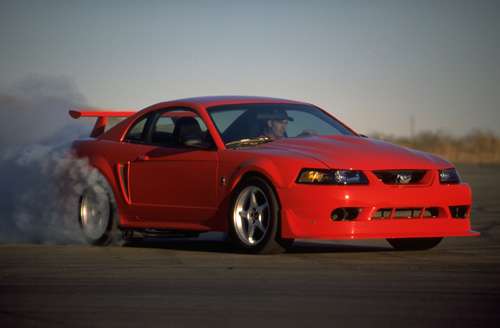
The Ford Special Vehicle Team�s 2000 SVT Mustang Cobra R is
the pony car icon taken to the extreme of pure performance.
Developed specifically for racing, 300 of these vehicles will be
built at Ford�s Dearborn Assembly Plant in March, 2000, and
shipped to selected SVT certified dealers.
�This
is the fastest, the best-handling Mustang ever. It will set a
performance benchmark for the competition,� says John Coletti,
Ford Special Vehicle Engineering manager. Cobra R combines
high-performance hardware and engineering that go a long way
toward making it the best of the breed.�
Tom
Scarpello, specialty vehicle marketing manager at Ford, says the
2000 Cobra R is both a race car and a modern icon. �Three
hundred people will be able to have a lot of fun in this car,
and be very competitive racing it,� Scarpello says.
�That�s what Mustang, and Cobra R in particular, is all
about. This car elevates the whole idea of Mustang without
changing what it�s been for more than 35 years.�
Cobra
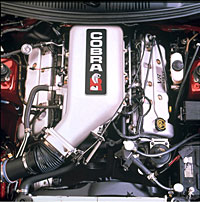
R equipment includes a 385-horsepower (estimated) 5.4-liter
4-valve DOHC V8 engine from Ford�s modular family, a McLeod
aluminum flywheel, a Tremec six-speed manual transmission, 18 x
9.5-inch wheels and tires, Brembo 4-piston aluminum front brake
calipers, Eibach racing springs, and a 21-gallon Fuel Safe fuel
cell. A rear wing and front splitter provide high-speed
aerodynamic stability. The car�s top speed is more than 170
mph.
With
lateral acceleration higher than 1.Og on the 100-foot skidpad,
Cobra R sets a new benchmark for road-holding in its class.
�Everything we�ve done on this car is a notch, or several
notches, above anything we�ve done before,� Coletti says.
�This 2000 Cobra R pushes the performance envelope far beyond
the capabilities of any previous Mustang.� Engine and
Drivetrain Producing 385 bhp and 385 lb.-ft. of torque, the
Cobra R�s engine shows the performance capabilities of
Ford�s overhead-cam modular family, says Coletti.
�One
of our goals is to make the Eord modular engine family the
performance benchmark of the industry. This application
demonstrates its real potential. This engine is street-legal,
EPA certified, and very driveable for its high power output.�
For
the Cobra R, SVE developed high-flow aluminum cylinder heads,
with dual overhead camshafts and four valves per cylinder. At
the bottom, a Canton Racing Products oil pan provides extra oil
capacity, reduced windage losses and improved oil control under
racing conditions. To cool the synthetic oil used in the Cobra
R�s engine, an air-to-oil cooler system is mounted behind the
front fascia. The exhaust system consists of short-tube headers
leading into a Bassani X-pipe system with catalytic converters,
which was chosen to achieve emissions compliance and improved
sound quality.
Borla
produces the Cobra R�s unique mufflers and side-exit pipes.
The side-exit routing is used to provide more clearance at the
rear for the 20-gallon fuel cell. To handle the engine�s
power, it was necessary to upgrade several components in the
drivetrain that were designed for the standard Cobra�s 320
horsepower and 317 lb.-ft. torque output.
The engine is mated to
a Tremec T-56 six-speed manual transmission, the first time any
Mustang has been equipped with a six-speed gearbox. The
transmission provides closer ratios for racing, as well as the
robustness necessary for the engine�s torque. It is fitted
with a special mounting bracket and reinforcement system for
extra strength and stiffness.
The
clutch is the 11-inch single plate unit used in the Cobra, which
in durability testing proved capable of handling the horsepower
and torque of the Cobra R engine. Visteon supplies the Cobra
R�s hydro-mechanical differential with speed and torque
sensitivity. For racing demands, it provides predictable
performance and greatly improved torque transfer capability.
Speed sensitivity is achieved with a gerotor pump, which is
activated when the half shafts rotate at different speeds.
When
this happens, the pump applies hydraulic pressure through a
piston to compress the clutch pack, transferring torque to the
other wheel. The differentials torque sensitivity provides
immediate torque transfer, which is very helpful in maintaining
grip during straight-line acceleration. When one wheel spins
relative to the other, the differential�s beveled helical
gears produce an axial force that tries to separate them and,
like the gerotor pump�s action, compresses the clutch pack to
transfer torque. The final drive ratio is 3.55:1, compared with
the Cobra�s 3.27:1. The rear axle half-shafts are unique to
Cobra R. These are induction-hardened GKN units with the
strength to perform reliably under the 5.4-liter engine�s
higher torque loads. Shaft diameter is unchanged from the Cobra,
but the inner splines have 31 teeth instead of 28, the inner
tulips are a tripod design, and the right-side shaft is shorter
to accommodate the larger differential.
The splitter itself
virtually eliminates front-end lift above 100 mph. The
splitter/wing combination dramatically increases the car�s
aerodynamic stability, and the effects are especially noticeable
approaching the car�s top speed of more than 170 mph. The
�power dome� hood, also unique to the Cobra R, provides the
extra clearance necessary for the engine�s intake
|
ENGINE
|
| Configuration: |
Longitudinally
mounted, 90-degree V8: cast-iron block: aluminum heads:
forged steel crankshaft: billet steel connecting rods:
forged aluminum pistons; McLeod aluminum flywheel |
| Bore
x Stroke: |
90.2mm
x 105.8mm |
| Displacement: |
5,409cc
I 330cid |
| Compression
ratio: |
9.60:1 |
| Horsepower: |
385
bhp @ 5700 rpm (estimated) |
| Torque: |
385
lb-ft. @ 4500 rpm |
| Redline: |
6500
rpm (6.800 rpm fuel shut-off: 7000 rpm ignition cut-off) |
| Valvetrain: |
Double
overhead camshafts: chain drive to exhaust cams, secondary
chains from exhaust to intake cams: roller finger
followers with hydraulic lash adjustment: ovate-wire,
beehive-shaped valve springs: four valves per cylinder |
| Intake
valves: |
2
per cylinder, 37mm head diameter |
| Exhaust
valves: |
2
per cylinder, 32mm head diameter |
| Ignition
system: |
Distributorless
coil-on-plug |
| Fuel
system: |
Sequential
electronic fuel injection |
| Intake
manifold: |
Cast
aluminum, tuned equal-length runners |
| Throttle
body: |
Single
oval bore |
| Mass-air
sensor: |
80mm |
| Air
filter: |
K&N
cylindrical |
| Exhaust
manifolds: |
Stainless
steel short-tube headers |
| Exhaust
system: |
Bassani
X-pipe: production 98 Cobra catalysts: Borla mufflers and
side-exit exhausts |
|
DRIVETRAIN
|
| Clutch: |
11.0
in. single-plate |
| Transmission: |
Tremec
T56 6-speed manual |
|
|
| Gear: |
Ratio |
|
1st
|
2.97
at 47mph at redline |
|
2nd
|
2.07
at 68mph at redline |
|
3rd
|
1.43
at 98mph at redline |
|
4th
|
1.00
at 141mph at redline |
|
5th
|
0.80
at 170+mph at redline |
|
6th
|
0.62
at 160+mph at redline |
| Reverse |
3.28 |
| Driveshaft: |
4-inch
aluminum |
| Rear
axle: |
8.8
in. ring gear with 3.55:1 Gerodisc TM hydro-mechanical
differential with speed and torque sensitivity; aluminum
case: high durometer front differential bushings |
| Halfshafts: |
GKN
with 31-tooth splines, induction hardened |
| |
|
|
SUSPENSION
|
| Front: |
Modified
MacPherson strut with gas- charged, monotube Bilstein
shock: separate 800 lb./in. Eibach spring on lower arm:
28mm tubular stabilizer bar |
| Rear |
Dual
A-arm independent with high durometer bushings: steel
upper control arm, aluminum lower control arm: fixed
toe-control tie rod: aluminum spindle: gas-charged
Bilstein twin-tube shock absorber: 750 lb/in Eibach coil
spring: 26mm tubular stabilizer bar |
Top
of page...
|
