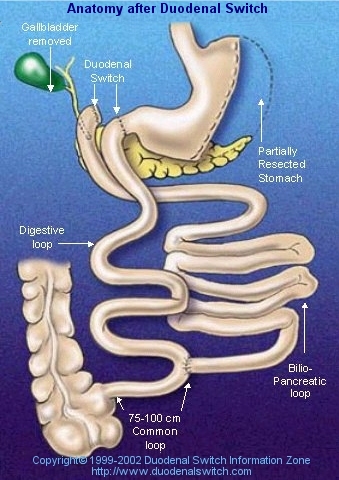
Unlike the unmodified BPD and RNY, which both employ a gastric �pouch� and bypass the pyloric valve, the DS procedure keeps the pyloric valve intact. This eliminates the possibility of dumping syndrome, marginal ulcers, stoma closures and blockages, all of which can occur after other gastric bypass procedures.
In addition, unlike the unmodified BPD and RNY procedures, the DS procedure keeps a portion of the duodenum in the food stream. The preservation of the pylorus/duodenum pathway means that food is digested normally (to an optimally absorbable consistency) in the stomach before being excreted by the pylorus into the small intestine. As a result, the DS procedure enables more-normal absorption of many nutrients (including protein, calcium, iron and vitamin B12) than is seen after other gastric bypass procedures. |