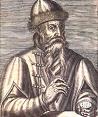
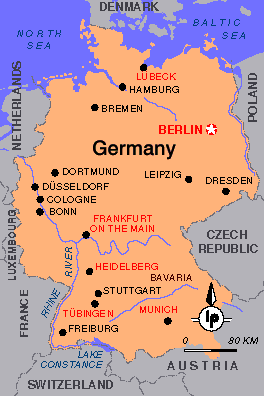
Johann Gutenberg was born in 1398 in Mainz, Germany to parents, Friele Zum Gensfleisch, father, and mother, Elsgen Wyrich. When Gutenberg's father was growing up books were hand written, they were also known as manuscripts. While Johann was growing up a much better way of producing books was founded called block-printing.
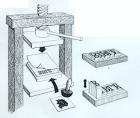
The process of making a book by block-printing is where the printer had to cut a block of hard wood the size of the page that he was going to print. Then he cut out everyword of the written page on the face of the block. when the page was finished the printer had to touch up the page and cut away all the wood from the sides of the letters. Next the letters were inked and paper was lain across them and pressed down. Although this seemed as a faster and easier way to copy books then it would be to hand copy them, the blocks to a long time to make and only printed one page. Gutenberg always felt sorry that only rich people could own books, and being that Johann's family was quit wealthy, Johann was always reading books and had easy access to manuscripts. Inventing an easy way of producing books became a priority to him.
He did most of his work in secret because he assumed it was a better idea for people not to know what he was working on. Gutenberg lived in Strasburg at the time and was searching for an old workshop where he was not likely to be found. Soon he came across a forgotten old building which used to be inhabited by monks. After performing an uncountable number of experiments Gutenberg felt reluctantly discouraged an was also out of money. Gutenberg then moved back to his old home in Mainz. While there he met the rich lawyer named Joahann Fust. Gutenberg then expressed to him how he had tried to find a way of making books cheaper but was out of money due to the number of his previous experiments. After Gutenberg presented this information to Fust, Fust became very intrested and gave Gutenberg the money to continue his experiments.
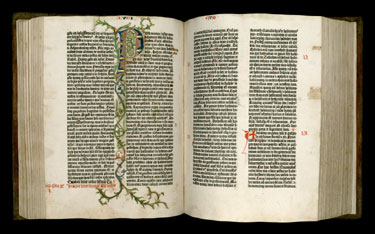
After months of trying to make wooden letters moveable he tried metal which seemed to work very well. Soon the first book ever printed by movable type was to be accomplished; the Bible in Latin. Soon Fust became annoyed at how long the process was taking and took Gutenberg to court. The judge ruled in Fust's favor and all Johann's tools and ideas were now in Fust's posession. Later the Latin Bibile was publuished. It was printed in two volumes each having 300 pages and 42 lines per page. Once people hears books were being printed my movable type the news spread all over Europe and soon the world! 200 copies of the Bible were to be printed on paper and 30 on velum animal skin. No one really knows how many copies were really printed. Yoday only 22 copies are known to exist, 7 of which are on velum.
Johann Gutenberg died in Mainz, Germany in 1468. He was buried in a Franciscan church was demolished then replaced and the demolished again. Gutenberg, whose printing press changed the world and made it possible for every one to own books, never profited from his invention and died a poor man. Gutenbergs invention of the printing press was an amazing event in history and without his brillance the Protestant Reformation would not have been possible. -Rachael Bramel |