Education Benazir attended the Lady Jennings Nursery School and then the Convent of Jesus and Mary in
Karachi and later the Rawalpindi Presentation Convent. Her education continued when she was sent to
the Jesus and Mary Convent at Murree where she passed her O-Level examinations at the age of fifteen
and her A-Levels were then taken at the Karachi Grammar School.
 At the Age of 16 Benazir�s higher education saw her moving to the United States of America to the
Radcliffe College and ultimately at Harvard University where she earned a Bachelor of Arts degree
cum laude in comparative government between 1969and 1973. Bhutto would later call her time at Harvard
"four of the happiest years of my life"and said it formed "the very basis of her belief in democracy".
As Prime Minister, she arranged a gift from the Pakistani government to Harvard Law School.
At the Age of 16 Benazir�s higher education saw her moving to the United States of America to the
Radcliffe College and ultimately at Harvard University where she earned a Bachelor of Arts degree
cum laude in comparative government between 1969and 1973. Bhutto would later call her time at Harvard
"four of the happiest years of my life"and said it formed "the very basis of her belief in democracy".
As Prime Minister, she arranged a gift from the Pakistani government to Harvard Law School.
In June 1972 summer before her senior year of college with her father,president Zulfikar Ali Bhutto of
Pakistan, she went in India. Zulfikar Ali Bhutto and India's Prime Minister Indira Gandhi sign Shimla
agreement which adjusts cease-fire line between the two countries and creates new Line of Control.
The next phase of her education took place in the United Kingdom. Between 1973 and
1977 Bhutto studied Philosophy, Politics, and Economics at Lady Margaret Hall, Oxford.
She completed a course in International Law and Diplomacy while at Oxford. In the
meantime in Pakistan New constitution goes into effect; Zulfikar Ali Bhutto becomes
prime minister.
In December 1976 she was elected president of the Oxford Union, becoming the first Asian woman to head
the prestigious debating society.
In 1977 she returned to Pakistan at the age of 24 where her father, Zulfikar Ali Bhutto,
had been elected prime minister, but days after her arrival, the military seized power and
her father was imprisoned. General Mohammad Zia ul-Haq proclaims martial law.
In 1978 she wrote the book"Foreign Policy in Perspective". Zia becomes Pakistan's sixth
president.
n April 4,1979 Zulfikar AliBhutto was hanged by the military government of General Zia Ul Haq
in the Rawalpindi District jail,where he had been confined since his conviction in 1978 on
charges of conspiring to murder a political opponent fouryears earlier. She said her father�s
death vigil prepared her for her political career.Bhutto herself was also arrested many
times over the following years, and was detained for three years.
Ms Bhutto was eager to avenge her father�s death and people who knew the family predicted
that she wants nothing less than to be Prime Minister, no small feat in a male-dominated Islamic country.
In March 8, 1981 Ms. Bhutto and her mother were arrested in a roundup of political
dissidents after government opponents linked to her brothers hijack a Pakistani
airliner.Ms. Bhutto spended the summer in confinement , then is transferred to house
arrest before finally leaving the country in exile in 1984.
In1983 Zia announces that martial law will be lifted, says army will retain key role
in future governments and In1984 Finally she allowed to leave country. she
suffered long periods in detention, during which her health deteriorated. Benazir
provided a detailed account of this traumatic period in her acclaimed autobiography
Daughter of the East (1988).
In August 29,1985 Ms. Bhutto was placed house arrest, eight days after returning
to Pakistan from self �imposed exile. she had returned to try to assume leadership of
her father�s party, and to mark the death of her younger brother. she returned to
Pakistan for his burial, and was again arrested for participating in anti-government
rallies. She returned to London after her release, and martial law was lifted in
Pakistan at the end of the year.
InApril 10, 1986 Ms. Bhutto returned to Pakistan from London to take the reins of
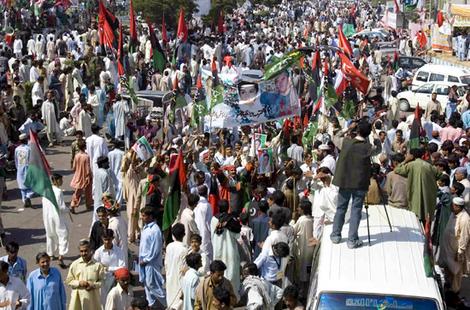
the party her father had founded . Tens of thousands of supporters lined the streets
chanting, �Welcome daughter of Pakistan� and �Benazir brings the revolution�. The
public response to her return was tumultuous, and she publicly called for the
resignation of Zia Ul Haq, whose government had executed her father. She was
elected co-chairwoman of the Pakistan People's Party (PPP) along with her mother.