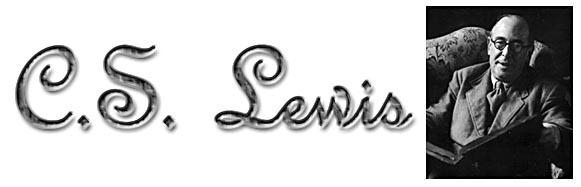
(1898-1963), British novelist

"Good and evil both increase at compound interest."
"The safest road to hell is the gradual one - the gentle slope, soft underfoot, without sudden turnings, without milestones, without signposts."
"Let him begin by treating the Patriotism or the Pacifism as a part of his religion. Then let him, under the influence or partisan spirit, come to regard it as the most important part. Then quietly and gradually nurse him on to the stage at which the religion becomes merely part of the "Cause", in which Christianity is valued chiefly because of the excellent arguments it can produce in favor of the British war effort or of pacifism. The attitude which you want to guard against is that in which temporal affairs are treated primarily as material for obedience. Once you have made the World an end, and faith a means, you have almost won your man, and it makes very little difference what kind of worldly end he is pursuing. Provided that meetings, pamphlets, policies, movements, causes, and crusades, matter more to him than prayers and sacraments and charity, he is ours - and the more "religious" (on those terms), the more securely ours. I could show you a pretty cageful down here."
The Screwtape Letters
"If individuals live only 70 years, then a state, or a nation, or a civilisation, which may last for a thousand years is more important than an individual. But if Christianity is true, then the individual is not only more important but incomparably more important, for he is everlasting and the life of a state or a civilisation, compared with his, is only a moment."
Mere Christianity
"One of the reasons why it needs no special education to be a Christian is that Christianity is an education itself. That is why an uneducated believer like Bunyan was able to write a book that has astonished the whole world."
Mere Christianity
"I have never concealed the fact that I regarded (George MacDonald) as my master; indeed I fancy I have never written a book in which I did not quote from him."
"A young man who wishes to remain a sound atheist cannot be too careful of his reading."
"An explanation of cause is not a justification by reason."
"Can a mortal ask questions which God finds unanswerable? Quite easily, I should think. All nonsense questions are unanswerable."
"There was a man born among these Jews who claimed to be, or to be the son of, or to be "one with,"
the Something which is at once the awful haunter of nature and the giver of the moral law...Either
he was a raving lunatic of an unusually abominable type, or else He was, and is, precisely what He
said. There is no middle way."

"The Problem of Pain" p. 23

"What about Mark 2:18-19. (Jesus had said, "No one need fast while I am here.") What man can
announce that simply because he is present, acts of penitence such as fasting, are "off." Who can
give the school a half-holiday except the Headmaster? The doctrine of Christ's divinity seems to me
not something stuck on which you can unstick but something that peeps out at every point so that
you'd have to unravel the whole web to get rid of it."

Case for the Christian Faith, by Richard L. Purtill, p.48
"There is a difficulty about disagreeing with God. He is the source from which all your reasoning
power comes: you could not be right and He wrong any more than a stream can rise higher than its
own source... you are arguing against the very power that makes you able to argue at all."

"God, who foresaw your tribulation, has specially armed you to go through it, not without pain but
without stain."

in Letters of C.S. Lewis

"The Son of God became man to enable men to become the sons of God."

"The human mind has no more power of inventing a new value than of imagining a new primary color,
or, indeed, of creating a new sun and a new sky for it to move in."

"The Abolition of Man"

"If you think of this world as a place intended simply for our happiness, you find it quite
intolerable: think of it as a place of training and correction and it's not so bad."

"In Scripture the visitation of an angel is always alarming. It has to begin by saying, "Fear not."
The Victorian angel looks as if it were going to say, "There, There."

"The Screwtape Letters"

"I have been suspected of being what is called a Fundamentalist. That is because I never regard any
narrative as unhistorical simply on the ground that it includes the miraculous."

"Doctrines are not God: they are only a kind of map. But the map is based on the experience of
hundreds of people who really were in touch with God--experiences compared with which any thrills
or pious feelings you or I are likely to get on our own way are very elementary and very confused.
And secondly, if you want to get any further, you must use the map... [This] is just why a vague
religion--all about feeling God in nature, and so on--is so attractive. It is all thrills and no
work; like watching the waves from the beach. But you will not get to Newfoundland by studying the
Atlantic that way, and you will not get eternal life by simply feeling the presence of God in
flowers or music. Neither will you get anywhere by looking at maps without going to sea. Nor will
you be very safe if you go to sea without a map."

"Mere Christianity"

"If you do not listen to Theology, that will not mean that you have no ideas about God. It will
mean that you have a lot of wrong ones--bad, muddled, out-of-date ideas. For a great many of the
ideas about God which are trotted out as novelties today, are simply the ones which real
Theologians tried centuries ago and rejected. To believe in the popular religion of modern England
is retrogression--like believing the earth is flat."

"Mere Christianity"

[Screwtape the Demon]: "If a man can't be cured of churchgoing, the next best thing is to send him
all over the neighborhood looking for the church that "suits" him until he becomes a taster or
connoisseur of churches. The reasons are obvious. In the first place the parochial organisation
should always be attacked, because, being a unity of place and not of likings, it brings people of
different classes and psychology together in the kind of unity the Enemy desires. The congregational
principle, on the other hand, makes each church into a kind of club, and finally, if all goes well,
into a coterie or faction. In the second place, the search for a "suitable" church makes the man a
critic where the Enemy wants him to be a pupil."

(The Screwtape Letters, New York: Macmillan, 1942, XVI, 72-73)

"What seem our worst prayers may really be, in God's eyes, our best. Those, I mean, which are least
supported by devotional feeling. For these may come from a deeper level than feeling. God sometimes
seems to speak to us most intimately when he catches us, as it were, off our guard."

"The Christian story is precisely the story of one grand miracle, the Christian assertion that what
is beyond all space and time, what is uncreated, eternal, came into nature, into human nature,
descended into His own universe, and rose again, bringing nature up to Him. It is preceisely one
great miracle. If you take that away there is nothing specifically Christian left."

"God In the Dock," (The Grand Miracle)

"Our leisure, even our play, is a matter of serious concern. There is no neutral ground in the
universe: every square inch, every split second, is claimed by God and counterclaimed by Satan."

Christian Reflections, edited by Walter Hooper, Grand Rapids, MI: Eerdmans, 1967 [1940], 33)

"I am crushingly aware how inadequate most of us are, in our actual and historical individualities,
to fill the place prepared for us. But it is an old saying in the army that you salute the uniform
not the wearer. Only one wearing the masculine uniform can (provisionally, and till the Parousia)
represent the Lord to the Church: for we are all, corporately and individually, feminine to Him. We
men make very bad priests. This is because we are insufficiently masculine. It is no cure to call
in those who are not masculine at all. A given man may make a very bad husband; you cannot mend
matters by trying to reverse the roles. He may make a bad male partner in a dance. The cure for
that is that men should more diligently attend dancing classes; not that the ballroom should
henceforward ignore distinctions of sex and treat all dancers as neuter. That would, of course, be
eminently sensible, civilized, and enlightened, but, once more, "not near so much like a Ball."

"A theology which denies the historicity of nearly everything in the Gospels to which Christian
life and affections and thought have been fastened for nearly two millennia ... if offered to the
uneducated man can produce only one or other of two effects. It will make him a Roman Catholic or
an atheist. What you offer him he will not recognize as Christianity. If he holds to what he calls
Christianity, he will leave a Church in which it is no longer taught and look for one where it is.
If he agrees with your version he will no longer call himself a Christian and no longer come to
church. In his crude, coarse way, he would respect you much more if you did the same."

(addressing a group of seminarians)

"The greatest thing is to be found at one's post as a child of God, living each day as though it
were our last, but planning as though our world might last a hundred years."

"A little courage helps more than much knowledge, a little human sympathy more than much courage,
and the least tincture of the love of God more than all."

"What are we to make of Jesus Christ?... On the one hand you have got the almost generally admitted
depth and sanity of His moral teaching, which is not very seriously questioned, even by those who
are opposed to Christianity... The other phenomenon is the quite appalling nature of this Man's
theological remarks... On the one side clear, definite moral teaching. On the other, claims which,
if not true, are those of a megalomaniac, compared with whom Hitler was the most sane and humble of
men. There is no halfway house and there is no parallel in other religions. If you had gone to
Buddha and asked him, "Are you the son of Brahma?" he would have said, "My son, you are still in
the vale of illusion." If you had gone to Socrates and asked, "Are you Zeus?" he would have laughed
at you. If you had gone to Mohammed and asked, "Are you Allah?" he would first have rent his
clothes and then cut your head off. If you had asked Confucius, "Are you Heaven?" I think he would
have probably replied, "Remarks which are not in accordance with nature are in bad taste." The idea
of a great moral teacher saying what Christ said is out of the question. In my opinion, the only
person who can say that sort of thing is either God or a complete lunatic suffering from that form
of delusion which undermines the whole mind of man... We may note in passing that He was never
regarded as a mere moral teacher. He did not produce that effect on any of the people who actually
met Him. He produced mainly three effects--Hatred--Terror--Adoration. There was no trace of people
expressing mild approval."

from "God in the Dock"

"In effect, Christ says, "Give me all. I don't want so much of your money and so much of your work
- I want you. I have not come to torment your natural self, but to kill it. No half-measures are
any good. I don't want to cut off a branch here and there, I want to have the whole tree down. I
don't want to drill the tooth, or crown it, or stop it , but to have it out. Hand over the whole
natural self, all the desires which you think innocent, as well as the ones you think wicked - the
whole outfit. I will give you a new self instead. In fact, I will give you myself, my own will
shall become yours."

in "Beyond Personality"

"We have nothing to offer to God that is not already His own.-- do not believe one can settle how
much we ought to give. I am afraid the only safe rule is to give more than we can spare."

"Think of me as a fellow-patient in the same hospital who, having been admitted a little earlier,
could give some advice."

"We all want progress, but if you're on the wrong road, progress means doing an about-turn and
walking back to the right road; in that case, the man who turns back soonest is the most
progressive."

"I never had the experience of looking for God. It was the other way round; he was the hunter and
I was the deer. He stalked me,... took unerring aim, and fired."

from "Christian Reflections"
"I have found out ludicrous and terrible things about my own character. Sitting by,
watching the rising thoughts to break their necks as they pop up, one learns to know the
sort of thoughts that do come. And, will you believe it, one out of every three is a
thought of self-admiration: when everything else fails, having had its neck broken, up
comes the thought "What an admirable fellow I am to have broken their necks!" I catch
myself posturing before the mirror, so to speak, all day long. I pretend I am carefully
thinking out what to say to the next pupil (for his good, of course) and then suddenly
realize I am really thinking how frightfully clever I'm going to be and how he will admire
me. When you force yourself to stop it, you admire yourself for doing that . It's like
fighting the hydra.There seems to be no end to it. Depth under depth of self-love and self-
admiration. Pride is the mother of all sins, and the original sin of Lucifer."

in "C.S. Lewis: A Biography," Green and Hooper, p. 105.

"It is not enough to want to get rid of one's sins. We also need to believe in the One who
saves us from our sins... Because we know that we are sinners, it does not follow that we
are saved."

"The real problem is not why some pious, humble, believing people suffer, but why some do
not."

"If you look for truth, you may find comfort in the end; if you look for comfort you will
not get either comfort or truth only soft soap and wishful thinking to begin, and in the
end, despair."
"If you are Christian, you do not have to believe that all the other religions are simply
wrong all through... all these religions, even the queerest ones, contain at least some
hint of the truth...there is only one right answer to a sum, and all other answers are
wrong: but some of the wrong answers are much nearer being right than others."
"Keep clear of psychiatrists unless you know that they are also Christians. Otherwise they start"A man may have to die for our country: but no man must, in any exclusive sense, live for his country. He who surrenders himself without reservation to the temporal claims of a nation, or a party, or a class is rendering to Caesar that which, of all things, most emphatically belongs to God: himself."
with the assumption that your religion is an illusion and try to "cure" it: and this assumption
they make not as professional psychologists but as amateur philosophers. Often they have never
given the question any serious thought."
"An open mind, in questions that are not ultimate, is useful. But an open mind about ultimate
foundations either of Theoretical or Practical Reason is idiocy. If a man's mind is open on these
things, let his mouth at least be shut."
"Enemy-occupied territory - that is what the world is. Christianity is the story of how the
rightful King has landed in disguise, and is calling us all to take part in a great campaign of
sabotage."
"My idea of God is not a divine idea. It has to be shattered time after time. He shatters it Himself. He is the great iconoclast. Could we not almost say that this shattering is one of the marks of His presence? The Incarnation is the supreme example; it leaves all previous ideas of the Messiah in ruins. And most are 'offended' by the iconoclasm; and blessed are those that are not."
from 'A Grief Observed'
"To sacrifice the greater good for the less and then not to get the lesser good after all that is
the surprising folly.... Every preference of a small good to a great, or a partial good to a total
good, involves the loss of the small or partial good for which the sacrifice was made. Apparently
the world is made that way. If Esau really got his pottage in return for his birthright, then Esau
was a lucky exception. You can't get second things by putting them first; you can get second things
only by putting first things first."

'First and Second Things'
"A little lie is like a little pregnancy - it doesn't take long before everyone knows."" 'Give us our daily bread' (not an annuity for life) applies to spiritual gifts too; the little daily support for the daily trial. Life has to be taken day by day and hour by hour."
"Never, never pin your whole faith on any human being: not if he is the best and wisest in the
whole world. There are lots of nice things you can do with sand; but do not try building a house on
it."
"It is only when you are asked to believe in reason coming from non-reason that you must cry
"Halt!" Human minds - they do not come from nowhere."
"Miracles are a retelling in small letters of the very same story which is written across the whole world in letters too large for some of us to see."
"The idea . . . that Christianity brought a new ethical code into the world is a grave error. If it"The next moment is as much beyond our grasp, and as much in God's care, as that a hundred years away. Care for the next minute is just as foolish as care for a day in the next thousand years. In neither can we do anything, in both God is doing everything."
had done so, then we should have to conclude that all who first preached it wholly misunderstood
their own message: for all of them, its Founder, His precursor, His apostles, came demanding
repentance and offering forgiveness, a demand and an offer both meaningless except on the
assumption of a moral law already known and already broken."
(Christian Reflections, edited by Walter Hooper, Grand Rapids, MI: Eerdmans, 1967 [c.1942], 46,
"On Ethics")
"We all want progress, but if you're on the wrong road, progress means doing an about-turn and walking back to the right road; in that case, the man who turns back soonest is the most progressive."
"Joy is the serious business of heaven."

"You don't have a Soul. You are a Soul. You have a body."

"It is hardly complimentary to God that we should choose him as an alternative to hell. Yet even
this he accepts. The creature's illusion of self-sufficiency must, for the creature's sake, be
shattered. And by trouble, or fear of trouble on earth, by crude fear of the eternal flames, God
shatters it, unmindful of his glory's diminution. I call this "divine humility," because it's a
poor thing to strike our colors to God when the ship is going down under us, a poor thing to come
to him as a last resort, to offer up our own when it is no longer worth keeping. If God were proud,
he would hardly have us on such terms. But he is not proud. He stoops to conquer. He would have us
even though we have shown that we prefer everything else to him, and come to him because there is
nothing better now to be had."
"All that we call human history - money, poverty, ambition, war, prostitution, classes, empires, slavery - [is] the long terrible story of man trying to find something other than God which will make him happy."
Mere
Christianity
"Love in the Christian sense, does not mean an emotion. It is a state not of the feelings but of
the will; that state of the will which we have naturally about ourselves, and must learn to have
about other people."
"Mercy, detached from justice, grows unmerciful."

"It is a Christian duty, as you know, for a Christian to be as happy as he can be."

"God gives what He has, not what He has not: He gives the happiness that there is, not the
happiness that is not. To be God - to be like God and to share His goodness in creaturely response
- to be miserable - these are the only three alternatives. If we will not learn to eat the only
food that the universe grows--the only food that any possible universe ever can grow - then we must
starve."

The Problem of Pain
"When I have learnt to love God better than my earthly dearest, I shall love my earthly dearest
better than I do now . . . When first things are put first, second things are not suppressed but
increased."

"We may ignore, but we can nowhere evade the presence of God. The world is crowded with Him. He
walks everywhere incognito."

"The words "God is love" have no real meaning unless God contains at least two Persons. Love is
something that one person has for another person. If God was a single person, then before the world
was made, He was not love."

"In science we have been reading only the notes to a poem; in Christianity we find the poem itself."

"Reality is usually something you could not have guessed. That is one of the reasons I believe
Christianity. It is a religion you could not have guessed."

"Nothing can deceive unless it bears a plausible resemblance to reality."

"We are not living in a world where all roads are radii of a circle and where all, if followed long
enough, will therefore draw gradually nearer and finally meet at the centre: rather in a world
where every road, after a few miles, forks into two, and each of those into two again, and at each
fork you must make a decision."

"The Great Divorce"

"Relying on God has to begin all over again every day as if nothing had yet been done."

"You are never too old to set another goal or to dream a new dream."

"Friendship is born at that moment when one person says to another, "What! You too? I thought I was
the only one!""

"Jesus . . . told people that their sins were forgiven. . . . This makes sense only if He really
was the God whose laws are broken and whose love is wounded in every sin. . . . I am trying here to
prevent anyone saying the really foolish thing that people often say about Him: "I'm ready to
accept Jesus as a great moral teacher, but I don't accept His claim to be God." That is the one
thing we must not say. A man who was merely a man and said the sort of things Jesus said would not
be a great moral teacher. He would either be a lunatic--on a level with the man who says he is a
poached egg - or else he would be the Devil of Hell. You can shut Him up for a fool, you can spit
at Him and kill Him as a demon; or you can fall at His feet and call Him Lord and God. But let us
not come with any patronizing nonsense about His being a great human teacher. He has not left that
open to us. He did not intend to."

Mere Christianity [1952], Book II, Chapter 3

"To the modern man it seems simply natural that an ordered cosmos should emerge from chaos, that
life should come out of the inanimate, reason out of instinct, civilization out of savagery, virtue
out of animalism. This idea is supported in his mind by a number of false analogies: the oak coming
out of the acorn, the man from the spermatozoon, the modern steamship from the primitive coracle.
The supplementary truth that every acorn was dropped by an oak, every spermatozoon derived from a
man, and the first boat... [from] a man of genius, is simply ignored. The modern mind accepts as a
formula for the universe in general the principle "Almost nothing may be expected to turn into
almost everything" without noticing that the parts of the universe under our direct observation
tell a quite different story."

From Present Concerns: Essays by C. S. Lewis, "Modern Man and His Categories of Thought," 1946

"I was at this time living like so many Atheists or Antitheists, in a whirl of contradictions. I
maintained that God did not exist. I was also very angry with God for not existing. I was equally
angry with Him for creating a world."

Surprised By Joy [1955], Chapter 7
"It is easy to
think the State
has a lot of different objects -- military, political, economic, and
what not. But in a way things are much simpler than that. The State
exists simply to promote and to protect the ordinary happiness of human
beings in this life.
A husband and wife chatting over a fire, a couple of friends having a
game of darts in a pub, a man reading a book in his own room or digging
in his own garden -- that is what the State is there for. And unless
they are helping to increase and prolong and protect such moments, all
the laws, parliaments, armies, courts, police, economics, etc., are
simply a waste of time."
"He
that but
looketh
on a plate of ham and eggs to lust after it, hath already committed
breakfast
with it in his heart."
"Eros will have naked bodies; Friendship naked personalities."
"If war is ever lawful, then peace is sometimes sinful."
"...[When I was an atheist] my argument against God was that the universe seemed cruel and unjust. But how had I got this idea of just and unjust? A man does not call a line crooked unless he has some idea of a straight line. What was I comparing this universe with when I called it unjust? If the whole show was bad and senseless from A to Z, so to speak, why did I, who was supposed to be part of the show, find myself in such violent reaction against it? ... Thus in the very act of trying to prove that God did not exist -- in other words, that the whole of reality was senseless -- I found I was forced to assume that one part of reality -- namely my idea of justice -- was full of sense. Consequently atheism turns out to be too simple. If the whole universe has no meaning, we should never have found out that it has no meaning."
"Law can only kill till gospel comes to transcend it; the king's head on the coins is a death's head unless the economic life is ruled by the spirit."
"What I want to fix your attention on is the vast overall movement towards the discrediting, and finally the elimination, of every kind of human excellence -- moral, cultural, social or intellectual. And is it not pretty to notice how 'democracy' (in the incantatory sense) is now doing for us the work that was once done by the most ancient dictatorships, and by the same methods? The basic proposal of the new education is to be that dunces and idlers must not be made to feel inferior to intelligent and industrious pupils. That would be 'undemocratic.' Children who are fit to proceed may be artifically kept back, because the others would get a trauma by being left behind. The bright pupil thus remains democratically fettered to his own age group throughout his school career, and a boy who would be capable of tackling Aeschylus or Dante sits listening to his coeval's attempts to spell out A CAT SAT ON A MAT. We may reasonably hope for the virtual abolition of education when 'I'm as good as you' has fully had its way. All incentives to learn and all penalties for not learning will vanish. The few who might want to learn will be prevented; who are they to overtop their fellows? And anyway, the teachers -- or should I say nurses? -- will be far too busy reassuring the dunces and patting them on the back to waste any time on real teaching. We shall no longer have to plan and toil to spread imperturbable conceit and incurable ignorance among men."
Screwtape Proposes A Toast (1959)
"I do not believe that God created an egalitarian world. I believe the authority of parent over child, husband over wife, learned over simple, to have been as much a part of the original plan as the authority of man over beast. I believe that if we had not fallen Filmer would be right, and patriarchal monarchy would be the sole lawful government."
"Membership" Sobernost #31 (June 1945)
"To be happy at home, said Johnson, is the end of all human endeavour. As long as we are thinking only of natural values we must say that the sun looks down on nothing half so good as a household laughing together over a meal, or two friends talking over a pint of beer, or a man alone reading a book that interests him; and that all economics, politics, laws, armies, and institutions, save in so far as they prolong and multiply such scenes, are a mere ploughing the sand and sowing the ocean, a meaningless vanity and vexation of spirit. ... But do not let us mistake necessary evils for good. The mistake is easily made. Fruit has to be tinned if it is to be transported, and has to lose thereby some of its good qualities. But one meets people who have learned actually to prefer the tinned fruit to the fresh. A sick society must think much about politics, as a sick man must think much about his digestion: to ignore the subject may be fatal cowardice for the one as for the other. But if either comes to regard it as the natural food of the mind - if either forgets that we think of such things only in order to be able to think of something else - then what was undertaken for the sake of health has become itself a new and deadly disease."
"Membership" Sobernost #31 (June 1945)
"..there
are two
opposite
reasons for being a democrat. You
may
think all men so good that they
deserve
a share in the government of the commonwealth, and so wise that the
commonwealth
needs their advice. That is, in my opinion, the false, romantic
doctrine
of democracy. On the other hand, you may believe fallen men to be so
wicked
that not
one of them can
be
trusted
with any irresponsible power over his fellows."
"Membership" Sobernost #31 (June 1945)
"No man knows how bad he is until he has tried to be good. There is a silly idea about that good people don't know what temptation means. This is an obvious lie. Only those who try to resist temptation know how strong it is. After all, you find out the strength of the German army by fighting against it, not by giving in. You find out the strength of a wind by trying to walk against it, not by lying down. A man who gives in to temptation after five minutes simply does not know what it would have been like an hour later. That is why bad people, in one sense, know very little about badness. They have lived a sheltered life by always giving in. We never find out the strength of the evil impulse inside us until we try to fight it: and Christ, because He was the only man who never yeilded to temptation is also the only man who knows TO THE FULL what temptation means - the only complete realist."
The Screwtape Letters [1941]
"...[A]s long as a man is thinking of God as an Examiner who has set him a sort of paper to do, or as the opposite party in a sort of bargain -- as long as he is thinking of claims and counterclaims between himself and God--he is not yet in the right relation to Him. He is misunderstanding what he is and what God is. And he cannot get into the right relation until he has discovered the fact of our bankruptcy."
"Aim at heaven, and you will get earth thrown in. Aim at earth, and you will get neither."
"It is a dreadful truth that the state of having to depend solely on God is what we all dread most.... It is good of Him to force us; but dear me, how hard to feel that it is good at the time."
Dec. 6, 1955
"I see only one thing to do at the moment. Your patient has become humble; have you drawn his attention to the fact? All virtues are less formidable to us once the man is aware that he has them, but this is specially true of humility. Catch him at the moment when he is really poor in spirit and smuggle into his mind the gratifying reflection, "By jove! I'm being humble", and almost immediately pride at his own humility will appear."
Screwtape Letters
"Courage is not simply one of the virtues but the form of every virtue at the testing point."
"If crime and disease are to be regarded as the same thing, it follows that any state of mind which our masters choose to call 'disease' can be treated as a crime; and compulsorily cured."
"It was not for societies or states, that Christ died, but for men."
"Love anything and your heart will be wrung and possibly broken. If you want to make sure of keeping it intact you must give it to no one, not even an animal. Wrap it carefully round with hobbies and little luxuries; avoid all entanglements. Lock it up safe in the casket or coffin of your selfishness. But in that casket--safe, dark, motionless, airless--it will change. It will not be broken; it will become unbreakable, impenetrable, irredeemable. To love is to be vulnerable."
"I didn't go to religion to make me happy. I always knew a bottle of port would do that. If you want a religion to make you feel really comfortable, I certainly don't recommend Christianity."
"It costs God nothing, so far as we know, to create nice things: but to convert rebellious wills cost Him crucifixion."
"The Resurrection is the central theme in every Christian sermon reported in the Acts. The Resurrection, and its consequences, were the 'gospel' or good news which the Christians brought: what we call the 'gospels,' the narratives of Our Lord's life and death, were composed later for the benefit of those who had already accepted the gospel. They were in no sense the basis of Christianity: they were written for those already converted. The miracle of the Resurrection, and the theology of that miracle, comes first: the biography comes later as a comment on it. Nothing could be more unhistorical than to pick out selected sayings of Christ from the gospels and to regard those as the datum and the rest of the New Testament as a construction upon it. The first fact in the history of Christendom is a number of people who say they have seen the Resurrection."
"The rescue of drowning men is ... a duty worth dying for, but not worth living for. It seems to me that all political duties (among which I include military duties) are of this kind. A man may have to die for our country: but no man must, in any exclusive sense, live for his country. He who surrenders himself without reservation to the temporal claims of a nation, or a party, or a class is rendering to Caesar that which, of all things, most emphatically belongs to God: himself."
"A man can no more diminish God's glory by refusing to worship Him than a lunatic can put out the sun by scribbling the word, 'darkness' on the walls of his cell."
The Problem of Pain
"There is one vice of which no man in the world is free; which every one in the world loathes when he sees it in someone else; and of which hardly any people, except Christians ever imagine that they are guilty themselves....The essential vice, the utmost evil, is Pride. Unchastity, anger, greed, drunkenness, and all that, are mere fleabites in comparison: it was through Pride that the devil became the devil; Pride leads to every other vice: it is the complete anti-God state of mind...As long as you are proud you cannot know God. A proud man is always looking down on things and people; and, of course, as long as you are looking down, you cannot see something that is above you..."
Mere Christianity
"You never know how much you really believe anything until its truth or falsehood becomes a matter of life and death to you."
"Anxiety is not only a pain which we must ask God to assuage but also a weakness we must ask him to pardon - for he's told us to take no care for the morrow."
"God cannot give us a happiness and peace apart from Himself, because it is not there. There is no such thing."
Mere Christianity
"The [Christian] "doctrines" are translations into our concepts and ideas of that which God has already expressed in language more adequate, namely the actual incarnation, crucifixion, and resurrection...."
"God whispers to us in our pleasures, speaks to us in our conscience, but shouts in our pains: It is His megaphone to rouse a deaf world."
The Problem of Pain
"I believe in Christianity as I believe that the Sun has risen: not only because I see it, but because by it I see everything else."
"Is Theology Poetry?"
"Christianity, if false, is of no importance, and if true, of infinite importance. The only thing it cannot be is moderately important."
"Of all tyrannies, a tyranny exercised for the good of its victims may be the most oppressive. It may be better to live under robber barons than under omnipotent moral busybodies. The robber baron's cruelty may sometimes sleep, his cupidity may at some point be satiated; but those who torment us for our own good will torment us without end, for they do so with the approval of their consciences."
"Love is not affectionate feeling, but a steady wish for the loved person's ultimate good as far as it can be obtained."
The Problem of
Pain
"The more we let God take us over, the more truly ourselves we become - because he made us. He
invented all the different people that you and I were intended to be... It is when I turn to
Christ, when I give up myself to His personality, that I first begin to have a real personality of
my own."

"We must not suppose that if we succeeded in making everyone nice we should have saved their souls.
A world of nice people, content in their own niceness, looking no further, turned away from God,
would be just as desperately in need of salvation as a miserable world."

"Part of every misery is, so to speak, the misery's shadow or reflection: the fact that you don't
merely suffer but have to keep on thinking about the fact that you suffer. I not only live each
endless day in grief, but live each day thinking about living each day in grief."

"Your bid - for God or no God, for a good God or the Cosmic Sadist, for eternal life or nonentity -
will not be serious if nothing much is staked on it. And you will never discover how serious it was
until the stakes are raised horribly high... Nothing will shake a man - or at any rate a man like
me - out of his merely verbal thinking and his merely notional beliefs. He has to be knocked silly
before he comes to his senses. Only torture will bring out the truth. Only under torture does he
discover it himself."

"Affection is responsible for nine-tenths of whatever solid and durable happiness there is in our
lives."

"Finally, though I have had to speak at some length about sex, I want to make it as clear as I
possibly can that the centre of Christian morality is not here. If anyone thinks that Christians
regard unchastity as the supreme vice, he is quite wrong. The sins of the flesh are bad, but they
are the least bad of all sins. All the worst pleasures are purely spiritual: the pleasure of
putting other people in the wrong, of bossing and patronizing and spoiling sport, and back-biting;
the pleasures of power, of hatred. For there are two things inside me, competing with the human
self which I must try to become. They are the Animal self, and the Diabolical self. The Diabolical
self is the worse of the two. That is why a cold, self-righteous prig who goes regularly to church
may be far nearer to hell than a prostitute. But, of course, it is better to be neither."

"Mere Christianity"

"Much of the modern resistance to chastity comes from men's belief that they "own" their bodies -
those vast and perilous estates, pulsating with the energy that made the worlds, in which they find
themselves without their consent and from which they are ejected at the pleasure of Another!"

"Wherever a man lies with a woman, there, whether they like it or not, a transcendental relation is
set up between them which must be eternally enjoyed or eternally endured."

"The Screwtape Letters" p. 91

"God himself has taught us how to speak to him. To say that it does not matter is to say either
that all the masculine imagery is not inspired, is merely human in origin, or else that, though
inspired, it is quite arbitrary and unessential. And this is surely intolerable."

"Priestesses in the Church?" in "God in the Dock" p 237

"To ask that God's love should be content with us as we are is to ask that God should cease to be
God: because He is what He is, His love must, in the nature of things, be impeded and repelled by
certain stains in our present character, and because He already loves us He must labour to make us
lovable."

"Next to the Blessed Sacrament itself, your neighbor is the holiest object presented to your
senses. If he is your Christian neighbor, he is holy in almost the same way, for in him also Christ
vere latitat - the glorifier and the glorified, Glory Himself, is truly hidden."

"The Weight of Glory"

"Puritanism" ... the value we [demons] have given to that word is one of the really solid triumphs
of the last hundred years. By it we rescue annually thousands of humans from temperance, chastity,
and sobriety of life."

The Screwtape Letters" p. 58

"According to the [doctrine of the Fall], man is now a horror to God and to himself and a creature
ill-adapted to the universe not because God made him so but because he has made himself so by the
use of his free will. To my mind this is the sole function of the doctrine. It exists to guard
against two sub-Christian theories of the origin of evil--Monism, according to which God Himself,
being "above good and evil," produces impartially the effects to which we give those two names, and
Dualism, according to which God produces good, while some equal and independent Power produces
evil."

"The Problem of Pain"

"A recovery of the old sense of sin is essential to Christianity. Christ takes it for granted that
men are bad. Until we really feel this assumption of His to be true, though we are part of the
world He came to save, we are not part of the audience to whom His words are addressed."

"I wonder whether people who ask God to interfere openly and directly in our world quite realize
what it will be like when He does. When that happens, it is the end of the world. When the author
walks onto the stage, the play is over."

"In God there is no hunger that needs to be filled, only plenteousness that desires to give... God,
who needs nothing, loves into existence wholly superfluous creatures in order that he may love and
perfect them."

"The Four Loves"

"One mustn't make the Christian life into a punctilious system of law, like the Jewish, for two
reasons. (1) It raises scruples when we don't keep the routine. (2) It raises presumption when we
do. Nothing gives one a more spuriously good conscience than keeping rules, even if there has been
a total absence of all real charity and faith."

Letters to an American Lady


"A pleasure is not full grown until it is remembered."