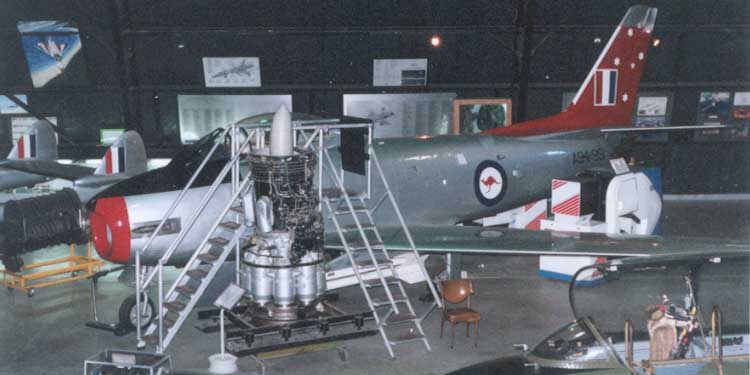
| Location The RAAF conducts air operations at RAAF base Williamtown every working day of the year. This is the place to see the tip of the sword of the Australian Defence Forces. RAAF Williamtown is located ten nautical miles directly north of Newcastle, however the journey takes around twenty minutes by car. Simply cross the Hunter River at Hexham and 1km further on turn right onto Nelson Bay Road. Continue for 15 kilometres and follow the road signs. Simple as that ! First Stop First stop should be the public viewing area located near the end of the runway. If there is any action happening there will probably be a few dozen spectators parked here, with binoculars, cameras and children on shoulders. For good viewing here, the trick is to find the highest point possible. Believe me, an extra metre of elevation makes a huge difference when looking 3 kilometres down a runway as flat as a billiard table. Standing ontop of your vehicle�s roof is my suggestion ! I suggest you also move on to Fighterworld. Fighterworld Fighterworld is an aviation museum dedicated to the fighter aircraft of the RAAF. For a small entry cost you will become a part of Australian aviation history. The aircraft are kept in immaculate condition and you can explore them without restrictions. Fighterworld also has photographic, model and other displays which add to the experience. Aircraft displays include: Dassault MirageIIIO/F A21-3 wearing natural metal finish and 76 Squadron insignia. A21-11? wearing the dark green camoflauge scheme and insignia of 2 Operational Conversion Unit. CAC CA-27 Sabre LOOK ! A94-951 wearing a natural metal scheme and the markings of 3 Squadron. CAC MB326H Macchi A7-070 wearing a brilliant scheme celebrating twenty five years of RAAF and RAN Macchi service.. 1 Dehavilland Vampire 1Gloster Meteor 1 Mikoyan Mig-21 1 Bloodhound ground to air defence missile The museum also has an observation deck giving a clear view of the runway. This is the ultimate place for viewing the flying. You can even listen to the radio communications between pilots and air traffic controllers which adds to the experience. On my last visit a recently delievered Hawk trainer took off and the pilot experienced an undercarriage retraction failure. Air traffic control directed the Hawk to move out of the Williamtown area, maintain a slow holding pattern and burn fuel. An hour later the Hawk returned with emergency crews on standby and made a safe landing. Even though the undercarriage failed to retract, the danger was the possibility of the undercarriage collapsing upon landing. This did not happen. Active Runway If the wind is blowing from the south or east Runway 12 will be in use. In this situation military aircraft will be tearing over your head after taking off, usually in tight formation at 200 knots and accelerating at a fast rate. Most aircraft will maintain the runway heading for a mile or so and then turn north and dash up to the salt air weapons range, or proceed north along the New South Wales coastline. If the wind is from the north or west runway 30 will be active. Aircraft taking off will be rapidly out of your view however you will be rewarded for your patience when they return for landing. Aircraft will enter the circuit from the south-east and cruise over the runway at 1000 feet. They will then perform left hand turns until they are aligned with runway 30. Aircraft will then glide above you at a height of less than 150 feet. They get so close you sometimes feel part of the action. On days when the wind is gusting, landing is very entertaining to watch. You can see the pilots concentrating on their descent, as they fight the wind shear. It is interesting to hear the pilots switch between afterburner and no thrust every few seconds. Arrested Landings If you are very lucky you may witness the F/A-18 Hornet aircraft performing arrested landing similar to on an aircraft carrier, minus the pitching deck and tiny landing area. The RAAF�s Hornets still carry their arrestor hook, even though the aircraft are strictly land based. (The McDonnell Douglas F/A-18 Hornet was designed to operate from American aircraft carriers). Located 460 metres from each end of runway is a �Hookcable� which is raised to a height of 10 centimetres when a Hornet takes-off or lands. If a power failure occurs or the pilot is unable to bring the aircraft to a stop, the arrestor hook is lowered, the cable is snagged and the cable will bring the aircraft to rest within 50 metres. If you are lucky you may see pilots practising arrested landings, but it�s rare Barriers Another feature of Williamtown�s airstrip are the �Barriers�. Imagine a 4 metre high tennis net made of vertical black rubber strips, which spans 50 metres. This is a simple description of the barriers which are located at the ends of the runway. These barriers are raised whenever a Hawk trainer takes-off or lands. If in trouble, the pilot lines the aircraft up with a central orange coloured circle (which usually has a humourous phrase written on it like "If you can read this it's too late), and the barrier catches and brings the aircraft to a rapid stop. Best Times Most air movements occur during working hours on working days, however night flights are often made throughout the year. Summer Monday - Thursday 9am-11am 1pm-6pm Friday 9am-Midday Winter Monday - Friday 9am-11am 1pm-3pm Friday 9am-Midday Photography Photographers are either highly rewarded for their effort or very dissappointed. A point and click camera will be acceptable if you can get close to the subject, however fast film and telephoto lenses will produce quality photographs. 400 ASA will capture the fastest aircraft, and allow some camera shake however results tend to be grainy. The trick to aviation photography is to use the slowest film possible to get the job done. 100 or 200 ASA is a good compromise, but if you�re confident you should try some Kodachrome 25 or 64. Here are some basic tips. Use long lenses focused to infinity and pan with the subject. A tripod may help. Don�t go beserk and snap at anything that moves. Get a feel for the technique needed and be patient for the right moment. On the other hand, don�t be too sensible. You never know when the action will end. The RAAF may stop flying at 10am in the morning or continue long into the night. A common problem with aviation photography is incorrect exposures. The most common fault is to underexpose the subject. In simple terms, the light meter within your camera takes an average of all the light in your picture, most of which is bright blue sky. The camera compensates by underexposing the overall scene, resulting in a dark grey aircraft. The cure for underexposure is to override the light reading which your camera automatically takes. Take a light reading of the ground, hold the reading and photograph your subject. The resulting image is usually a nice and bright subject with a very bright sky. Exposing for your subject is critical. On the Inside Generally, RAAF bases are off limits to the public. You will not be allowed access without a legitimate reasons for being there. However Fighterworld carries out a tour of RAAF Williamtown which is the ultimate way of experiencing the base. A $3.00 fare will get you on the bus for a 40 minute tour of what is one of the great air bases of the world. The tour passes through the security gates and immediately heads towards the airstrip. The boundary road parallels the runway, and the driver will usually stop during activity which gives passengers plenty of time to watch and take photographs. If you stop close to the threshold during a takeoff you will literally feel the afterburners rattle the bus. A Hornet burning 10 litres of aviation fuel per second also creates quite a loud sound. The tour then proceeds to the Squadron workshops including avionics buildings, crewrooms and maintenance hangars. You will then stop at the flightline where the aircraft are parked. Here you will see maintenance personnel and aircrew. Over 2500 RAAF personnel and civilian employees are on the base during daytime hours, many of whom work underground such as the fighter controllers. LOOK ! The timing of the tour can be perfect like on this occassion or terrible. LOOK ! The main taxiway is within metres of the bus. Aircraft taxi at a jogging pace which gives you plenty of time to watch. LOOK ! The pilots usually wave back too. LOOK ! A pair of Hornets sit on the Operational Ready Platform awaiting permission to taxi onto the runway and line up for takeoff. LOOK ! Hornets are now lined up and going through checks before advancing the power and releasing brakes. LOOK ! A21-109 rolls past the bus onto the perational Ready Platform next to the runway. LOOK ! Paul J Smith took this photograph of a 2OCU jet parked under the 'carports' on the flightline. |


 |