?

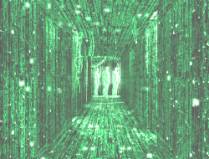
The Matrix is, at its core, a film with a moral plot. We, the
viewers, like the heroes, are in on a secret: The reality that forms the lives
of millions of human beings is not real. The world that seems real to most
people is in fact a computer-generated simulation, but almost no one knows it.
In reality human beings are floating in liquid in machine pods, with tubes
connected to them in a grotesque post-apocalyptic world where the sun is
blotted out. Things seem, of course, to the average person to be the ordinary
world of 1999. Although some details of the history remain untold, it is an
essential part of The Matrix that we are provided with a specific account of
how all of this happened. There was a battle between human beings and machines
whose cognitive capacity had surpassed their own. In a desperate attempt to
win, human beings blocked out the sun's light in order to deprive the machines
of their power source. Despite this extreme tactic, the humans lost, were
enslaved, and are now farmed to supply energy sources for the machines. The
machines induce the appearance of ordinary 1999 life in the human beings with a
computer generated "virtual community" for the purpose of keeping
them docile and asleep so that they and their offspring can be used like living
batteries. While humans seem to walk around in an ordinary life, their minds
are radically deceived and their bodies are exploited. The heroes are thus
depicted as fighting a noble battle for the liberation of the human species.1 I
have so far drawn out two aspects of the "moral background" of the
film: enslavement and deception. We should also note the perspective we have on
the Matrix as viewers of The Matrix. We have what is sometimes called a
"God's eye" perspective: we can see both the Matrix reality and
"real" reality. We are let in on the truth about the situation, and
we are not supposed to question, for example, whether the battle between
Morpheus and his friends and the Agents is itself being conducted in another
"meta-matrix", or whether the view of the human pods we see might
only be some sort of dream image or illusion. As viewers of the Matrix, we are
in on the truth and we can see for ourselves that human beings are both
enslaved and deceived. Given the outlined history, we are meant to understand
the situation of the humans as a terrible and unfair one. 1. How Does the
Matrix Differ from Reality? Excluding, for the moment, the heroes ?Morpheus,
Trinity, eventually Neo, and the rest of their crew ?and the machines, no one
in the Matrix shares our God's eye perspective. In everyday life as well, as
far as we know, reality is simply there. When we watch the film, we identify
with the heroes in part because we are repulsed by the idea that human beings
are enslaved and deceived.2 It is easy to find these two elements at work in
The Matrix in part because we think of enslavement and deception as things that
are done to some people by others; one group of people enslaves another, or one
person or group deceives others. In the film it is the machines who are the
agents of slavery and deception and almost all of the humans are victims. But
how does the Matrix, and the situation of the ordinary people within it differ
from reality and the people within it (i.e., us)? Let's begin with enslavement.
We are forced to do many things in ordinary reality: we must eat, drink, sleep,
on penalty of death. Also, no matter what we do, we shall eventually, within a
fairly predictable time frame, die; we cannot stay alive forever, or even for a
couple of hundred years. We can't travel back and forth in time; can't fly to
other planets by flapping our arms. The list could go on and on, and I have
simply offered limits we are subject to in virtue of the laws of nature. In
other words, compared with some easily imaginable possibilities, we are
severely constrained, in a type of bondage, though ordinarily most of us don't
think of it as such. Writers, artists, philosophers, and theologians over the
centuries have of course been keenly aware of these limitations, examined many
forms of human bondage, and offered various types of suggestions as to how to
free ourselves. Human beings have longed to "break out" of this
reality, to transcend the imposed limitations on their physical being. We
should be clear that these limitations are imposed on us. We simply find
ourselves in this condition, with these rules: we all die within approximately
100 years. It has nothing to do with our voluntary choice, our wishes, or our
judgements about what ought to be the case. Who has done this to us? Answering
this question is important to some degree because we typically use the term
"enslavement" to refer to something done by one agent to some others.
In the case of the constraints I outlined above, it may be harder, initially,
to find anyone on whom to pin the blame. But of course human beings have
offered answers to this question: one is God; another, the laws of nature.
Religious thinkers have struggled with questions about why we should not be
angry at God for constraining us in the ways he does: why do people die, why
can't we go back in time, travel to other planets, etc.? Others conclude that
God is not constraining us, but simply the laws of nature. At least at first
this thought might be a bit more palatable insofar as we think of the laws of
nature as impersonal features of reality; no one made them that way (if God
did, then we get angry at him again). They do not mean to constrain us and
there is no mind or intelligent force actively doing anything to us.3 Either
way, however, our actual situation is one of involuntary constraint, much akin
to the humans' situation in the Matrix, except that it is not at the hands of
machines against whom we lost a war, but at the hands of God or
"nature". The second aspect of the moral background of The Matrix is
deception. The Matrix into believing things about reality that are not true is
actively deceiving human beings. Deception offends many people, except perhaps
for committed subjectivists, since many people believe that they want to know,
or at least have the right to know, the truth, even if it is terrible. For one
person, or a group of people, purposefully to keep others in the dark about
some truth is to diminish the respect and authority of those people; it is to
act patronizingly and paternalistically. In such situations, a few people
decide which truths others can handle, and which they can't. Although this
happens routinely ?consider the relationship between those who govern and
those who are governed ?many people bristle at this idea and want the scope of
such filtering of the truth to be severely limited. We might think, however,
not about the deception of some people by others (just as we did not look at
the enslavement of some people by others), but the deception of humanity in general.
In Homer's Iliad and Odyssey the gods are depicted throughout as capriciously
deceiving human beings, compelling them knowingly and unknowingly to do
specific things, and generally interfering quite frequently in human affairs.
The humans in Homer certainly seem to be caught in a matrix of sorts, with gods
and goddesses operating on a plane of reality that is not accessible to them
(unless the gods want it to be) but that nevertheless often affects matters in
the humans' ordinary reality. As human beings began to understand that the
Earth rotated around the Sun, and not vice versa, Descartes certainly worried
about the extent to which God had had a hand in deceiving all of humanity for
tens of thousands of years up to that point. He devotes a significant portion
of the Meditations4 to worrying about how an all-good, all-knowing, and
all-powerful God could have allowed (and whether indeed he was complicit in)
people's radical deception about the relative motions of the planet they live
on, and other truths that turn out to be radically different from how things
seem to be. So in our ordinary situation, without any cruel machines doing
anything to us, we realize that there are nevertheless many things we cannot
do, and we know that we humans have been radically deceived by natural
phenomena (or by the gods, or by God) about things in the past, and that it
only stands to reason that we may be radically mistaken about our explanations
of things now. I say people's "radical deception", despite the fact
that, as with being enslaved, being deceived also seems to require an agent ?
someone to do the deceiving. We should note, however, that we talk of being
deceived or fooled by mirrors, or by the light, or by angles. Natural phenomena
are often described as contributing to our misunderstanding of them for a
reason. Even though human beings were mistaken for millennia about the fact
that the Earth moves relative to the Sun, and not the other way round, it is
hard to describe our error as simply having "made a mistake", as
though humanity forgot to carry the two in some addition calculation. Surely
part of the reason that it took humans so long to understand the motions of the
Earth is that the appearances themselves are deceptive: it certainly looks as
though the Sun is moving across the sky.5 We can see the very development of
philosophy, art, religion, science, and technology as all stemming from a drive
to "free humanity" from such deception and enslavement, as part of a
struggle to achieve the position of a Morpheus or a Neo.6 We develop planes to
break the bonds of gravity that keep us physically on the surface of the Earth;
we develop complex experiments and gadgets designed to discover the truth about
things independently of how they may appear. My first point, then, is that if
we could get a hold of the being responsible for setting up the reality we're
actually in, then we could perhaps "free" ourselves, finally knowing
the full truth about things, and being able to manipulate reality. If God is responsible,
we would need to plead with him successfully, or to fight him and win; if it's
the mathematical formulae (computer programs?) underlying "the laws of
nature," we would need to learn how to write and rewrite them. We would
then all be Neos.7 We might note too, at this big-picture level, a difference
between the Homeric gods and the Judaeo-Christian-Islamic God. In Homer's world
the gods were frequently literally in battle with humans who were greatly
outmatched, although not entirely impotent ?much like the humans that, before
Neo, fought with the "Agents". With the God of the major contemporary
religions, he is, by definition, all-good. From this perspective, we should not
fight God, for he set things up the way he did for a wise and benevolent reason;
rather, we need to learn to accept the position he has put us in (this
"mortal coil", our reality, our matrix) and, then, if we act certain
ways, or do certain things, he will free us from this reality after we
"die" (i.e. not go out of existence, but end our stay in this
reality) and show us the truth in heaven. I hope this necessarily brief
discussion enables us to see the importance of both the God's eye perspective
and the moral background of the film for effecting a difference between the
situation depicted in The Matrix and our ordinary condition. As viewers of the
film we are in a special position: we can see both inside and outside of the
Matrix. We can see that it is not a benevolent God who has set up this 1999
reality, replete with constraints and deceptive appearances, pain and toil, for
some wonderful, miraculous purpose. Nor is the reality of most people in the
Matrix the result of impersonal laws of nature. Instead, machines who use human
beings as batteries are responsible for what counts as reality for most people.
The Matrix then supplies us the viewers with a definitive answer about who is
responsible for what most human beings take to be reality.8 2. A Benevolently
Generated Matrix Now The Matrix could be significantly altered, without changing
anything in the Matrix. Imagine that the real world is a post-apocalyptic hell,
just as in the film, but, unlike in the film, suppose that the cause of the
world's being in such a state is not some battle with machines that wanted to
enslave us, but the emission of so many greenhouse gases with our
three-lane-wide SUVs that we completely obliterated the ozone layer and thereby
rendered the planet uninhabitable by us or by the plants and animals that we
rely on for our survival. Suppose further that sometime in the future, in order
to save the human race, scientists set up an enormous self-sustaining machine,
just as in the film (minus the scary "Sentinels"), designed to keep
the human species alive and reproducing for the 100,000 years it will take for
whatever weeds are left on the planet to fix our atmosphere and make the planet
once again habitable in a normal way. The machine operates simply on solar
power (since, on this scenario, the sun is now stronger than ever, frying
almost everything else on the planet), so that human beings are not needed as
"batteries".9 While humans are stuck in this state, the scientists
create the Matrix for them to "live" their lives in instead of being
conscious of floating in a vat for the length of their life, which would clearly
be a most horrific torture. Once the power of the sun is diminished to a
habitable degree (because of the repaired atmosphere) the machine would
"wake" us humans, and we could go back to living on the planet. The
ordinary person in this scenario is in the same condition as an ordinary person
in the film, except that instead of the Matrix being the diabolical result of
evil machines who exploit the human race, it is the result of benevolent human
beings trying to keep the human race alive in as good condition as possible
under the terrible circumstances. Of course it would seem no different to the
person in the Matrix. We, the viewers, however, would have quite a different
response to The Matrix. There would be no enemy to fight, no injustice to rectify
(the pushers of SUVs being long dead). If there were a Morpheus in this
situation, how would we think of him? If Morpheus and his friends had left the
Matrix, and figured out that they could, with extreme difficulty, survive in
the devastated world (eating disgusting porridge, etc.), should they go about
"freeing" everyone, even if it would take another 10,000 years for
the Earth to return to its present state of habitability? As Chris Grau
discusses in his introductory essay (section "C"), the Matrix is importantly
different from Robert Nozick's "experience machine".10 Grau points
out that we retain free will in the Matrix. The "world" in the Matrix
will respond to our free choices, just as the ordinary world does now. Another
difference that I think is quite significant is that in the Matrix, unlike in
the experience machine, I am really interacting with other human minds. There
is a community of human beings. With the experience machine, it is all about my
experience, which is the private content of my own consciousness. It is
imaginable that I am alone in the universe, floating in a vat set up by a god
who has since committed suicide. In sceptical problems that stem from the Evil
Genius hypothesis in Descartes' first Meditation, there is a threat of solipsism
and the dread of feeling that one might be alone in the universe.11 In the
Matrix, however, when two people meet there are really two consciousnesses
there that are each experiencing "the same things" from their
respective positions. Everyone is hooked up to one and the same Matrix; there
are not unique matrices generated for each individual. Of course people aren't
really shaking hands ?their hands are in vats ?but it seems to each of their
consciousnesses, not just to one consciousness, that they are shaking hands.
This feature of the Matrix is also a respect in which life in the Matrix is
critically unlike a dream, despite the fact that the humans are described as
"dreaming".12 Regardless of the amount of conscious control one has
or lacks in a dream, a dream is private to one's own consciousness. It is part
of the grammar of "dream", as Wittgenstein might say, that only I can
have my dream.13 Now this seems to me to be of enormous significance in
thinking about the Matrix. If two people fall in love in the Matrix, in what
sense would their love not be real? It would not be as if a person merely
dreamt that he had fallen in love with someone; for in a dream that person is
not really there at all, just like in Nozick's experience machine. It is true that
in the Matrix they would not really be giving each other flowers, or really
holding hands. They would, however, both be experiencing the same things
together. They would know each other as persons, who display their characters
in how they react to all of the ?in one sense ?"unreal" situations
of the Matrix. Moreover, people in the Matrix really suffer and experience
pain, and when they die in the Matrix, they die in the "real world"
too. The fact that one and the same Matrix is inhabited by millions of minds
means that millions of people are really interacting, even if the physical
universe in which they are interacting is radically different from how it
appears. Consider as well writing a novel, a poem, or a philosophy paper. Or
consider painting or dancing, making music or a movie. Would any of these
activities be affected by the fact that what I took to be material objects were
objects that were computer generated? And if not, in the benevolently generated
Matrix I hypothesized we would seem clearly better off as a species, developing
artistically, intellectually, loving each other within the Matrix rather than
fighting for survival and barely succeeding outside of it. If my aim in life
was to write some extraordinary philosophy or a groundbreaking novel, surely I
could do that far better within the Matrix than outside of it where a person
must battle simply for his or her survival. After all, where does my novel or
my philosophy paper exist for much of its genesis and storage? In a computer of
course. If I wrote a novel in the Matrix, and you read it, and so did 10,000
other minds, and I then win the Pulitzer Prize for it, in what sense would it
be unreal or even diminished in value? This differs again from the experience
machine. In the experience machine, I might have programmed it so that it would
seem to me that I had written a brilliant novel and that people had appreciated
it. In fact, however, no one would have read my novel and I would have simply
programmed myself with memories of having written it, although I never really
did. In the Matrix, however, I am not given false memories, and I do really
interact with other minds. Physics as we know it would be false (not of course
the physics of the Matrix, which scientists would study and which would
progress as does ordinary science; see below). But art and human relationships
would not be affected. I am trying to show that while we are attached to
reality, we are not attached to the physical per se, where that refers to what
we think of as the underlying causes of the smells, tastes, feels, sights, and
sounds around us: they could be molecules, they could be computer chips, they
could be the whims of Homeric gods. Indeed, very few human beings have much
understanding of contemporary physics and what it maintains things
"really" are.14 Nozick's experience machine may have shown us that we
have an attachment to the real, an attachment to the truth that we are really
doing things, really accomplishing things, and not just seeming to, but we should
not for that reason think we are necessarily attached to a certain picture of
the physical constitution of things. I would like return to the question of the
sense in which the reality of the Matrix is different from the real world. I
think that there is an important difference between being deceived about the
reality of an object and being deceived about the real underlying physical or
metaphysical cause of something. Avoiding deception and error about the latter
is the concern of physics (and metaphysics). That we might be wrong, indeed
radically wrong, about the physics/biology of an elephant is quite different
from hallucinating that there is an elephant in front of you, or dreaming of an
elephant, or experiencing an elephant in Nozick's machine. In the latter three
cases, one is deceived about the reality of an object, about whether there is
an elephant there at all. I am not saying that the actual physics or
metaphysics of a thing will not determine whether it is there; if something is
really the underlying cause of something else, of course it must determine its
existence. I do claim, however, that given the reality of a thing, knowing its
true physical/metaphysical explanation neither augments nor diminishes its
value or its reality.15 To discover that, contrary to what you had believed,
elephants evolved from single-celled sea creatures and are mostly water, and
that water consists of molecules, and that molecules consist of atoms, and that
there is a certain interrelationship between matter and energy ?that is all
part of science's attempt to understand the truth about physical reality. None
of these conclusions impugns the elephant's reality or the value it has in the
world. What substances at bottom are is a question for science or, perhaps,
metaphysics. The moral background of the film is quite relevant here. If the
fact that we are in the Matrix is simply a matter of our being incorrect about
or ignorant of what the real physics of things is, then the Matrix is quite
close to our ordinary situation, although our position as viewers of The Matrix
is not like that at all. Since we have a "God's eye" perspective, we
are able to know what is really the cause of things and what is not. In the
benevolent Matrix that I envisaged, however, you could learn Matrix-physics and
Matrix-history just as we now learn ordinary physics and ordinary history. At a
certain age in school you might be taught that your body is really floating in
a vat, and then perhaps you could put on goggles and see the world outside of
the Matrix, like looking at an x-ray or at your blood under a microscope.
Brought up with such a physics and biology, it would seem natural ?about as
exciting (and unexciting) as being told that your solid unmoving table is made
of incredibly small incredibly fast moving parts, or that all of your physical
characteristics are determined by a certain code in your DNA, or where babies
come from ?despite the fact that such truths are hardly obvious, and conflict
radically with the way things appear. Just consider any of the conclusions of
contemporary physics or quantum mechanics. History too might continue as
normal, divided into BM (before Matrix) and AM (after Matrix) dates. After all
in the "real" world, outside of the Matrix, nothing would be happening
of interest except to scientists. It would be like the contemporary study of
bottom of the ocean, or of the moon. Aside from its causal influence on the
physical state of the planet, what goes on down there or up there has no part
to play in human history. All of human history would occur within the Matrix.
By hypothesizing a benevolent rather than a malevolent cause of the Matrix, we
can see how much of what I am calling the "moral background" of The
Matrix influences what we think of it. Deprived of that moral background, a
benevolently generated Matrix can show us that our attachment is not to the
physical constitution and cause of things, but also not simply to experience.
Our attachment is to things that have value. Let me explain. Take the example,
discussed in the film, of the pleasure of eating. Imagine that science develops
a pill which supplies the perfect amount of nutrition for a human being each
day. Humans no longer need to eat at all in the ordinary way. In fact they are,
as far as their health is concerned, far worse off if they try to rely on their
taste to supply them with the appropriate nutrition (see current statistics on
fast food consumption and obesity). They can simply take the pill and get
nutrition far superior to what they would if left to their own taste to
determine what and how much to eat. Let's suppose too that science has found a
way to simulate food with a computer, so that they have created a
"food-matrix". My real nutrition would come from the pill, but I
could still go out for a "simulated" steak and it would seem just as
though I were really eating a steak, including the sensation of getting full,
although in fact I would be eating nothing and getting no nutritional harm or
benefit from the experience at all. It is hard to imagine such a perfect pill
and such perfect computer-simulated food; such a pill is no simple vitamin, and
a tofu-burger is no simulated steak. But if we suppose that there are such
things, I think human beings would readily give up eating real steak. What those
who value eating steak value is not the eating of real cow flesh (in fact,
putting it that way inclines one to become a vegetarian), but the experience of
eating. If eating the computer steak really were, as we are assuming,
absolutely indistinguishable from eating a real steak, no one would care
whether they were eating a "real" steak ?that is, one that was
obtained from a slaughtered cow. At this level the discussion is again about
what the underlying causes of phenomenal qualities are: whether the causes of
the taste, smell, etc. of the steak are cow molecules or computer chips or the
hand of God. This is, as it were, a matter of science or metaphysics ?not of
concern to the consumer as a consumer. Now for all physical objects, I contend,
it is of no value to us if their underlying constitution is ordinary atoms, or
computer generated simulation. My favorite pen still writes the same way, my
favorite shirt still feels the same way. If these things are not
"real" in the sense that their underlying constitution is radically
other than I had believed, that makes no difference to the value that these
things have in our lives. It does, of course, make a difference to the truth of
the physics I learn. But none of this implies that I was being deceived about the
reality of the object ?that the object I valued was or is not there in the
sense that matters to the non-scientist.16 In a scene discussed by Grau, Cypher
claims his knowledge that the steak is "unreal" ?that is, computer
generated ?does not diminish his enjoyment. Cypher then looks forward to the
point when he expects his memory to be wiped clean, and when he will no longer
remember that the Matrix is the Matrix. But it seems to me to be unclear why
Cypher needs to forget anything about his steak being unreal in order to fully
enjoy it ?as he himself seems to understand ?nor does he need to forget that
he is in the Matrix in order to make his life pleasant and satisfying within
it. What he desperately needs to forget in order to have a comfortable and
satisfying life is the memory of his immoral and cowardly betrayal of his
friends and of the rest of those outside of the Matrix who are engaged in the
fight for human liberation. But this is an issue, once again, not arising from
the Matrix itself, but from the "moral background" of the film.
Having a radically different underlying constitution is very different from
saying that things are not real, in the sense of being a mere illusion, as in a
dream or a hallucination. Consider again the case of our human interactions. If
a person I am friends with is not, after all, a person, then I think there is a
clear sense in which the friendship is not real, just as in Nozick's experience
machine or in a dream that I was friends with Tom Waits. I would then seem to
have a relationship to someone, but in reality not have one. What matters is
whether I am really interacting with another free mind. I certainly won't try
to say what it is to have a mind, or what it is for that mind to be
"free", but whatever it is, I am claiming that its value is not
importantly tied to any theory in physics or metaphysics. Whatever the cause
and explanation is of the existence of a free mind, it is the having of one and
the ability to interact with other ones that matters. If the underlying
constitution of Tom Waits is computer chips, instead of blood and guts, what
difference does that make? This is not a question about his reality ?whether
he is really there or not ? it is a question about his physical or
metaphysical constitution. If he has a mind, whatever that is, and he has free
will, whatever that is, what do I care what physical parts he is ?or is not ?
made of?17 Indeed, I earnestly hope in the actual world never to see any of
those parts or have direct contact with them at all. 3. The Matrix on the
Matrix I shall conclude by claiming that The Matrix itself provides evidence
that, barring enslavement and deception, we would prefer life within the
Matrix. I have so far considered how we would feel about the reality of a benevolently
generated Matrix. But in The Matrix, the cause of the Matrix is explicitly not
benevolent. Human beings are enslaved and exploited by scary-looking machines.
The Matrix is a story about a few human beings fighting to save the rest of
humanity. That is how the movie generates excitement, the thrill for the viewer
as he or she hopes that the heroes can defeat the enemy. Of course, the film
expects one to root for the humans. But I think there is some duplicity at work
in the way The Matrix exploits the Matrix. Neo is the savior of humanity, and a
large amount of the pleasure that the viewer gets from the film consists of
watching Neo and his friends learn to manipulate the Matrix. Key to Neo's
eventual success is his training. In his training he learns that a human being
can manipulate the Matrix, as a computer-generated group dream. The idea, I
guess, is that if one could bring oneself to believe deeply enough that,
despite appearances, things are not real, then one could manipulate the reality
of the Matrix. The thrill that Neo feels, and that we feel watching him, is
that as he gains this control he is able to do things that are, apparently,
superhuman ?move faster than bullets, hang onto helicopters, fly, etc. We
ought to note here, though, that Neo's greatness, his being the One, is only
the case because the Matrix exists. Outside of the Matrix, Neo is just a smart
computer geek. He can't really fly, or really dodge bullets (nor, apparently,
does he dress in full-length leather black coats, though I guess he could). We,
as viewers, would not get any pleasure from The Matrix if it were not for the
Matrix. If there were no Matrix, everyone would be eating terrible porridge in
a sunless world and simply fighting for survival, which would make for a bad world
and a bad movie. The premise of the movie is that there is a moral duty to
destroy the Matrix, and "free" the humans. But all of the
satisfaction that the viewer gets, and that the characters get in terms of
their own sense of purpose and of being special, is derived from the Matrix.
It's not just Cypher's steak that is owed to the Matrix, it is Morpheus's
breaking the handcuffs, Trinity's gravity-defying leaps, and Neo's bullet
dodging. If my argument is right, then, the irony of The Matrix is that the
heroes spend all of their time liberating human beings from the Matrix although
afterwards they would have good reason to go back in, assuming the conditions
on Earth are still so terrible. This is because there's nothing wrong with the
Matrix per se; indeed, I've argued that our reality might just as well be the
Matrix. What we want, now as always, one way or another, is to have control
over it ourselves. What we would do with such power is a question, I suppose,
for psychologists; but, looking at what people have done so far, I at any rate
hope we remain enslaved and deceived by something for a long time to come.18
Iakovos Vasiliou Footnotes 1. Another topic raised by the film, which I will
not discuss beyond this note, would be to assess the moral background of the
plot. Are the humans clearly in the right? After all, it was they who blotted
out the sun in an attempt to exterminate the machines. Particularly in light of
the machines' claim that they are simply the next evolutionary step, we ought
to think about whether there is some objectionable "speciesism" at
work in the humans' assessment of the situation. For my purposes I'll assume
the humans are morally justified in the fight for liberation, which, I might
add, is certainly a defensible position. For even if machines are the next
evolutionary step, and some human beings are guilty of having acted wrongly
towards them, that would hardly justify the involuntary enslavement of the
entire human race in perpetuity. Moreover, the existence of a "more advanced"
species than our own (however that is to be determined) surely should not
deprive us of our human rights. 2. And in part because we too would like to
control reality; see below. 3. The Stoics thought of the natural world, of the
universe as a whole, as itself a rational creature with an overall goal or
purpose. 4. Although this theme is present throughout, see especially
Meditations I and IV. 5. The idea that reality is tricky and tries to hide its
nature from us is very old, even without, as in Homer's case, any gods acting
as agents of deception. For example, the Presocratic philosopher Heraclitus
(c.540-c.480 BC) writes (fr. 53) "an unapparent connection is stronger
than an apparent one" and (fr. 123) "nature/the real constitution [of
things] (phusis) loves to hide itself." 6. Morpheus and company are an
interesting amalgam of technological sophistication and religious symbolism. 7.
Or, more precisely, those of us who accomplished this. 8. Of course for
Morpheus and his crew, and for the machines if they were sufficiently
reflective, the same questions could be raised about what makes the reality
outside of the Matrix the way it is ?who is responsible for that? And then we
can imagine them responding in the sorts of ways I have described, pinning the
blame on God, the laws of nature, etc. 9. This detail is meant simply to avoid
the possibility of unease over the issue of whether human beings are being used
as batteries, voluntarily or not. 10. I shall assume that my reader has read
that essay, where Grau clearly explains Nozick's example. (The essay can be
found here.) 11. See Grau, "Dream Skepticism". The threat of
solipsism seems to me to be the same in the Matrix or in the ordinary world;
and that is not my concern here. I am simply taking the truth of the
"God's eye" perspective offered the viewer of the film for granted.
The Matrix tells us and shows us that we are all hooked up to the same Matrix.
12. I think that perhaps Colin McGinn's essay too quickly assimilates the
Matrix to dreaming, and Neo's control over it to "lucid" dreaming.
Although McGinn may be right that the Matrix must be dealing with
"images" rather than "percepts", there are important
disanalogies between Matrix-experience and dream-experience. First, in a dream,
there is only your own mind involved. The Matrix must be, at a minimum, a group
dream. I am arguing above that the fact that one mind is really interacting
with other minds is critical to assessing the value of the Matrix reality. This
complicates the apparently clear idea of controlling one's dream, since it is
not simply one mind at work that can "alter" the images one is
conscious of. I am not sure of the coherence of the hypothesis here. For
example, when the young boy bends the spoon, Neo "sees" this. So the
boy's control of his environment is perceivable both by the boy's mind and by
Neo's. So he must be changing something that is, "in reality", in
Neo's mind ?namely, Neo's image of the spoon. But what if Neo straightens the
spoon at the same time the boy bends it? Whose lucid dream will win out, and be
perceived by the other minds? The one with the stronger will? Second, the
"images" that are in your mind in the Matrix can, and regularly do,
really kill people; that is, kill their bodies outside of the Matrix. Except in
some bad horror movies, dream images cannot really kill you, or make you bleed.
The difficulty of understanding how something which is a mere "image"
is supposed to have this sort of effect seems therefore to cause some problems
for calling the state of ordinary people in the Matrix "dreaming".
See also next note. 13. We could certainly, if we wish, call the experience of
the Matrix "a dream", as the movie does. But we should remember that
Neo, while in the Matrix and before he has met Morpheus, has a dream while he
is "asleep". So we need some distinction between that sort of
"dream" and Neo's "waking" "group-dream" within
the Matrix. 14. This sentence implies that contemporary physics represents
humans' best understanding of the true nature of reality, which is certainly a
contentious claim. 15. The question of whether I know something is in fact real
or an illusion remains as legitimate or illegitimate as always. As throughout
this essay, I am simply bypassing any sceptical questions, since it is part of
my argument that being in the Matrix does not affect them. 16. All human being
might be considered "scientists" insofar as we are curious about and
have a conception of what the reality of things are: what causes them, how they
come into being, how they are destroyed, etc. But we are also interested in
other people, objects, and activities because of their inherent value, a value
they retain regardless of the correct explanation of their reality. 17. Given a
true account of what it is to have a mind, I would surely care if what appeared
to be a person did not fulfill those criteria, for then he would not be a
person after all. For example, if someone somehow showed that a machine could
not have a "free mind", then I would care whether my friend was a
machine or not, but only secondarily, given that ex hypothesi as a machine he
would not have a free mind. My point is only that it is "having a free
mind" or "being a person" that is the source of value, not the
correct theory about what makes someone a person. I am claiming that ignorance
of or deception about the right physical or metaphysical account of mind does
not thereby cast doubt on the value of having a mind. Scepticism about other
minds ?the questions of whether there really are other minds and how we could
tell whether there are ?is not addressed at all by what I am saying. I am
taking for granted the truth of what the film tells us: there are other minds.
The problem of other minds, like solipsism mentioned above, is equally a
problem in or out of the Matrix. 18. I am grateful to Chris Grau and Bill
Vasiliou for comments on and discussion about an earlier version of this essay.
-Raad friends([email protected] )
)
Click here to vote our site