DEVIATION OF THE LIGHT WHEN PASSING NEAR THE EARTH�S MOON
In multiple opportunities it has been observed that the light coming from a planet deflect when it passes near the horizon of the Earth�s Moon. The magnitude of this deviation and the cause that it originates it are not in the physics texts, it is more, the existence of this phenomenon is not even mentioned. Here we will try to calculate approximately the magnitude, and to explain the possible cause that originates it.
As example we will take a photographic sequence of the planet Saturn moving behind the Earth�s Moon, taken by Bradford A. Smith, New Mexico State University Observatory. This photographic sequence was published in the page 185 of the magazine National Geographic Magazine of the month of August of the year 1970.
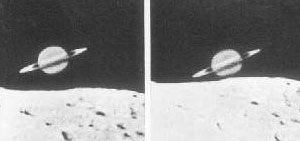
Photographic sequence
Comparing the polar diameter of both pictures, it is noticed that the picture of the right has a smaller diameter that that of the left.
For a better appreciation of this difference let us see the amplification of these pictures.
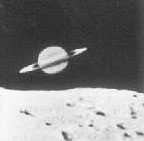
Left photograph
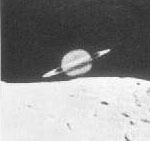
Right photograph
In order to calculate the magnitude of the deviation of the light coming from the lowest part of Saturn that passes near the horizon of the Moon, we will take the following approximate numeric data:
Saturn polar diameter ............................. 108,000 km
Saturn- Earth distance.................... 1,277'000,000 km
Measuring the polar diameter of both pictures we have:
Left photograph = 29 mm
Right photograph = 26 mm
29 mm................ 108,000 km
26 mm..................... X
26 x 108,000
X = ��������� = 96,828 km
29
Making the pertinent calculations with these data, we have:
108,000 - 96,828 = 11,172 km
11,172
Angle = tan-� ����������� = 1.80 seconds of arc.
1,277'000,000
Surprisingly this magnitude of deviation of the light is very similar to that observed in the total eclipses of Sun.
According to the theory of Einstein's relativity, a ray of light that passes near the Sun should deflect 1.75 seconds of arc. However, the results obtained in the eclipse observed from May 29 1919 until the present times don�t agree in magnitude neither in the course of the deviation with this theory.
As we can appreciate, this deviation of 1.80 seconds of arc coincides very closely with the half deviation observed by Dr. Campbell and Dr. Trumpler during the total eclipse of Sun happened on September 21, 1922 that was 1.72 seconds of arc with a probable error of 0.11 seconds of arc.
Before the man arrived to the Moon, many scientists thought that it should have some atmosphere type that deviated the rays of light coming from the planets when it pass near the horizon of the Moon, but now, we know that the Earth�s Moon doesn't have any atmosphere type, consequently, this deviation of the light cannot be produced by the atmospheric refraction.
Considering that the magnitude of the deviation of light observed in the case of Saturn before mentioned (1.80") or in those observed during the eclipse (1.72") are very similar, and that the cause that produces this phenomenon, cannot be given by the mass that they represent, due to the great difference existent among them; consequently, like in both cases the Moon of the Earth was present, we could conclude that, in both cases, the deviations could be motivated by the Moon of the Earth.
THE POSSIBLE CAUSE THAT COULD ORIGINATE THIS PHENOMENON:
Comparing both pictures, a great difference is not only appreciated in its polar diameters, but also, it is appreciated that in the picture of the right the inferior part of Saturn contours the irregular form of the horizon of the Moon.
It is known that the rays of light deflect (DIFFRACT)* when they are obstructed by any obstacle that find in their road, this property of the light can allow us to explain the deviation from the light when passing near the Moon, if we considered that the wave front of the light coming from Saturn diffract when it is obstructed by the Earth�s Moon, similar phenomenon to which one observes in the shade taken place by a post, this goes disappearing gradually, that is to say, the light contours the obstacle.
On the non coincidence in the course toward the center of the Sun observed in the eclipses, as Einstein's theory require, we could explain it considering that the course of the deviation is perpendicular to the irregular surface of the Moon�s horizon, as can be observed in the right photograph.
(*) As "DIFFRACTION" must be understood as the tendency of the waves of light to deviate inside the geometric shade. (I make this annotation because some physic�s books usually mention as diffraction to rays deviated toward away from the geometric shade.)
I will appreciated very much your comments.
[email protected]
In the address that is shown below you will be able to see a new explanation of the phenomenon of the Inferior Mirage.
Did you know that you this phenomenon can be observed during the 24 hours of the day and in any time of the year?