EXPERIMENT TO DETERMINE THE CAUSE OF THE INFERIOR MIRAGE PHENOMENON
The explanation of the phenomenon of the Inferior Mirage that is given in the optic's books usually uses terms nothing scientific such as, "in certain occasions", "sometimes", "under certain circumstances", etc.
I am a self taught that doesn't have the necessary means to carry out the
experiement that I expose below.
The experiments that I have carried out on this phenomenon are very scarce,
since what I wanted to find was the cause of this phenomenon, that is to say, if it was due to the phenomenon of the refraction or reflection.
The refraction of the light happens when it passes from a layer to another layer
of different optic density, at certain angle of incidence happens a total reflection.
However, in order that this happens it is required that the layer has to be very
defined, that is to say, as flat as possible. What I am not able to understand is
how can be possible to find very defined layers inside a gaseous medium in which their molecules are completely riotous?
With regard to the Inferior Mirage I have observed that this phenomenon seems to happen independently of the temperature as I expose in
my web page.
I will appreciate very much if you could make it and send to me the results of the experiment as well as yours comments.
Sincerely,
Ricardo Pradel
[email protected]
http://www.geocities.com/r_pradel/index.html
EXPERIMENT
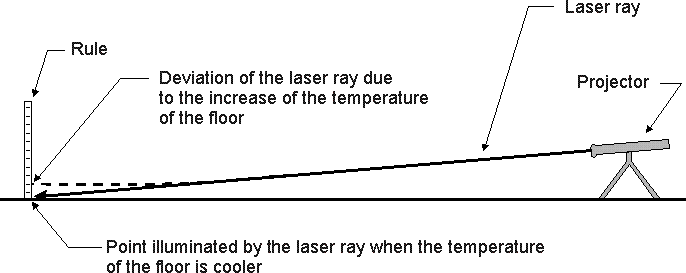
The following graph shows a possibility to determine if the observed phenomenon of which the floor seemed wet during the days with enough Sun is caused by the atmospheric refraction.
For this it is required to projecte a laser ray from a height of approximately 60 centimeters to the inferior part of a vertical rule located to approximately 100 meters of distance (angle of 20 minutes approximately), the first reading should be done early in the morning and the other reading to half-day or lightly later.
If the point where the laser ray impact on the rule show a higher reading in the second reading, it would determine that the atmospheric refraction would be the cause of this phenomenon.
The trajectory of the ray of light in the first reading has to be direct since it doesn't exist differences of temperature (if there was, it would be very small). being that in the second reading the trajectory of the ray of light is curved by the temperature, it should impact in a higher point of the rule, what would determine that the atmospheric refraction would be the cause of this phenomenon.
If the point of incidence of the laser ray in the rule is the same one in both readings, it would determine that the atmospheric refraction doesn't have nothing to do with this phenomenon, just as I expose in my web page.