Research is an important part of the activity of any tertiary institution and must be encouraged. Students should expect to be involved in such research activity at some level, if not doing original research then as research assistants and data collectors. Profesors should definitely be involved on an on-going basis in their own areas of specialisation. This is important from an institutional viewpoint as well as Institutions are rated partly by the quality of output from its academics. Lecturers who simple teach will disappear without making any contribution to the body of knowledge they hold so dear and do a disservice to themselves, their students and the institution. The old maxim "publish or perish" comes to mind here.
Broadly, the research process starts with a hunch, a problem, or a question which give rise to a hypothesis and research questions formulated to provide direction for the investigation. The investigator would then want to look at any antecedental situations from the literature or previous experiments that may shed some light on the problem. At this point, the experimental design takes place. We shall examine the design in the next paragraph. The results are then analysed and finally, the investigator must interprete the outcome of the experiment in the light of the new evidence for or against the hypothesis, and make his or her conclusions and recommendations. This is nowhere as difficult as the initial reaction to the word may have us believe, and quite something that may be done even at pre-tertiary levels as well.
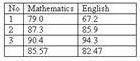
The design phase of a research project can be a very simple or a little complex. Imagine that in a particular college there is a feeling that say English marks are better than Mathematics marks. The experimental design may select two sets of examination scores of the same set of students for the two subjects. In the analysis, the averages are computed and compared and a conclusion arrived at. More complex analyses are possible but a simple computation of average would suffice for now. In the design of the experiment, we have two sets of data. In technical jargon, we have two levels of some factor say S, subjects. The table representing the data collected is a simple two-column table with headings English and Mathematics, and since we have the same number of students in each group and the marks for each student in both subjects, we say that the data is paired. The notation for this design is R (S) signifying that we have collected response, R, for the subjects S. It is a very simple design but worthy of being called a research project by any means.
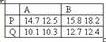
Consider a situation where we have say two varieties, V, of a crop like pigeon peas, and two fertilizers, F. Let A and B represent the varieties of the crop and P and Q represent the two different fertilizers. The researcher is led to believe that there is a significant effect between fertilizer and crop variety, and his hypothesis is that "The fertilizer used on a particujlar crop variety does make a difference." Now we always need some response variable, which we can measure. In the case above it was the examination scores. Here, we could measure the yield. Experiments also require control of the conditions and the data collection. In the design, you would prepare a plot of land with consistent soil qualities throughout. Assume that we divide the plot into four squares for simplicity. Now treat each of the two rows similarly with each of the fertilisers and sow in each of the two columns one of the varieties of the crop. In the growing process, all four plots are subjected to similar conditions of wetting and sunlight. At the end of the time, the produce is harvested and measured for productivity in some way.
In the second example the data would be collected for each plant in each of the four blocks. Thus you would have two columns and two rows. In each cell, there would be several values of the response variable, the weight of produce from each plant. The design is R (V x F) where you have a two-way contingency table and are looking at the responses, R, which is say the weight of produce recorded for each plot. We have data for variuos levels of the variables or factors V and F. The design should also indicate the type of sampling and the method of analysis of the data be it ANOVA or some other. In this case, an ANOVA analysis is most suitable. The ANOVA would reveal whether the is any reason to believe that there is a relationship between the type of variety and the fertilizer used.
In the next article, I shall deal with the creation of the data collection instruments including on-line instruments, and the methods of analysis. Things are not quite as complex as the word "research" initially makes them out to be. I do hope that this article has been of some help in clarifying the importance of research and how this could be approached in a very simple manner.