Situation: You are in your physics class minding your own business, or sleeping as some people would say, and the teacher suddenly says, "I am assigning you an egg drop project. You may construct the egg drop apparatus with whatever materials you want but the apparatus may not exceed four inches on any side."
High School Pre-AP Physics Project, First Quarter, Year 2000-2001
Objective:
Restrictions:
Grading Criteria:
Phase 1: The Design
When you are designing this apparatus, there are a few things that you need to keep in mind. First of all, this device must be protective. The raw egg inside must not even crack at the first drop. This is much harder to accomplish than one would think. Second of all, it has to be strong enough to withstand the weight of the physics teacher.
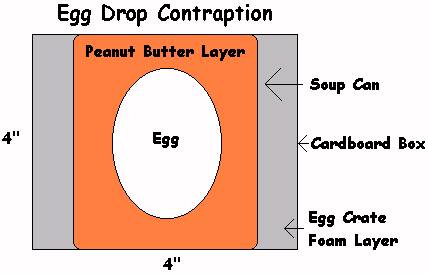
I designed my apparatus as something that I felt would be protective as well as strong. I took a soup can and hammered the bottom down about a half an inch so it would fit into the 4"x4" box. Then, I wrapped the can with egg crate foam and put it in the box. Finally, I put peanut butter in the can and put the egg inside, covered in saran wrap so I could take the egg out to inspect in between drops.
See "Designing Tips"
Phase Two: Testing
Request practice runs at the drop site before the actual project due date to make sure that your apparatus will withstand these tests. Also, test standing on the object with your own weight to determine if it might withstand the heavy weight of your physics teacher. The project takes much trial and error and it is highly doubtful that you will succeed in your design on the first trial. You will most likely have to modify your current design or start completely over and design a new apparatus.
Phase Three: Actual Drop
Eggs should be provided by the teacher at the drop site so there is no way that a student could modify an egg before the drop. The student should bring a small repair kit for their apparatus, i.e. tape, scissors, rubber gloves (if semi-solids were used), etc. Be fully prepared and bring all items to the drop site.
What worked, what didn't
Heavily constructed objects did not work. Some used metal boxes to withstand the weight of the teacher, but the egg hit the metal on the initial drop and cracked. Normal packing materials do not work every time. Even though one would imagine bubble wrap protecting the egg, it does not seem to work every time. On some apparatuses it did, others it didn't. The overall outcome of the project was that most student's projects failed. There was about a 5% complete success rate. This was mainly due to a failure to test the project before the due date.
The lightest strongest materials worked. One student used popped popcorn to surround an egg and it withstood all three tests. Another used high impact foam used in computer shipment. They cut out the outline of an egg and it withstood all three trials. Similarly, another used the green foam used in flower arrangements. Peanut butter works very well in protecting the egg. It is a very good material to incorporate into the apparatus. The only downside of peanut butter is that it is very messy and requires the use of rubber gloves.
The apparatus which I built only withstood the first trial. The use of the peanut butter is what saved the egg. The second trial cracked the egg because it was thrown at too fast of a speed onto the concrete and the device was much too heavy and had little space inside of the can for the egg to shift.
Dos:
Don'ts:
I hope this web site helped you at least a little in your quest to build the perfect egg drop project. Just remember, your grading criteria and requirements will most likely be different as they are different among many teachers and schools.
If this web site has helped you any at all, please drop me a line at [email protected] and tell me how. Also feel free to make comments and suggestions on how to improve the site. Also, if you reproduce any items from this page, please tell me why you did so. I want to make sure that this site is being effective. Thank you!
You can also search for other egg drop sites at Google.

There has been
hits to this site since 5/28/2001