Information on Screw Threads
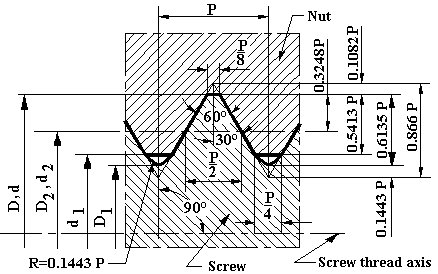 |
| Pitch
P |
Thread Per Inch
TPI = 1/P |
Major diameter
screw
D MM ISO |
Basic thread
diameter screw
D " UST |
Major diameter
nut
d MM ISO |
Basic thread
diameter nut
d " UST |
Pitch diameter
D2=d2=D-0.64952*P |
Pitch diameter
D2= d2=D-0.64952/TPI |
Minor diameter
screw
D1= D-1.227*P |
Minor diameter
screw
D1= d1=D-1.227/TPI |
Minor diameter
nut
d1= D-1.0826*P |
Minor diameter
nut
d1=D-1.0826/TPI |
Total Height
H = 0.866*P |
Total Height
H = 0.866/TPI |
Screw thread
height
H = 0.6135*P |
Screw thread
height
H = 0.6135/TPI |
|
Basic Size is the nominal size to which
the tolerance is applied to determine the maximum and minimum
material size.
Allowance is the difference between the
design (maximum material condition, MMC) size and the basic size.
Thread Classes: The different thread
classes have differing amounts of tolerance and allowance.
- Classes
1A, 2A, 3A apply to external threads;
- Classes 1B, 2B, 3B apply to
internal threads.
- Classes 2A and 2B. The
maximum diameter of uncoated (unplated) class 2A, (external) thread
are less than the basic by the amount of allowance. When a coating
is intended, the max diameter of class 2A may be exceeded by the
amount of allowance. For an internal thread, the minimum diameters
are basic whether or not coated (plated)--no allowance is available
at the maximum metal limits.
- Classes 3A and 3B are used for closer
tolerances than those available from classes 2A and 2B. The maximum
diameters of Class 3A (external) threads and the minimum diameters
of Class 3B (internal) threads are basic, whether coated (plated) or
not--thus no allowance or clearance is available for assembly of
components at maximum material condition. See
- Classes 1A and 1B are the replacement
threads for American National Class 1. They are intended for special
applications involving replacement parts, for quick and easy
assembly even when the threads are slightly damaged or dirty.
Coating (or plating) of threads The
external threads should not be greater than basic size after
plating, and the internal threads should not be less than basic size
after plating. For electro-plated parts, Class 2A allowance is
sufficient for the plating build-up. After plating the external
threads should pass a basic Class 3A GO gage and a Class 2A NO-GO
gage. Class 3A does not include an allowance--the class 2A allowance
may be used as long as it is adequate for the plating thickness
considered. Since only Class 2A external threads have an explicit
allowance for coating, other classes both internal and external
should have the size limits adjusted to allow for the desired
coating thickness.
There are several international standards
on screw threads. The typical structure of a chain of
standards related to screw threads consists of the following links :
(1) Basic profile, basic dimensions (one
or more separate standards).
(2) Tolerances (in some cases � several
documents).
(5) Gauging system and tolerances of
gauges.
There are numerous types of screw threads
applied in machinery; the main differences concern thread profiles. The
most important for design and manufacturing of machinery are ISO general
purpose metric screw
threads. The basic profile of metric screw thread, specified in ISO 68-1,
is of triangular form. All dimensions of the profile depend on
the pitch P .
Another standard
is
ISO 724 concerning basic (nominal) dimensions: major diameter designated D (for internal thread) or
d (for external thread), pitch diameter D2 or d2 and
minor diameter D1 or d1. The
diameters d and D1 are often called crest
diameters.
The major diameter D or d is the nominal diameter of the
thread. In most cases there are several threads with different pitches for a
given nominal diameter. The coarse thread is the one with the largest pitch; fine threads have smaller pitches
(for a general plan of metric screw threads � see ISO 261). ISO 724 covers
threads of nominal diameters 1 up to 300 mm. Designation of coarse metric screw
threads consists of the letter M followed by the value of nominal diameter, e.g.
M12; the pitch of a coarse thread may be found in ISO 261 (in this case P = 1,75 mm. Designation of a fine
screw thread contains also the pitch value, e.g. M12 x 1.
Tolerances of metric screw threads are
specified in ISO 965, consisting of five parts. Most essential is part 1 (ISO
965-1) covering principles and basic data. It should be noticed that this
standard belongs basically to the 2nd link of the chain, but it
contains also the coding system of metric screw threads; therefore it may be
allocated to both links of the chain � 1st and
2nd.
The tolerance system of metric screw threads is
based on tolerances of two diameters in each thread: the pitch and crest
diameters. So in internal threads the diameters D2 and D1 are toleranced, in
external threads � the diameters d
and d2.
There are several tolerance grades on which the
diameter tolerances depend. For the crest diameter of a given thread the
tolerance depends, besides the tolerance grade, only on the pitch
value
The pitch diameter tolerance of a given thread
results from the tolerance grade, and the pitch and the basic diameter
values.
The
fundamental deviation determines the screw thread tolerance position. It may
be noticed that the concept of screw thread fundamental deviations is similar to
that adopted in the tolerance system according to ISO 286-1 .
Tolerance positions are indicated using letters � capital for internal threads,
small for external ones. The following fundamental deviations are
specified:
For internal threads: G and H.
For external threads: e, f, g and
h.
The fundamental deviation, for a given
tolerance position, depends only on the pitch of the
thread.
Fundamental deviations apply to all the
diameters of the thread � D, D2 and D1 for internal threads,
d, d2 and d for external threads . It means that the basic profile of the thread is uniformly shifted positively (for an internal thread)
or negatively (for an external
thread) resulting in maximum material thread profile. If tolerance position H or
h is specified, the maximum material profile is just the basic profile. See thread tolerance zones with tolerance position G and external
thread with tolerance position f.

Tolerance zones of an internal (a) and external thread
(b).
Only the diameters of screw threads are
toleranced in a direct way. Tolerances of pitch and of flank angle are not
specified directly; however, actual thread profile shall be within the tolerance
zone over the assumed length of thread engagement. There are three standardized
groups of these lengths, designated S (= short), N (= normal), and L (= long).
The combination of grade and tolerance position
of a thread is called the tolerance
class. In general case the tolerance classes for pitch and crest diameters
are different � e.g. for pitch diameter 5g, for major diameter 6g (external
thread). However, in most recommended cases tolerance classes for both diameters
are the same. It should be underlined that the tolerance of pitch diameter
always is smaller than the tolerance of crest diameter.
The complete designation of a thread consists
of the following components:
-
designation of thread itself (see
above),
-
a dash,
-
designation of tolerance class for pitch
diameter,
-
designation of tolerance class for crest
diameter,
If the length engagement belongs to the groups
S or L, the group symbol shall be added to the thread designation, separated by
a dash.
In the case of designation without any
tolerance class, symbols have the following default meaning:
-
for internal threads up to M1,4: 5H, for
M1,6 and larger:
6H,
-
for external threads up to M1,4: 6h, for
M1,6 and larger:
6g.
Various tolerance classes give tolerance qualities of screw threads:
fine, medium and coarse; for recommended tolerance classes � see
the following tables. Tolerance classes in broad frames are intended for
commercial screw threads; first choice is in bold print, second choice is in
ordinary print �and third choice is in parentheses.
Recommended tolerance classes for internal
threads.
|
Tolerance
quality |
Tolerance position
G |
Tolerance position
H |
|
S |
N |
L |
S |
N |
L |
|
Fine |
- |
- |
- |
4H |
5H |
6H |
|
Medium |
(5G) |
6G |
(7G) |
5H |
6H |
7H |
|
Coarse |
- |
(7G) |
(8G) |
- |
7H |
8H |
Recommended
tolerance classes for external threads
|
Tolerance
quality |
Tolerance position
e |
Tolerance position
f |
Tolerance position
g |
Tolerance position
h |
|
S |
N |
L |
S |
N |
L |
S |
N |
L |
S |
N |
L |
|
Fine |
- |
- |
- |
- |
- |
- |
- |
(4g) |
(5g4g) |
(3h4h) |
4h |
(5h4h) |
|
Medium |
- |
6e |
(7e6e) |
- |
6f |
- |
(5g6g) |
6g |
(7g6g) |
(5h6h) |
6h |
(7h6h) |
|
Coarse |
- |
(8e) |
(9e8e) |
- |
- |
- |
- |
8g |
(9g8g) |
- |
- |
- |