| Sphere
A three-dimensional figure with all of its
points equidistant from its center.
|
|
Radius: r
Diameter: d
Surface area: S
Volume: V
S = 4 p
r2 = Pi d2
V = (4 p
/ 3) r3 = (p / 6) d3
|

|
Sector of a Sphere
The part of a sphere between two right
circular cones that have a common vertex
at the center of the sphere, and a common axis.
(The interior cone may have a base
with zero radius.)
|
|
Radius: r
Height: h
Volume: V
S = 2 p
r h
V = (2 p
/ 3) r2 h
|

|
|
Spherical Cap
The portion of a sphere cut off by a
plane. If the height, the radius of the sphere, and
the radius of the base are equal: h = r (= r1),
the figure is called a hemisphere.
|
Radius of sphere: r
Radius of base: r1
Height: h
Surface area: S
Volume: V
r = (h2+r12)
/ (2h)
S = 2 p
r h
V = (p
/ 6) (3 r12 + h2) h
|

|
|
Segment and Zone of a Sphere
Segment: the portion of a sphere cut off
by two parallel planes.
Zone: the curved surface of a spherical segment.
|
Radius of
sphere: r
Radii of bases: r1, r2
Height: h
Surface area: S
Volume: V
S = 2 p
r h
V = (p
/ 6) (3r12+3r22+h2)
h
|

|
|
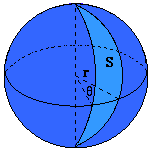
Lune of a Sphere
The curved surface of the intersection of
two hemispheres.
|
Radius: r
Central dihedral angle: theta (in
radians),
alpha (in
degrees)
Surface area: S
Volume enclosed by the lune
and the two
planes: V
S = 2r2theta
= (p/90)r2alpha
V = (2/3)r3theta
= (p/270)r3alpha
|
|