Quadrilateral
|
|
| |
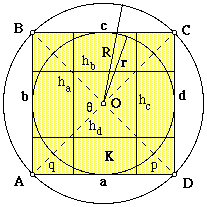
A polygon (plane figure) with 4
angles
and 4 sides.
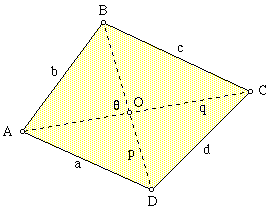
Sides: a, b, c, d
Angles: A, B, C, D
Around the quadrilateral are a, A, b, B, c, C, d, D, and back to
a, in that order
Altitudes: ha , etc.
Diagonals: p = BD, q = AC, intersect at O
Angle between diagonals: theta
Perimeter: P
Semiperimeter: s
Area: K
Radius of circumscribed circle: R
Radius of inscribed circle: r
|
| |
|
| General |
|
| |
|
P = a + b + c + d.
s = P/2 = (a+b+c+d)/2
A + B + C + D = 2 p radians = 360o
K = pq sin(theta)/2
K = (b2+d2-a2-c2)tan(theta)/4
K = sqrt[4p2q2 - (b2+d2-a2-c2)2]/4
K = sqrt{ (s-a) (s-b) (s-c) (s-d) -
- a b c d cos2 [(A + C) / 2]}
(Bretschneider's Formula)
|
| Square |
|
| |
-
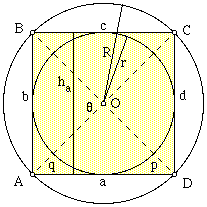
A quadrilateral with four right angles and all four sides of
equal length.
a = b = c = d
A = B = C = D = Pi/2 radians = 90o
theta = p/2 radians = 90o
|
| |
|
ha = a
p = q = a sqrt(2)
P = 4a
s = 2a
K = a2
R = a sqrt(2)/2
r = a/2 |
| Rectangle |
|
| |
-
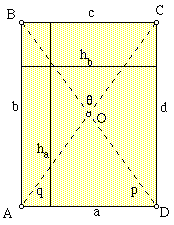
A quadrilateral with adjacent sides perpendicular
(all four angles are therefore right angles).
a = c, b = d.
A = B = C = D = p/2 radians = 90o
|
| |
|
ha = b
hb = a
p = q = sqrt(a2+b2)
theta = 2 arctan(a/b)
P = 2(a+b)
s = a + b
K = ab
R = p/2 = sqrt(a2+b2)/2
r = minimum(a,b)/2 |
| Parallelogram |
|
| |
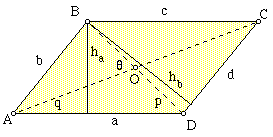
A quadrilateral with opposite sides parallel.
a = c, b = d
A = C, B = D
|
|
| |
|
A + B = p radians = 180o
ha = b sin(A) = b cos(B-Pi/2)
hb = a sin(A) = a cos(B-Pi/2)
p = sqrt[a2+b2-2ab cos(A)]
q = sqrt[a2+b2-2ab cos(B)]
p2+q2 = 2(a2+b2)
theta = arccos[(a2-b2) / p q]
P = 2 (a+b)
s = a + b
K = ab sin(A) = ab sin(B) = bhb
= pq sin(theta)/2 |
| Rhombus |
|
| |
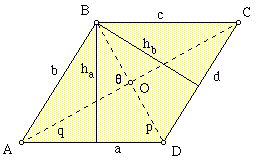
A parallelogram with all sides equal.
a = b = c = d
A = C, B = D
theta = p/2 radians = 90o
|
| |
|
A + B = p/2 radians = 90o
ha = a sin(A) = a cos(B-p/2)
ha = hb
p = a sqrt[2-2 cos(A)]
q = a sqrt[2-2 cos(B)]
p2+q2 = 4a2
P = 4a
s = 2a
K = a2sin(A) = a2sin(B)
= aha = pq/2 |
Trapezoid
|
|
| |
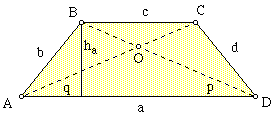
a parallel to c, m = (a+c)/2
A + B = C + D = p radians = 180o
|
| |
|
P = a + b + c + d
K = ham = ha(a+c)/2
|
| |
If a = c, the trapezoid is actually a parallelogram,
so b = d, and the height and area cannot be determined from a, b,
c, and d alone. If a and c are not equal, then
|
| |
|
ha2 =[(a+b-c+d)
(-a+b+c+d) (a-b-c+d) (a+b-c-d)] / [4(a-c)2].
|
| |
If ha2 < 0, no trapezoid
having those side lengths exists.
|
| Kite |
|
| |
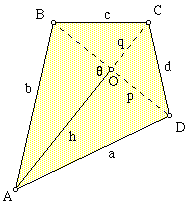
A quadrilateral with two pairs of distinct
adjacent sides equal in length.
a = b, c = d
theta = p/2 radians = 90o
|
| |
|
OB = OD = p/2, OA = h, OC = q - h
h = sqrt(a2-p2/4)
q = sqrt(a2-p2/4) + sqrt(c2-p2/4)
P = 2(a+c)
K = pq/2 |
| Cyclic
Quadrilateral |
|
| |
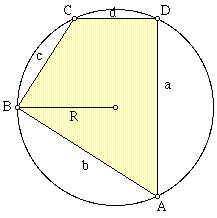
A quadrilateral all of whose vertices lie on a circle.
Points A, B, C, and D lie on a circle of radius R.
A + C = B + D = p radians = 180o
|
| |
|
K = sqrt[(s-a)(s-b)(s-c)(s-d)]
(Brahmagupta's Formula)
K = sqrt[(ab+cd)(ac+bd)(ad+bc)] / (4 R)
p = sqrt[(ac+bd)(ad+bc)/(ab+cd)]
q = sqrt[(ab+cd)(ac+bd)/(ad+bc)]
R = sqrt[(ab+cd)(ac+bd)(ad+bc) /
(s-a)(s-b)(s-c)(s-d)] / 4
theta = arcsin[2K / (ac+bd)] |
| Cyclic-Inscriptable |
|
| |
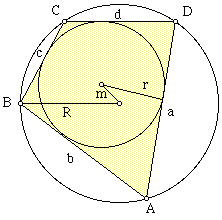
A quadrilateral within which a circle can be
inscribed, tangent to all four sides.
Points A, B, C, and D lie on a circle of radius R.
Sides a, b, c, and d are tangent to a circle of radius r.
m = distance between the centers of the two circles.
A + C = B + D = Pi radians = 180o
a + c = b + d
|
| |
|
K = sqrt[abcd]
r = sqrt[abcd] / s
R = sqrt[(ab+cd) (ac+bd) (ad+bc) / abcd] / 4
1 / (R+m)2 + 1 / (R-m)2 = 1 / r2
|
|