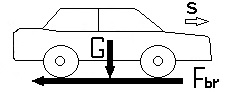
 The friction force witch is the braking force
G = M*g
; Fbr =
μ*G
= μ*M*g
;
The friction force witch is the braking force
G = M*g
; Fbr =
μ*G
= μ*M*g
;Braking Force and Braking Distance
For the calculation of the braking force and the stopping distance we are taking in consideration the following parameters:d = braking distance; unit = m;
s = speed of the car ; si = initial speed; sf = final speed; unit = meter/sec =m/s
a = acceleration or deceleration (braking); unit = meter/s2=m/s2
G = weight of the car ; unit = for force is the Newton (=1 kg·m/s2) which is abbreviated N
g = acceleration of gravity. Its value is 9.8 m/s2 on Earth (g=3.71 m/s2 on Mars)
M = mass ; unit = Kg
Gravity makes a 1 kilogram mass exert about 9.8 Newtons of force; 10 N = 1 kgf (kgforce);
therefore gravity makes a 1 kilogram mass exert about 0.98kgf of force; (physics 1/1)
W = work done; unit =1 kg m2 / s2 = 1 J (Joule)
K = kinetic energy; unit = 1 kg m2 / s2 = 1 J (Joule)
W =KWhen you decelerate an object, you are doing work against inertia, such that the work equals the change in kinetic energy of the object.
μ = coefficient of friction between tires and the road surface ; value = 0.4 to 0.8 (depending on condition of the tires and the road);
The friction force witch is the braking force
G = M*g
; Fbr =
μ*G
= μ*M*g
;
Fbr = μ*M*g ; on the other side the force given by deceleration is F = M*a
The equation of speed in this case is: s2f = s2i - 2ad ; (physics 1/1); if sf =0; a=s2i /(2*d);
The Work done is W=M*a*d = M * [s2i /(2*d)]* d = 1/2* (M * s2i ) ; W = 1/2 * (M * s2i ) ;
and W = Fbr * d = μ*M*g * d
therefore 1/2 * (M * s2i ) = μ*M*g * d from this equation d = s2i / (2 * μ * g)
Braking force Fbr = μ * M * g is direct proportional with the coefficient of friction between tires and the road surface and the weight of the car.
Braking force Fbr = M * s2i / (2*d) is direct proportional with the square of the initial speed and inversely proportional with the distance.
In conclusion the braking force is bigger when the weight of the car is bigger, when the initial speed is bigger and when the braking distance is smaller.
Braking distance d = s2i / (2 * μ * g) is direct proportional with the square of the initial speed, therefore the braking distance is bigger when the
initial speed is bigger .