|
BRAKING SYSTEM |
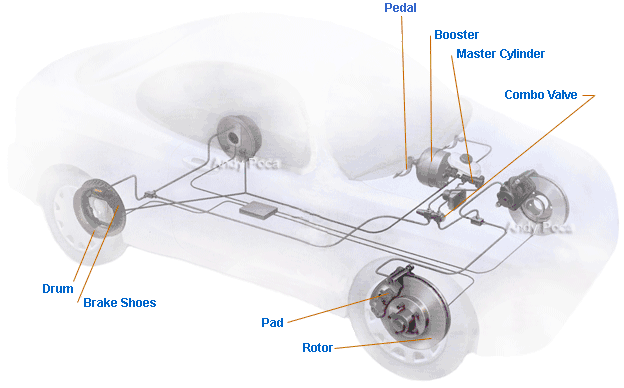 |
|
BRAKING SYSTEM |
|
|
Braking With Brake Rotors or Discs
Braking with brake rotors (also called discs) is accomplished by the brake pads
being forced against the surface of the brake rotor [torque]. The brake pads
skate across the surface of the brake rotor squeezing the brake rotor between
the two brake pads. Friction
is the mechanism that converts dynamic energy into heat. Just as there are two
sorts of friction between the tire and the road surface (mechanical gripping of
road surface irregularities by the elastic tire compound and transient
molecular adhesion between the rubber and the road in which rubber is
transferred to the road surface), so there are two very different sorts of
braking friction - abrasive friction and adherent friction. Abrasive friction
involves the breaking of the crystalline bonds of both the pad material and the
cast iron of the disc. The breaking of these bonds generates the heat of
friction. In abrasive friction, the bonds between crystals of the pad material
(and, to a lesser extent, the disc material) are permanently broken. The harder
material wears the softer away (hopefully the disc wears the pad). Pads that
function primarily by abrasion have a high wear rate and tend to fade at high
temperatures. When these pads reach their effective temperature limit, they
will transfer pad material onto the disc face in a random and uneven pattern.
It is this "pick up" on the disc face that both causes the thickness
variation measured by the technicians and the roughness or vibration under the
brakes reported by the drivers.
With adherent friction, some of the pad material diffuses across the interface
between the pad and the disc and forms a very thin, uniform layer of pad
material on the surface of the disc. As the friction surfaces of both disc and
pad then comprise basically the same material, material can now cross the
interface in both directions and the bonds break and reform. In fact, with
adherent friction between pad and disc, the bonds between pad material and the
deposits on the disc are continually being broken and some of them are
continually reforming.
With many pad formulas, the pad material must be abrasive enough to keep
the disc surface smooth and clean. As the material can cross the interface, the
layer on the disc is constantly renewed and kept uniform - again until the
temperature limit of the pad has been exceeded or if the pad and the disc have
not been bedded-in completely or properly. In the latter case, if a uniform
layer of pad material transferred onto the disc face has not been established
during bedding or break-in, spot or uncontrolled transfer of the material can
occur when operating at high temperatures.
The friction material that is quiet and functions well at relatively low
temperatures around town will not stop the car that is driven hard. If you
attempt to drive many cars hard with the OEM pads, you will experience pad
fade, friction material transfer and fluid boiling. The true racing pad, used
under normal conditions will be noisy and will not work well at low
temperatures around town.
Mechanically,
the brake pads skate across the brake rotor's
surface, the rotor's surface must be smooth and flat . If the
surface of the brake rotor is not flat it will transmit the surface variations to
the vehicle's steering wheel or brake pedal via the hydraulics systems.There are three primarily surface variations:
1) Lateral runout (sometimes call
Warpage) is a variation of the lateral surface position, starting with a
measurement of 0.004"(0.1mm) and greater. Lateral runout or Warpage may be caused by several factors; over tightening the
lug nuts (over-torquing), inaccurate lathe setups, and rapid temperature changes
during normal driving [very hot brake rotors are subjected to a splash of very
cold water multiple times]. The driver feels lateral runout when he applies
the brakes and feels the brake pedal "pulsate" or "judder".
2) Parallelism is a variation in the
thickness of the rotor starting with a measurement of 0.004"(0.1mm) and
greater. Parallelism or thickness variation is caused by a slight wobble in the rotor
allowing the rotor to come into contact with the brake pads at the wobble peaks.
This wobble may create significant parallelism in as few as 5000km. The driver feels parallelism by as
a "shake"
in the steering wheel.
3)
Martensitic transfer, or hard spots occurs as a result of a temperature build-up due to
the inability of the rotor surface to dissipate heat evenly resulting in a
"hard spot" on the rotors surface.Martensitic transfer occurs when the brake rotor is flat and its does not
dissipate heat rapidly and uniformly. The internal rotor heat increases to a
point where at critical temperatures a Martensitic transfer takes place producing
a "hard spot(s)". The Martensitic spot may be slightly raised from the
rotors surface. Excessive heat also results in increasing the surface hardness
and glazing of the friction brake pad materials. The driver may find this
similar to lateral runout, depending upon the severity of it and the number of
hard spots on a rotor.
Problems occurring in the braking system
Air in the system This is usually caused by air getting into the brake fluid
area, usually from the master cylinder. As the brake pads wear, the caliper
pistons ride farther out of the caliper, allowing more fluid to remain in
the calipers. Over time this can add up to almost as much fluid as there is
in the master cylinder reservoir. If neglected, this will allow the master
cylinder to pump some air into the brake lines. Air is very compressible,
whereas brake fluid is not, as long as there is a solid stream of brake
fluid between the master cylinder piston and the caliper piston, the brake
pedal will be nice and firm. If there is air in the system, the pedal will
feel spongy and will go down almost all the way to the floor, maybe all the
way, depending on how much air is in the system. The standard way of dealing
with air in the brake system is to perform an operation called
"bleeding the brakes".
Hard brake pedal
Can be caused by bad power booster, (or loss of vacuum to the booster)
seized caliper pistons, seized caliper slides, pinched brake lines, and
(rarely) problems with the pedal linkage under the dash. The probable best
fix is new calipers, and new pads.
Brake fade
Two phenomena contribute to brake fade, one is the fact that the
coefficient of friction of most substances gets lower at high
temperatures, and that most liquids will boil at some temperature, and
that gases compress, while liquids do not. When you use the brakes to
decelerate 3,000 or 4,000 or 7-8-15,000 lbs of vehicle, they get hot.
Under normal circumstances this would be no big deal, the heat that builds
up in the pads, rotors, and calipers will slowly radiate back to the air
flowing over them as the car continues down the road. If you are back on
the brakes, doing more decelerating, instead of cooling off, the brakes
are getting hotter. .As the pads and rotors get hotter the friction
material of the pads starts to separate. The binding agent starts to melt
off from the surface of the pad, and the coefficient of friction
approaches zero, as does the braking efficiency.
Brake squeal This is a high pitched squealing noise, often heard when you are going
slow and are not applying the brakes. If it goes away as you apply the
brakes, it could be coming from the brake wear sensors. (Also called
'squealers' by mechanics.) They are small bits of spring steel that are
attached to the brake pads in such a way that when the pads are about 75%
worn out, the sensors start to rub on the rotors, making the noise.
Grinding noise
Sometimes it is just a small stone, trapped between the brake rotor and
the air deflector. The faces of the rotor should be smooth and clean. If
you see large scaly rusted places on the friction surfaces of the rotor
you should replace them. If your pads are worn out(less than 3/16 of an
inch of friction material left) and you catch it in time, all you have to
do is install new brake pads. If the surface of the rotor is damaged, you
will have to replace it.
Brake pedal pulsation There
are a lot of things that can cause this, from out-of-adjustment wheel
bearings to rotors that are bent, brake drums that are out-of-round, rusty
spots on the rotors that have a different surface smoothness. To determine
whether the pulsation is coming from the front or the rear wheels, check
to see if you can feel the pulsation in the steering wheel when the pedal
is pulsating. If you can, the problem is coming from the front wheels.
Brake pull Mostly
this one comes from either a caliper piston seized or caliper slides
seized. Replace calipers and pads and service the caliper slides.
Brake grabbing When
you just barely touch the brake pedal and one or more wheels locks up and
skids. This one most commonly comes from contaminated friction material on
one or more brakes.
Pedal goes to the floor
Stop driving and check your fluid level. It might just need to be topped
up to temporarily get you some braking .