 |
 |
|
Durante conflictos entre grupos de gente, se buscan maneras de alivianar preocupaciones exteriores e interiores. El baile siempre trae momentareos olvidos a los conflictos. La gente busca distraerse, busca el olvido del pernicioso dolor, y desea borrar los perjudiciales pensamientos de la conciencia. Busca la manera de unirse con su pr�jimo, de gozar, aunque sea pasajeramente. Escuchando las palabras que nacen del pueblo al son de la m�sica, logra desahogar su dolor, o a lo menos divertirse brevemente. Durante la gran depresi�n hubo mucho sufrimiento. �Y qu� hac�a la gente para cobijar ese sufrimiento? Bailaban, por supuesto.
Poco de nuestra historia. Recordamos aqui a la familia G�mez durante los 30s y 40s. Ellos compartieron mucho de sus talentos para alivianar el dolor y cansancio de la gente mexicana de nuestros tiempos. Despu�s de sus pesadas labores, la gente se reun�a para olvidar sus problemas, y restaurar sus esp�ritus. La plataforma, centro de nuestro pueblo en esos tiempos, fue lugar donde podr�a juntarse como familia toda la comunidad mexicana. As� se compart�a de lo poco que pose�a la gente, sin codic�a ninguna. �ramos en esos tiempos unidos por la necesidad y por el amor. Lo siguiente es solamente un momento de reflejo. Music & Dance Early m�sicos Pablo Lucero and Medardo Segura both knew how to play the fiddle. There were no organized Mexican-American musicians, so they played at the Anglo dances. When the G�mez family came to town, things changed. They were the group, the orchestra, and every single family member knew how to play one or more instrument. I have often pondered what would have become of this family had they been fortunate enough to have settled in a city like Los Angeles, San Antonio, or any other big city where they could have showcased their talents. As it happened, destiny brought them to Van Horn, a small community struggling to survive and suffering from growing pains. Their talents were magnificently exhibited at small functions in the Mexican-American side of town. The played at get-togethers at the plataforma, at the wedding dances, and quincea�eras at the Barranday dance hall, and at the courthouse. The dances at the courthouse were really the best of the best. That's where the G�mez family would shine. The popular songs of the day were played time and again at people's behest, depending on their mood. (This depended on the quantity and quality of beverages consumed) The most popular songs in those days were: Morir So�ando Julia Vals Atotonilco El Barrilito Solamente Una Vez Begin the Beguine La Barca de Oro Amor Chiquito Amor Perdido El Rancho Grande Margarita Cuatro Milpas In the Mood (the jitterbug) String of Pearls B�same Mucho Tacuachito Sentimental Journey Don't Get Around Much Anymore I'll Never Smile Again Paper Doll Till the End of Time Jalousie Amapola Chattanooga Choo Choo Daddy Green Eyes Maria Elena Blue Champagne White Christmas Jingle, Jangle, Jingle I've Got a Gal in Kalamazoo Tangerine Sleepy Lagoon Blues in the Night Who Wouldn't Love You I've Heard That Song Before Paper Doll Sunday, Monday, or Always You'll Never Know In the Blue of the Evening Taking a Chance on Love That Old Black Magic Swinging on a Star Shoo-Shoo Baby Don't Fence Me In I'll Get By San Fernando Valley I Love You Rum and Coca Cola Till the End of Time On the Atchison, Topeka, and Santa Fe I Can't Begin to Tell You Chickery Chick It's Been A Long, Long Time I'm Beginning to See the Light The musicians consisted of Don Cleto G�mez, who played cornet and the violin, Calo Orona the drums, Baltazar (Chal) G�mez, the violin, Jes�s (Surdo) Gom�z, the valve trombone and the guitar, and Don Sylvestre Orona, the guitar. Don Sylvestre, a totally blind person, and his son, Calo, came from Carlsbad to help Don Cleto. Later, Calo grew up and formed his own group, playing in Van Horn many times. Later on Melchor (Cuate) Gom�z played the drums, Jes�s G�mez played the guitar, Hern�n Cortez the trumpet and the guitar, and later Alfredo (Fero) Gom�z, David Gom�z, and Benjamin Gom�z all played saxaphones. Sometimes Johnny Montoya, who played the guitar, the piano, and the saxaphone, would join in. Johnny Montoya, Johnny Mendoza, and Jos� Alba were the vocalists. They would sing many of the songs listed above. Sometimes Johnny Mendoza and Rale Navarrette, both guitarists, would accompany the G�mez. During these gatherings at the platform we would drink teswino and tepache made by Sabas Fierro and my padrino Martin Barrera. Teswino is a homemade beer made from corn. It is an old Indian recipe. Sabas Fierro would place dried corn seeds in between wet burlap sacks. After a few days the seeds would sprout and he would then boil them in a big vat and then mashed them. Later, he poured the mess into crocks and they sat in a dark cool place for some days fermenting. After straining out the solids, all the adults would enjoy. The whole neighborhood would get together and sample each batch of the tasty, delicious teswino. Tepache, on the other hand, is a traditional drink consumed in the center of the Mexican kitchen table. Its alcoholic strength depends on how long it is allowed to ferment. However, it is not consumed as an alcoholic beverage meant to get a person drunk. It is fixed by taking three quarts of water, two sticks of cinnamon, 400 grams of barley, one and one half piloncillos, one large, mature pineapple, and eight cloves. The pineapple is washed and cleaned carefully, cut into pieces including the peeling, and crushed. It is put into a jar with water, putting in the cinnamon and cloves. This is left in a dark room for several days. The barley is boiled with the piloncillo in a quart of water until the cloves burst. The pineapple is added, and this is left to ferment in a hot place. Afterwards, the mixture is sifted into a clean jar. Add chopped ice to serve. How many of you remember these drinks? Later on Artemio Luna, Florinda Luna, Lydia Luna and I would take music lessons from Don Cleto. When Don Cleto went to that gran sala de baile in the sky, Don Ram�n Morales, who was also a composer of music and a shoe repairman, became our music teacher. I would take music lessons from Don Ram�n, and I would also help him repair shoes. I got so good at the repair business, he taught me how to make shoes from scratch. How many kids get that opportunity nowadays? I had the good fortune to have played with both the G�mez and the Morales families. Don Moises, Don Ramon's son, played the valve trombone, just like I did, Gallo played the trumpet, and Beto played the guitar, Ram�n the tololoche (Bass) and Johnny Morales the violin. Lala Calder�n played the clarinet. Sometimes my dad,C�stulo Luna, who played the guitar, would accompany us. The Morales's played entirely different kinds of music pieces than the G�mez's. Those were happy days. |
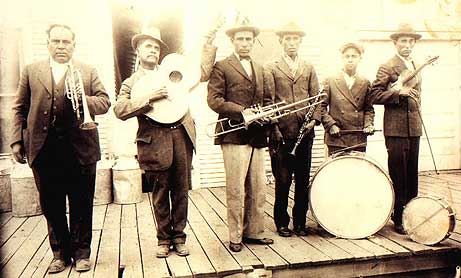
Cleto G�mez, Sylvestre Orona, Jes�s Gomez, Refugio (Cuco) G�mez, Calo Orona, Baltazar G�mez
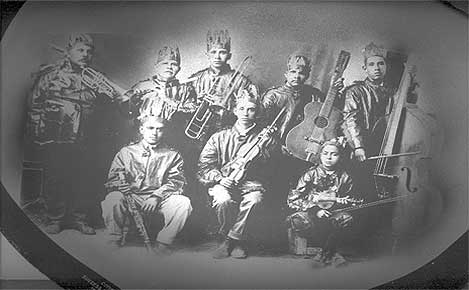
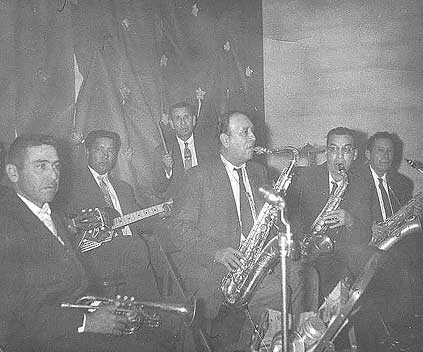
Hern�n Cortez, cornet, Rale Navarrette, guitar, Cuate G�mez, drummer,
Baltazar G�mez, saxaphone, Alfredo G�mez, saxaphone, David G�mez, saxaphone