The following cryptographic system uses Private Key Cryptography which involves use of same key for both encryption and decryption. The key which is used to encrypt and decrypt may be of any length or even larger then the information to be transformed in to cipher text.
Number of stages of encryption α Key length
The process of encryption and decryption is divided into many stages and each successive character in the key text is used as the key for DES algorithm. The number of stages depends on the length of the key. DES (Data Encryption Standard) algorithm is used by the cryptographic system for each stage of encryption.
Encryption:
Key String: C1C2C3…Cn
Length of key string =n
No of stages of encryption=n
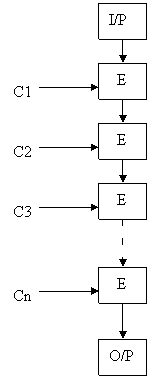
E : DES Encryption algorithm
I/P : Input Character
O/P : Encrypted Output Character
For a given string each character of the string in the form of ASCII code is used as the key for encryption. The ASCII code of ith character (Ci) is used as key for ith stage of encryption process, the result of ith stage is used as the input to (i+1)th stage which is encrypted using ASCII code of Ci+1th character. A key string of length ‘n’ results in ‘n’ stages of encryption.
Decryption:
Key String: C1C2C3…Cn
Length of key string =n
No of stages of decryption=n
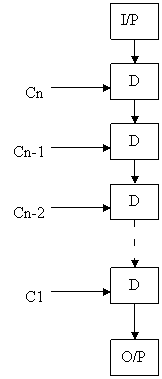
D : DES Decryption algorithm
I/P : Input Character (Encrypted Character)
O/P : Decrypted Output Character
Decryption is the reverse process of encryption, the characters of a given key string are used in reverse sequence staring from ‘n th ’ to the ‘1th’ character. For a given string each character of the string in the form of ASCII code is used as the key for decryption.
ASCII code of last character is used in the first stage and the penultimate character is used in second stage and so on. Here also the output of a stage of decryption is used as the input to the next stage. A key string of length ‘n’ results in ‘n’ stages of decryption.
The strength of cryptography lies in the choice (and management) of the keys, longer keys will resist attack better than shorter keys. Depending on the level of security required the user may choose a key length, unique feature of this technique is that the user may perform any number rounds of encryption on given information with separate key string for each round. Any file format (*.txt,*.rtf,*.exe …) can be encrypted with the above technique, to protect the unauthorized person from using them or a group of files may be zipped and the zip file can be encrypted. Once encrypted the zip file becomes a invalid archive and no password cracker can be used, the only possible way is to use the secret key string to decrypt it and transform into a valid zip archive.