^
 2000
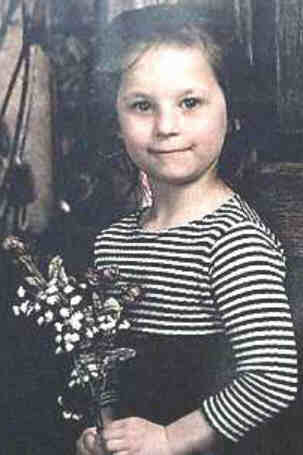
Kayla Rolland, 6. 2000
Kayla Rolland, 6. She is shot dead by 6-year-old boy (a Black) from the same first grade, in a Buell Elementary School classroom, Mount Morris Township, just north of Flint, Michigan.. At about 10:00, the class of 22 was going to the library. The teacher was standing in the doorway. The last five children were still in the classroom, when the boy — who had the .32 semiautomatic pistol tucked in his pants — pointed it at a pupil. Then he turned toward Kayla and fired the only bullet in the gun, striking her in the neck. The children said that the boy had been showing them the gun and threatening to shoot someone. Why the teacher didn't notice anything has not been explained. The mother, Tamarla Owens, had left the boy and his 8-year-old brother in the care of her brother in a house where stolen guns were traded for drugs. Jamelle James, 19, who lived there too, had left the loaded gun under a blanket, where the boy found it. Charged with involuntary manslaughter, James would be sentenced on 11 September 2000 to 2 to 15 years in prison. The boy, considered too young to form criminal intent, would not be charged with anything. Dedric Owens, the father, is in jail since 20 February 2000, awaiting trial for breaking parole on a home invasion charge. |
2000 Edwin Haroldo Ochoa López, and Julio Armando Vásquez Ramirez,
murdered in Puerto Barrios, Guatemala. They were environmental workers
with the Guatemalan National Council on Protected Areas (Conap). Ochoa
had investigated allegations of land-grabbing, illegal lumber cutting
and other environmental crimes in the departamentos of Petén and Izabal.
Ochoa’s cases included an Izabal deforestation accusation against retired
Col. Otoniel Ponciano García and two associates.
1996 All 117 passengers and 6 crew members aboard a Peruvian
Faucett Airline Boing 737 which crashes in the Andes as it prepares to
land at Arequipa.
| ^
1980 Yigal
Pavlovich “Allon”, Israeli soldier
and politician, born on 10 October 1918 in Palestine. — He was best known as the architect of the Allon Plan, a peace initiative that he formulated after Israel captured Arab territory in the Six-Day War of June 1967. Allon was one of the first commanders of the Palmach, an elite branch of the Haganah, a Zionist military organization representing the majority of the Jews in Palestine after World War I. He was involved in smuggling European Jews into Palestine in defiance of restrictions placed on immigration by Great Britain, the region's mandatory power during the period between the world wars. During World War II he fought as a volunteer alongside British soldiers against the Vichy French in Lebanon and Syria. After Israel proclaimed independence on 15 May 1948, the Haganah became the Israel Defense Forces (IDF), and Allon's initial reluctance to place the Palmach under IDF command earned him the enmity of David Ben-Gurion [16 Oct 1886 – 01 Dec 1973], the first prime minister of Israel. As a commander of the Palmach, Allon fought major battles against the Arabs on various fronts during the first Arab-Israeli War. Pursuing Egyptian forces from the Negev into Sinai, he captured many prisoners of war, including Egypt's future president, Gamal Abdel Nasser [15 Jan 1918 – 28 Sep 1970], then a junior officer. Allon entered politics in 1955 when he was elected to the Israeli Knesset (parliament) as representative of Ahdut ha-'Avoda–Po'ale Tziyyon (“Unity of Labour–Workers of Zion”). He held important portfolios in the cabinets of Ben-Gurion, Levi Eshkol [25 Oct 1895 – 26 Feb 1969], and Golda Meir [03 May 1898 – 08 Dec 1978] and served briefly as acting prime minister in 1969. Following the 1967 war, as deputy prime minister, he developed a peace plan that proposed restoring most of the West Bank territory to Jordan while retaining military settlements along the Jordan River. The plan was never adopted but spurred the growth of Israeli settlements in the occupied territories in subsequent decades. His unexpected death occurs while he is being considered for the leadership of the Israel Labor Party. |
1960 Some 13'000 persons in magnitude 5.7 earthquake
at 23:40 with shallow epicenter at Agadir, Morocco. Some 20'000 persons
are made homeless.
1956 Elpidio Quirino, 65, President of Philippines (1949-1953)
1948 27 British soldiers, as Stern gang of Zionist terrorists
bombs Cairo-Haifa train.
1924 (11 Feb?) Jean-François Raffaëlli, French
painter, sculptor, and printmaker, born on 20 April 1850.
| ^
1868 Louis
I, in Nice, France, king of Bavaria (1825-1848), born
on 25 August 1786 in Strasbourg, France. — He was a liberal and a German nationalist who rapidly turned conservative after becoming king. He is best known as an outstanding patron of the arts who transformed Munich into the artistic center of Germany. Louis, the well-educated eldest son of King Maximilian I [27 May 1756 – 13 Oct 1825], was a fervent German nationalist as a youth and served only reluctantly at the headquarters of Napoléon [15 Aug 1769 – 05 May 1821] in the wars against Prussia and Russia (1806–1807) and Austria (1809). In Bavaria he came to head the anti-French party, and at the Congress of Vienna (1814–1815) he unsuccessfully advocated the return of Alsace and Lorraine to Germany. The liberal Bavarian constitution of 1818 bears his stamp, and he repeatedly resisted the demands of Klemens Metternich [15 May 1773 – 11 Jun 1859], the Austrian statesman, for basic changes in that document. In church questions, however, Louis was more conservative, opposing his father's secularization of monasteries. He played an active part in the downfall of Bavaria's leading minister, Maximilian Montgelas [10 Sep 1759 – 14 Jun 1838] (1817), whom he blamed for these anti-ecclesiastical policies. Louis's liberal reputation assured him of general acclaim upon his accession, but he was soon to disappoint his subjects. The king frequently feuded with the Diet, and after the revolutions of 1830 in Europe he came to distrust all democratic institutions. The Öttingen-Wallerstein ministry (1831–1837) was a shift to the right, and the subsequent government under Karl von Abel (from 1837) steered a strictly reactionary and clericalist course, restoring many monasteries and proceeding to erode the liberal constitution. Culturally, however, Louis's reign was brilliant. An enthusiastic patron of the arts, he collected the works that formed the nucleus of Munich's two best-known museums, the Glyptothek and Alte Pinakothek. His large-scale planning of Munich created the city's present layout and classic style. He commissioned many representative buildings, among them the Ludwigskirche, Neue Pinakothek, Propyläen, Siegestor, Feldherrnhalle, and Odeon. On the outbreak of the revolutions of 1848, Louis, whose passion for the dancer Lola Montez [1818 – 17 Jan 1861] had reduced his popularity even further, abdicated in favor of his son Maximilian II [28 Nov 1811 – 10 Mar 1864]. |
1848 Louis-François baron Lejeune, French general,
painter, and lithographer born on 03 February 1775. — Author of
Mémoires du Général Lejeune. — MORE
ON LEJEUNE AT ART “4” FEBRUARY
with links to images.
|1604 John Whitgift, 74, Archbishop of Canterbury (1583-1604)
| ^
1528 Patrick
Hamilton, 24. He is burned at the stake, protomartyr of the Scottish Reformation, Scottish preacher educated in Paris and at Aberdeen University. His Lutheran sympathies then forced him to flee to Germany. He returned to Scotland in 1527 and began to preach at Kincavel. He was invited by James Beaton, Archbishop of Saint Andrews, to attend a conference at Aberdeen. But in 1528, he was brought to trial on a charge of heresy, found guilty, and executed. His 'Loci communes', or 'Patrick's Places', setting forth the doctrine of justification by faith, is included in John Foxe's "Actes and Monuments of these Latter and Perillous Dayes", commonly known as "Book of Martyrs.".[I found no such doctrinal tract in the online edition, but it has the following about Patrick Hamilton at the beginning of chapter 15]
|

