- EXECUTIVE SUMMARY
The Queen's University entry
to the 2000 Canadian National concrete Canoe Competition
is Quixote, a high performance, exhaustively researched,
and very attractive boat. Quixote embodies the heart,
soul and dedication of the Queen's Concrete Canoe Team.
It has an asymmetrical hull 5500 mm (18 ft) long, 870 mm
(34 in) wide at the widest point, and 270 mm (10.6 in)
deep. The hull thickness varies from six to eight
millimetres (0.24 to 0.31 in). The mass of the canoe is
52 kg (115 pounds), and it is finished in a stunning
blend of yellow, red and blue - the traditional Queen's
Tricolour.
The 2000 Canadian National Concrete Canoe Competition
marks a significant point in the development of the
Queen's concrete Canoe Team (QCCT). The culmination of
four years of experimentation, trials, tribulations,
successes and failures has developed a well balanced,
durable, attractive and fast canoe capable of challenging
the best in the world. This year saw the advent of
significant breakthroughs in construction technique (a
vacuum de-watering and finishing system) and research
work for both concrete mix design and reinforcement.
These breakthroughs, coupled with the enthusiasm and
spirit Queen's engineers are renowned for should carry
the QCCT to victory in Canada.
2. INTRODUCTION
In 1841, twenty-six years before Confederation, Queen
Victoria issued a Royal Charter for a Queen’s
College at Kingston. Though established primarily to
train the clergy, the small denominational college became
Queen’s University at Kingston when the
Canadian Parliament amended the charter in 1912
separating the church from the university.
Queen’s 65 hectare (160-acre) campus is set on
the north east shore of Lake Ontario in Canada’s
historic "Limestone City", Kingston. The city
was founded in 1673 and has been shaped by a powerful
sense of geography. It’s strategic location, at the
southernmost end of the Rideau Canal where Lake Ontario
feeds into the St. Lawrence River, provided prosperity
through shipbuilding and national defense during the
1800’s. Kingston was the first capital of colonial
Canada before the National Seat of Government was moved
to Ottawa.
Of the more than 17 650 students enrolled at
Queen’s University, 1755 are registered with the
Faculty of Applied Science. Approximately 180 individuals
are studying civil engineering, seventeen of which are
member of the Queen's Concrete Canoe Team. In recent
years, the Team has consisted mainly of civil engineering
students. This year, students from engineering physics,
chemical and mechanical engineering have contributed
greatly to the development of Quixote, this
year’s NCCC entry.
The Team has christened its canoe "Quixote"
after Don Quixote de la Mancha, the hero of Miguel de
Cervantes’ infamous tale. Though originally
published in 1605, the story is timeless as it reflects
the anti-individualism still existing today. Quixote is
ridiculed for his seemingly pointless mission to
"make a knight-errant of himself, roaming the world
over in full armour and on horseback in search of
adventures." (REF) Like Quixote, the Team is often
mocked for the tremendous effort invested into the
research, design and construction of the concrete canoe.
The Team's response to such chastising is simple. As Don
Quixote did, the Team is "in search of
adventures."
Queen’s began concrete canoe racing in 1976.
Though Queen’s participated in the competition the
following year, it did not participate in its third
competition until 1997, when a group of students from
Arnprior decided to resurrect the team. Although they
placed sixth overall, their concrete mixture and
technical report placed among the top three teams.
Improvement to the design enabled Queen’s to clinch
fourth place overall in 1998, where we received an award
for best oral presentation. Last year was our best
competition yet, having placed third overall and winning
the spirit award. Our goal for the 2000 CNCCC is to win
the competition outright and represent Canada at the
concrete canoe competition in Colorado.
- HULL DESIGN
Quixote is the product of an extensive and methodical hull
design process. The principles used in the design stem from
classic naval architecture methods with specific applications for
canoe design. Quixote’s hull form is an original design
developed by the members of the QCCT.
General
Our three years of competition experience has provided us with
a wealth of knowledge in the construction and shaping of concrete
canoe hulls. There are a few "tricks of the trade"
which must be kept in mind when designing a hull made of
concrete. Firstly, tensile stresses should be minimized in order
to reduce cracking in the hull. This prevents damage to the
canoe’s finish, and decreases the likelihood of water
infiltration. However, for the reinforcement to develop its full
strength the hull must crack to some degree. Secondly, if the
composite section has orthotropic properties, such as higher
bending strength in one direction, the material should be
oriented in the direction of the dominant stress to maximize the
hull strength.
Quixote
Following the conclusion of the 1999 Canadian Concrete Canoe
Competition the design process for the 2000 canoe began. The QCCT
was pleased with the performance of its 1999 entry, Krakatoa,
who's third-place finish had prompted team members to review the
current design to determine how the hull could be modified to
improve the canoe’s performance. The consensus was that a
longer, finer hull would reduce drag and increase the theoretical
hull speed. It was thought that modifying the profile of the
canoe to a more hydrodynamic shape by increasing the concavity of
the stern would promote laminar flow over a longer portion of the
canoe hull and reduce form drag.
In the fall, the QCCT conducted a cost-benefit analysis to
determine the most cost-effective way of producing a competitive
concrete canoe. It was decided that the polystyrene foam mold
used to produce Krakatoa 1999 would be re-used by
reshaping the form as per Quixote’s specifications.
This produced a set of geometric constraints, as mold dimensions
could be decreased with ease, but increasing the width or depth
of the existing form would be difficult.
Table XX: Design Constraints
| Parameter |
Constraint |
| Length |
5400 mm +/- 500 mm |
| Maximum Width |
850 mm |
| Maximum Depth |
350 mm |
| Profile and silhouette |
within Krakatoa’s
limits at all points, except for at the ends |
These constraints were considered in the evaluation of the new
hull shape.
Modifications to the cross-section incorporated the following
points; a steeper vee bottom to produce better straight line
tracking; soft chines to reduce drag as much as possible and
promote good secondary stability; and finally a profile just
above the waterline on both sides of the canoe that would
increase the rocker of the hull when heeled over, thus making it
easier to turn.
With these concepts in mind, and full of enthusiasm, the
design team began the process of producing the plan for the hull.
Initial work was completed with the use of three-dimensional
computer modelling, to allow changes to the hull profile to be
analysed. The computer system was also used to analyze the
stresses on the hull after the design was finalized. When the
hull shape had characteristics that the team was happy with, a
one tenth scale model was produced using basswood. This model was
tank tested to determine its relative merits with other models
available at the same scale. The Team has amassed a large
collection of these models over the past years. The hull shape
was slightly modified based on the results of these tests, and
the test results show that the design produced has the lowest
drag of any hull considered by the team over the past three
years. (INSERT DRAG CHART HERE)
At this point, the Team began the process of analysing the
hull shape to determine the maximum stresses on the hull. The
following conditions were examined, supported at both extreme
ends (upright and inverted, corresponding to being carried from
place to place by two people), supported in the water carrying
both two and four paddlers, and finally inverted, supported on
two interior points and subject to lateral wind loading of 120
km/h, which corresponds to the worst case transportation loading
experienced by the Team in the past. Dynamic loading due to self
weight and bouncing was also considered (heavy hits of bumps on
highways). Unsurprisingly, the worst case stresses were due to
transportation loading. This analysis determined that the maximum
elastic stress that would be developed in the hull would be 15
Mpa. This information was incorporated into both the concrete mix
design research and the reinforcement research.
- Final Hull Shape
The final hull design arrived at by the Team is an asymetrical
hull shape, of maximum width 870 mm and overall length 5500 mm.
The depth is 270 mm to give generous freeboard and allow for
choppy on-water conditions. The hull has a pronounced shallow vee
bottom, soft chines and a gentle flare. The bow and stern are
rockered slightly to allow quick turning, and the rocker becomes
more pronounced as the angle of heel increases. A fifty
millimetre gunwale is monolithic with the hull to increase the
stiffness of the boat. Flotation chambers filled with polystyrene
foam take up the front and rear 570 mm of the hull. The widest
point is located 3000 mm from the bow, and from that point the
hull quickly tapers to a concave stern.
- CONCRETE MIXTURE DESIGN
The Team recognized early in the campaign to build Quixote
that a systematic approach to developing a concrete mix was
necessary. The structural system chosen for Quixote required a
high strength concrete with a low density to reduce the weight of
the canoe and increase performance. A very low permeability
concrete was also desirable to prevent weight gain due to water
exposure on the unpainted band on the canoe. The hull design
called for a minimum strength of 25 Mpa, and a density of less
than 1300 kg/m3.
The teams' goal was to produce such a high performance
concrete, but this could not be achieved by applying the
conventional theory and practice for lightweight concrete. For
this reason, the Team decided to investigate the behaviour of
concrete mixes based on the following theory. Concrete strength
is generally assumed to be dependent on the density and stiffness
of the concrete, and the quality of the cement paste is a major
determining factor in developing the strength of a mix. The team
decided an ideal mix would be one in which the cement paste was
as dense and impermeable as possible, while the aggregate in the
concrete had high strength, low density and very low
permeability. This approach differs from the usual method where a
low strength, highly porous aggregate is used to produce low
density, low strength concrete.
The Team decided to conduct background research to develop the
above theory to the point that it could be used to predict the
properties of a mix design. To this end, 35 research mixes were
created to investigate the effects of water/cement ratio, varying
silica fume content in total binding material, cement/aggregate
ratio, and effects of different aggregates on both strength and
density. The results from these tests were used as background to
design five trial batches for the final mix design. The results
from these tests are presented in the following conclusions. All
though the research is not totally definitive in that more
samples would be required to achieve statistically accurate
design guidelines, they are certainly suitable for the purpose at
hand.
Table ### Concrete Mix Guidelines
| Conclusion 3.1 Effect
of Water/Cement Ratio |
| When adequate
superplasticizer is used to ensure workability, a water
cement ratio of 0.41 produces the highest quality
concrete. |
| Conclusion 3.2 Effect
of Cement/Aggregate Ratio |
| When only ceramic
microspheres are used as aggregate, and the water/cement
ratio is held constant, increasing the cement/aggregate
ratio increases both the density and strength of the
concrete. The optimum range is 2.0 to 2.2 |
| Conclusion 3.3 Effect
of Silica Fume |
| When silica fume is used
in the range of zero to twenty five percent of binding
materials by mass, the greatest increase in strength is
found between 15 and 18 percent silica fume by weight. |
| Conclusion 3.4 Effect
of Blast Furnace Slag as Aggregate |
| Slag used as aggregate
increases the strength and density of lightweight
concrete. It also creates problems with workability and
concrete placement due to the larger size of the
aggregate particles. It is not suitable for concrete in
the structural system used for Quixote. |
Concrete strength and density were evaluated using the
procedures of ASTM ####(REF), generally used for evaluating the
compressive strength of cement based grout. The general procedure
used for this test was to cast 51 mm (2 in) cubes of the test
concrete, cure them in a fog room for seven days and test them in
compression. All strength results quoted in this report are based
on seven day strengths. The results of this test were found to
correlate very well with the results of tests using the
procedures of CSA A23.2-9C, Compressive Strength of Cylindrical
Concrete Specimens(REF). This non-traditional test was done to
speed the feedback cycle to the concrete mix design team and to
economise the use of scarce resources.
Additional testing on the concrete used to cast the canoe was
done using both CSA A23.2-9C, ASTM C 469 - 94, Standard Test
Method for Static Modulus of Elasticity and Poisson's Ratio of
Concrete in Compression(REF), and CSA A23.2-13C, Splitting
Tensile Strength of Cylindrical Concrete Specimens(REF).
Composite Section
Standardized composite sections have been tested by the Team
for the past three years. The standard plate is 4 inches wide, 14
inches long and 1/4 inch thick. Various combinations of
reinforcing are placed in the forms and concreted, and the test
method used by the team involves manual loading the plate with a
single line load at midspan, while recording deflections if
necessary using a dial gauge indicator. The final concrete mix
chosen for its compressive strength and density was used in all
composite section tests. The results of this testing are
presented in the Reinforcement section.
- REINFORCEMENT
- As the structural system chosen for Quixote required a
thin, relatively rigid composite wall, and the
construction of the hull required a flexible
reinforcement, the choices for reinforcing material were
constrained by the following requirements. The material
should have a thickness of less than 1.5 mm, have a
modulus of elasticity greater than 100000 Mpa, yet be
ductile and flexible enough to conform to the mold while
retaining integrity. These somewhat incompatible
conditions led to the choice of galvanized steel wire
mesh as the reinforcing system.
While composite
materials such as carbon fibre, aramids and other
plastics have become more available in recent years,
steel is a very cost competitive material, and has
additional benefits with respect to the rules of the
competition. The high modulus of elasticity of steel
means that smaller cross-section of steel can carry
similar loads to larger sections of composites. Most
fibre reinforced polymers tend to have brittle behaviour
near failure, while steel is capable of yielding to a new
shape while retaining a useful amount of strength. A
further attractive feature of steel is that it can be
easily cut and shaped with available tools, requires no
special protective equipment and in general has very
isotropic behaviour. Steel has an unmatched stiffness,
and that is of paramount importance when dealing with
composite sections as called for by the hull design.
Finally, steel mesh is available in a wide range of wire
gauges, mesh sizes, weaves and coatings.
Extensive comparison of the properties of steel mesh
led to the testing of various sizes of mesh conforming to
the guidelines of ASTM A 740 - 96 Standard Specifications
for Hardware Cloth. The meshes chosen were square welded
wire, hot dip galvanized and were of two sizes - 6.35 mm
(0.25 in) and 12.7 mm (0.5 in). These materials were
tested in tension for the ultimate strength. The
procedure used to test the materials was a variation on
ASTM E 8, Standard Test Methods of Tension Testing of
Metallic Materials. Specimens were produced using reduced
cross-sections over a gauge length three times as long as
the width. The samples were placed in specially prepared
wedge-type grips and tightened in place with a torque
wrench to ensure uniform gripping pressure between all
tests. The samples were then installed in the testing
machine and loaded until failure. The failure loads were
recorded, and the strengths in load per unit width were
determined. All test specimens failed at connection
points where welding had taken place.
The thicknesses of the reinforcement layers were found
following the procedure outlined in the official concrete
canoe rules.
Composite section tests were used to evaluate the
strength, ease of placement and density of the various
reinforcement combinations considered for Quixote. In
all, sixteen composite sections were tested in
preparation for choosing the reinforcement, as well as an
additional twenty nine identical sections from the
previous year that were used to provide baseline data.
This large bank of knowledge allowed the Team to fine
tune the reinforcement used to the stress levels in the
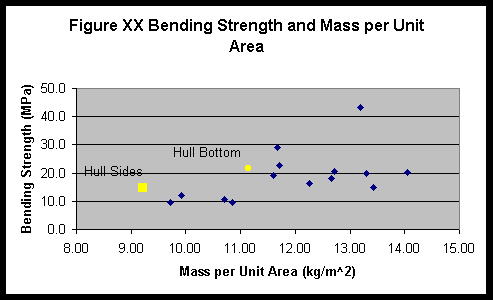
different parts of the hull. Plots of bending strength
against mass per unit area are shown in Figure XX. While
the highest absolute strength reinforcement combinations
were not chosen, the selected combinations had
outstanding performance to weight ratios, and exhibited
good constructability and finishing properties.
- CONSTRUCTION
- Introduction
The success of the previous year's
construction method, DASCHUNT 2.1 (Differential Axial
Sandwich Construction Technique, Version 2.1) was
considered greatly during the development of the
techniques used to build Quixote. The cost-benefit
analysis carried out by the Team indicated that reuse of
the polystyrene foam mold would have the greatest benefit
to the Team, while carrying the least cost. It follows
that the technique used would be very similar to previous
year's. Other options considered in the analysis were a
female mold, or producing a two part mold (both inside
and outside surfaces produced). These latter two options
were dismissed for the following reasons: A female mold
would make stretching the reinforcement tightly to the
mold surface difficult, and thus make control of hull
thickness difficult. A two part mold, while having
distinct advantages, would again be difficult to produce
with the resources of the Team, and any variations in
dimensions between the two molds would lead to localized
areas of thin or thick spots. It was decided that a male
mold composed of 51 mm thick polystyrene foam sections
would give the best performance. As the Team had an
oversized mold available, construction went very quickly.
To quickly describe DASCHUNT 2.1, it involves the
following steps. First, sections of the three dimensional
canoe model are taken and plotted full size. These are
used to produce cross-section shaped pieces of
polystyrene foam, that are then glued together and
aligned using a notch cut out of the base. These
sandwiches are then sanded smooth according to the plans
produced, covered in shrink wrap plastic and are ready
for the concrete pour. By starting with a pre-existing
mold, a great amount of labour and expense was saved.
The existing sytrofoam mold was reshaped according to
the plotted cross-sections, and the extreme ends of the
mold were rebuilt to the new shape. When the foam was as
smooth as possible, a gypsum based drywall joint compound
was used to fair the mold to a perfectly smooth surface.
Plastic shrink wrap was again used to seal the mold and
prevent the concrete from adhering. This created a built
in mold release layer.
Prior to the final application of shrink wrap, the
layers of reinforcement were cut to fit the hull shape
and set aside. The initial layer of concrete was hand
applied to the mold, the innermost layer of reinforcement
was applied to the concrete. Further layers of concrete
and reinforcement were then alternated until the final
surface layer was in place. At this time, trowelling of
the concrete surface began, to remove any large surface
imperfections. The vacuum de-watering system was then
used over individual sections of the hull, working from
one end of the boat to the other. This system compressed
the concrete beneath the area being de-watered, and also
smoothed the surface to a great degree, thus producing an
excellent finish and ensuring that there would be few if
any air voids in the concrete. After the vacuum system
had finished, the surface was re-trowelled to remove any
remaining imperfections, and a polyethylene sheet was
used to cover the hull.
A vaporisor was used to provide a 100% relative
humidity environment beneath the polyethylene sheet, and
this was maintained for 40 hours, when the hull was
removed from the mold. The hull was again sealed inside
the plastic, and left to cure in the 100% humidity
environment for 10 days. At this time the protruding
gunwales were cast in place after the reinforcement left
exposed for this purpose was bent to shape. After a
further seven days of curing, the plastic was removed and
the vaporisor shut off. At this point the Team began
sanding the outer surface of the hull to prepare for
painting. Any small hollows at this stage were filled
using a special low density cement and microsphere
fairing compound. This compound is not expected to
contribute any strength to the hull, and is only in place
for aesthetic reasons. When the surface is as smooth as
practical, the hull is primed and then painted using a
base coat – clear coat automotive paint system. This
produced the final product.
- PROJECT MANAGEMENT
- The team’s organizational style has made substantial
improvements and advances from previous years. This year,
the team has organized itself into two main groups:
research and construction. Each group would be
responsible for carrying out various tasks under the
direction of two co-captains. The older and more
experienced captain led the research team in search of
innovative features and improvements to the canoe, while
the younger and less experienced one acted as project
manager to provide planning and organization for the
various stages of canoe construction. Both captains work
together to define the overall goals and ensure the
progress of the team.
In order to divide the tasks
equally amongst the two groups of members, positions were
assigned according to experience and capability. Such
positions include materials specialist, concrete mix
designer, construction manager, treasurer, communicator,
and fundraiser. Biweekly meetings were held to ensure
effective communication and exchange of information
between the two groups. At the same time, opinions are
voiced and decisions made.
This year marks the transition year in which new,
unskillful members emerge and old, knowledgeable members
depart. To successfully pass on the torch, a good project
planning and team structure has been implemented to
ensure the success of the Queen’s Concrete Canoe
Team in the future.
- COST ASSESSMENT
- The total cost to build Quixote is calculated based on
the methods and rates established in Section III.E-F of
the rules. From the beginning to the end of the project,
time and money spent on the canoe were carefully
recorded. They are broken into three phases: research and
development, construction, and competition.
The
majority of the expenses belong to labour cost. Each
phase of the project is divided into sub-categories in
which the hours spent by each member are recorded. As
shown in Table XXX below, the hours spent on construction
phase is the greatest, and therefore, accounts for the
largest labour expenses. . In addition, an outside
consultant was hired for a cost $600. The total hours
spent for each phase is multiplied by the Direct Labour
Rates (DLR) for each team member and summed to obtain a
total labour cost of $40,255.75. (See Appendix XXX, Table
XXX for Billable Direct Labour Rates)
The rest of the expenses comprise of construction and
project materials. Reinforcement and painting costs are
high as compared to other costs such as concrete
materials. This is due to generous sponsorship from the
Civil Engineering Department at Queen’s. In project
expenses, major costs include display, race equipment,
and T-shirts. The total costs are again summed up and
multiplied by a markup of ten percent to reach a total
cost of $3,623.39.
Table XXX below shows the summary of costs involved in
the construction of Quixote. For more detailed cost
breakdown, see Table XXX in Appendix XXX.
Table XXX Summary of Costs
| Category |
Hours |
Labour
Cost |
Material
Cost |
Total
|
| |
|
|
|
|
| Research and
Development |
191 |
$14,702.75 |
$103.39 |
$14,806.14 |
| Construction |
277 |
$19,279.75 |
$1,045.00 |
$20,324.75 |
| Competition |
104 |
$6,273.25 |
$2,475.00 |
$8,748.25 |
| |
|
|
|
|
| Total |
572 |
$40,255.75 |
$3623.39 |
$43,879.14 |
- INNOVATIVE FEATURES
The 1999-2000 academic year was a breakthrough year for the
Queen's Concrete Canoe Team. Since a great deal of labour was
saved by reshaping the mold from 1998-1999, the Team's energy and
effort was spent in more in depth research for concrete mix
design, construction technique and in a highly original method of
finishing the canoe.
- Concrete Research
- Beginning with the concrete mix design research,
the Team realized that published guidelines on
lightweight concrete mix design did not include
the methods and materials most useful for the
high performance low-density concrete desired for
the structural system. Established sources (fn)
using typical lightweight aggregate claim that
strength and low density are incompatible. It has
been the Team's experience that it is quite
possible to produce concrete with density below
1200 kg/m3 while maintaining strength
above 30 MPa. It was apparent that if we wished
to systematically design our mix, we would need
to develop our own guidelines for the effects of
the various parameters that influence concrete
strength and density. To this end, the large
number of trial mixes produced were all tailored
to investigate the effects of individual
variables, rather than attempting to jump to the
final mix design at once. This approach has the
added benefit of informing future teams of the
behaviour of concrete mixes utilizing the
ingredients investigated here. A set of design
guidelines was produced to accurately predict the
strength and density of the final mix, and
comparatively few final trial mixes were
produced.
- Construction and Finishing
- The most significant innovation of the 1999-2000
Team is about to be described. It falls mainly in
the category of finishing, although its
application has effects on concrete mix design
and other construction methods. For the first
time, after several years of thought, the Team
has developed and used a vacuum de-watering
system for final finishing of the canoe. The
theory and the application of this system will be
described in the following paragraphs.
- Theory
- Applying a vacuum to the surface of
freshly placed concrete causes mix water
to be removed from the concrete, lowering
the effective water/cement ratio. This
action also has the effect of
consolidating the fresh concrete through
the application of atmospheric pressure
on the flexible vacuum membrane. This
two-fold effect causes an increase in the
strength, durability and degree of
impermeability of the concrete. Tests
conducted during the development of the
system show an increase in bending
strength of a composite section of 24 %.
Beneficial side effects are the increased
uniformity of the surface finish (with
respect to hand troweled concrete), and
the speed with which vacuum processed
concrete can be removed from the form. It
should be noted at this time that due to
losses in the system it is impossible to
accurately determine the amount of water
removed, and thus the new water/cement
ratio.
- Application
- Densely woven cotton filter cloth is
placed directly on the surface of the
fresh concrete. This filter allows the
passage of water but stops the movement
of other concrete constituents. A heavy
vinyl sheet is then placed above the
cotton filter. This sheet is larger than
the filter to allow a seal to be
developed between the vinyl and the fresh
concrete. A vacuum pump is attached to
the vinyl sheet, and the air beneath the
vinyl is removed from the system to
create the low pressure environment
necessary to remove the water. The system
used by the Team reduces the pressure to
approximately 1/8 atmosphere, or 87.8 kPa
(26 in Hg) below ambient conditions. This
low pressure is maintained for
approximately 20 minutes for each section
of the hull being processed. Processing
the entire canoe in this fashion takes
approximately 240 minutes.
- Effects
The vacuum de-watered concrete resulted in an increase of
bending strength of 24 percent. The compressive action caused all
reinforcement to be pressed beneath the surface of the concrete,
resulting in a much more uniform appearance. The surface of the
processed concrete was hardened immediately, and could be touched
up to allow instant repair of any imperfections. The
consolidating action caused most air voids to be removed
throughout the thickness of the canoe wall. The vacuum
de-watering system has proved to be a highly effective and useful
tool in preparing a concrete canoe hull.
- SUMMARY