ESPRESSO
An Interview with Michael Maloney
(London, March 2001. Royal Court)
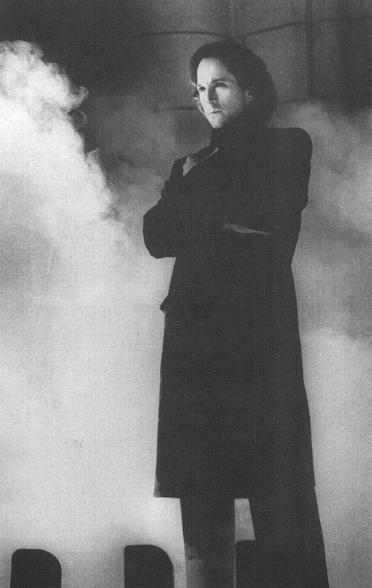
Michael Maloney in "In the bleak midwinter" by Kenneth Branagh
B – How about your first Hamlet? When did you do it first?
M – I think it was in the film of Mel Gibson’s Hamlet, I played Rosencrantz in that.
B – Was it your first approach?
M – Yes, then In The Bleak Midwinter and then Kenneth Branagh’s Hamlet. And then I played Hamlet myself…
B – Was it at the Barbican?
M – I did play it at the Barbican, it was in the foyer. It was an experiment, the first forty minutes, and then I played it at the Greenwich Theatre, it was 1996. I finished participating in the film in about April 1996, maybe May and then in about October 1996 I played it.
B – What are your feelings about Hamlet as a play and as a character? Because it’s such a peculiar role, so "wide"…
M – My approach as an actor from a egotistical point of view… I just wanted a very big part! Then you have many, many dilemmas, many of which… many theories relating to Hamlet’s state of mind have been grafted on this last century, and deal with psychological imbalances and hallucinations and delusions of thinking. I don’t think any of these applied when the play was written, and I think what he says he believes in, and when he talks about attempting to murder Claudius, he says "why should I when he’s thinking good thoughts, I must wait till he’s thinking bad thoughts and when I kill him his spirit will go to the bad way". Which I think was a commonly held belief at that time than what it is now, and now we have major debates about "did he really see a ghost?". So I wanted to treat it as if Hamlet believed everything. And I wanted to treat the play as if it was a revenge play only. And anything else after that is a bonus that I could find. So you just to have to hit a simple objective. I think it’s a very interesting and a very sofisticated Hamlet, but I wished to take it back to simple foundations, because it has a lot of dinamic, a lot of energy that way.
B – In The Bleak Midwinter is interesting not just because of the mingle between theatre and cinema, but also because of the lives of the actors during the play which are so mixed up with the play itself. Most of the times when you are talking to an actor, male or female, you realise that Hamlet is a great role, and a play that gives many chances to play any role, and take in anything about life. Is that what you felt when you were playing Hamlet?
M – Yes. It is. I’m glad I did it. I’m glad that I approached Hamlet. But I don’t mind if I don’t do it again. It’s finished. It’s a rite of passage… and it’s a rite of passage that you are told you must do, if you have the opportunity. It’s not necessarily true. We have swallowed this idea that Shakespeare is our greatest writer. That he invented civilization, or civilized thinking, as that book suggests. It’s an absolute myth, an absolute illusion, but it’s a very good one.
B – About life on stage and off stage, how do you feel about being an actor?
M – When I’m working, and I’m working on something I believe in, I can think of nothing else and so this is very important. Because we have established a civilization whereby we have to earn money in oder to live and then you end up doing lots of different kinds of jobs, some of which are fun, some of which you have to swallow your pride, and some of which are quite cinically there to give you money.
B – But that’s what you have to fight for…
M – You have to fight for, and you have to fight against that line of thought. And most of the times if you set out to care about something the money will come anyway. So you don’t have to worry about that kind things.
B – Or sometimes you have to go for a compromise…
M – I agree, but this is a very dangerous way to live. In the end you end up living 90% compromise and 10%… So you have to be careful about this. You have to bite the bullet and take it quickly and throw it away quickly.
B – Something that seems very interesting, as I was reading an interview with british actor Tim Curry, whose fater was a Navy Chaplain, said that he noticed that many young people who take up an acting career belong to a background where their parents have a job in a totally different environment. And your father was in the RAF…
M – Yes, my father was in the Air Force. But I went to the same drama school as my mother, and she was a ballet dancer as well. So she had a great influence on me, so i think I inherited this sense of the arts from my mother. My father loves to go to theatre too. I think about the Air Force is that you move around every 18 months, so I’m used to this kind of life so it’s continuing exactly as I used to live as a child.
B – Do you think that being an actor can be some kind of rebellion against something…?
M – I think there are certain things that people are capable of which stand outside the system that everybody is required to bow down. And you cannot explain it, you cannot define it, and you cannot take it down. And I think acting falls in this category. It’s something instinctive, something intuitive, and very active.
B – You do needs lots of craft as well.
M – yes absolutely.
B – it’s not like going to work everyday, going to the office and having the same rhythms and routine every day. You have routines all broken up, but you do need discpline. All my actors friends are all so different, so peculiar, so different but they are all linked by the same thing, that is acting! What they tell me is that you know if you are an actor you know because you can’t be anything else. It’s like having a vocation… But it can be tough to get started.
M – It can be very, very tough. Of the 26 people I started drama school with only 18 finished, so people dropped out every year, in a very short space of time, 2 or 3 years, 12 people were acting. And now I can think of 3 left. So I think people change their directions. I was very fortunate, as much as I had a job before I left drama school, I know if I had not had the chnces after the first six months I would have given up. I was not made of very much, I didn’t understand how it worked, and I thought I don’t know where to go, what to do. So I was picked up! I had no confidence...
B – How old where you, 21?
M – No, 20. I had no confidence. But I worked solidly for 4 years. And then I knew there was a path. And I knew I could take care of myself. I see, thank you very much, this is what I do, bang. So when the bad times come up I was prepared.
B – Acting takes away lots of energy…
M – yes it does…
B – So what do you do to recover your energies?
M – I drink lots of espressos. It’s very bad… coffee is the worst I can do for myself, but I can never stop drinking. Coffee is very bad, I wished I could stop drinking.
B – You should go to Italy then!
M – I did, I spent 3 or 4 months in Rome for an italian film called "La Maschera". I had never experienced espresso before. It’s fantastic! It’s real poison.
B – So you never ever rest?
M – No… I don’t like resting, when I feel tired I start to get worried I’m losing my vitality. I know it’s strange, it’s daft, but that’s what I do. But I have to make sure I rest, when I leave here I will go and talk to the director. And then I must find 20 minutes to disappear completely.
B – What do you do before stepping on stage?
M – I do a long warm up that lasting about half an hour. Breathing, making noises, making sure that my body is warm… even if I’m doing a show where I just stand with a drink. To make sure that everything works.
B – What’s the place that makes you think "I’m home", even if it’s not a physical place…?
M – I don’t have any particular place that I can think of home. I always dream of leaving England. But then I am away and I keep having memories of England, and I have to come back. I have no area… I like very much Suffolk, which is the Est of England, that’s where I was born, it’s all flat lands, all great sky. But wherever I’m living I have to close doors and think there’s no one else. It an be a hotel, it can be a flat…
B – It’s Youreslf then…
M – To be alone is fantastic to me, I love it.
B – Let me ask you a few questions about Kenneth Branagh. In the films you end up always playing complementary roles. Why do you think?
M – That’s the way it happened. I played the Dauphin in Henry V… that’s the way he thinks of me. We’ve know each other on and off for 20 years. I know he likes what I do as an actor, and I obviously like what he does. So he goes "where can I put him, how can I put him?" and it’s usually as a friend, or you know…
B – Of course it makes it easier, he doesn’t have to explain much.
M – Of course, he knows me since I had no reputation and he had no reputation, so he knows he can trust me. He knows me from drama school in a way. We were in different drama schools but at the same time.
B – How did you two actually meet?
M – It was in someone’s garden in Stratford, one night he come down to celebrate his girlfriend’s 21st birthday party, and we had a chat by the fire. It was very good.
B – What’s your favourite shakespearean play?
M – You know I am not honestlly sure about that, I think I would be interested in having a look at Macbeth. But I don’t know what my favourite is. They are all extraordinary. There is a certain amount of power in them. I’m thinking of the ones I’ve done… All great. I enjoyed King Lear very much.
B – I saw that. If I can spend a word about that, in some moments I thought that the actors were a bit detached one from the other on stage. On the contrary when you were alone on stage, or with Nigel Hawthorne, everything was smoother, it flew better. Rather then everyone was on stage.
M – I think they got into a lot of troubles, but I wasn’t there for that. My part is so separate. In a way I was happy, but it was separate. There were lots of difficulties, it’s just a matter of english actors not being able to understand japonese ways.
B – It was a difficult mixture even for the audience… it’s a bit mechanical, but you did enjoy it in the end…
M – Good!
B – Do you want to tell me more about this play (Mouth to Mouth)?
M – This play I am very proud about being envolved in. I have known the writer for twenty years, on and off, very casually. I am very very happy about working with the Royal Court thetare. It’s a great athmosphere, very healthy, it’s just the right size, so that everybody knows each other… and can help each other, and evrybody wants each other to succeed. Their idea of success is to do the play properly. Not to become famous, not to make a play or write it, but to serve the writer. That’s very important.
B – This thetare is quite small, I’m sure you can see the audience in the first… four, five rows?
M – I can. I must stop looking. It’s a big distraction. I must stop looking. It’s a very bad habit to do it. I want to see if they’re enjoying themselves. And if they like ME! I must do my job, and about what people think… that is their right. That is their part of the ticket.
B – How is it for a totally different theatre though, like the Globe? You have to make it work differently because there you can’t avoid the audience, but you have to make them part of the performance…
M – It’s a different style of concentration. At the Globe you have to talk out towards the audience because of the show. And if you start talking on a side 30% of the audience can’t hear, can’t see. But they get to see you eventually all over the place. You don’t have to worry about that, it works over a whole evening. But here they have arranged a situation whereby the lights go down and you are in a box of white light and you must concentrate. We have to allow to hear laughter or to hear certain information… but really I’m in a white box, in a white light box. And they are in the black light box.
B – So knowing that the audience is there, tell me, have you ever felt, in general during your career, that you didn’t want to be on stage, that you were uneasy for some reason?
M – Oh yes when I first did Romeo in Stratford, in Romeo & Juliet, it was a production that did not succeed. And there were some nights when I felt very ashamed to be on stage. Then then I felt very, very uneasy. I just didn’t want to be there and you knew the poeple were goiing to caugh all the way through because they couldn’t really hear it properly. It was grim, really difficult.
B – So what do you do when you find yourself in that kind of situation?
M – Try to concentrate. Most of your spirit is going (looks up) ahhh… let me do something else! But you have to finish… and then do what you can… and then go home and watch the football!
B – You really like it! What do you like…
M – I like everything! Everything that moves with a football I am very happy with!!
B – How about you next job, what are you doing next?
M – I’m doing a television series called the jury, which is about people who go to court and judge other people…
B – What are you doing in it?
M – I’m the head of the jury… Nicholas Farrell is also in it. He was here this afternoon, by chance…
by Francesca Silveri - Bardolatry 2001