The purpose of Engineers without Borders (EWB) is to increase the quality of life for people in developing countries. The EWB-Johnson Space Center chapter is working on helping a hospital in Mugonero, Rwanda, in a number of ways. The big focus of EWB is to give such countries a technology that they not only understand, but one they can utilize on their own after we are gone. Towards that end, the use of local resources in constructing hardware (ie: water filters) for them is highly emphasized. The primary focus of my work is increasing the quality of their water by removing harmful bacteria.
The water filter I'm designing utilizes sand and gravel to remove almost all large and small particulates from water. Most of the water used by the folks in Africa is from dirty streams, which contain not only dirt but huge quantities of harmful bacteria, including E. coli and others. The water filter, in conjunction with a rainwater catchment system, should decrease (but not eliminate) the number of harmful contaminants in the water. This is a system that is not perfect, but is a good starting point upon which upgrades can be made later.
The sand filter is essentially a can (or pot, or anything that can hold water) with a 4-5-inch-thick layer of gravel above a 5-inch layer of sand in it. There are holes drilled/cut into the bottom area of the filter to allow water that has flowed through the sand and gravel to escape out of the bottom. Sand residue is kept out of the water, currently by use of a small layer of cloth. It is hoped that flow rates will increase dramatically by replacing the cloth with a metal mesh of some kind.
This system has been built/tested by myself multiple times. Dirty, murky bayou water from the backwoods of Louisiana was poured numerous times through the filter, and clear, tasteless water was the product. I, and several other EWB members, tasted the water and did not die. In fact, the water tasted pretty good!
We're hoping to take this filter to Africa sometime this January so the Rwandans can begin to make use of this low-tech, high-impact design.
Space Generation Congress
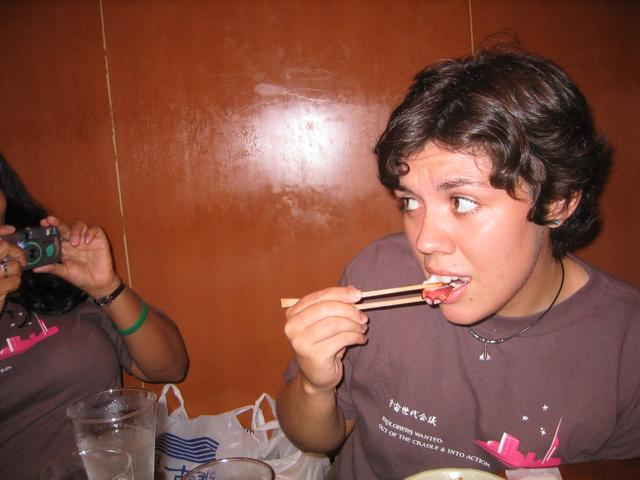
The Space Generation Congress is a 3-day event that brings together young scientists, engineers, and students to talk about space. I recently attended the SGC in Fukuoka, Japan, and it was a dream come true! Here is a picture of me eating octopus for the first time in Japan. I didn't like it very much.
Check oot the Space Generation Congress page for the details of my trip (and cool pictures!!).
NASA Microgravity Student Research onboard the C-9
Robotics
Origami
