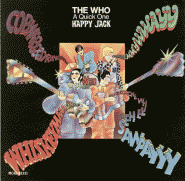
Tommy is perhaps what solidified The Who as a permanent installment in the hard rock era. It became, more or less, the Who's calling card in the early seventies.
Tommy Walker's father didn't come home from the war. His mother found herself a new love interest, who meets his demise at the belated return of Captain Walker himself. Tommy is unfortunate enough to walk in on the violent scene, and the horific vision sends the young boy into a state of detachment, with the loss of his ability to see, speak, and hear.
From this point on, life is a rollercoaster of new vibrations and psychedelic experiences for Tommy. He is bullied mercilessly by his malicious cousin, falls victim to the Acid Queen, and discovers the "silver ball". Tommy becomes the pinball champion, an ironic position, due to the fact that he is deaf, dumb, and blind. All the while, Tommy has an odd obsession with his reflection, the only thing he is capable of seeing. A doctor who runs a few tests on Tommy, hoping to cure him by some miracle, insist that the problem is all in his head. Finally, his senses are regained, when his mother smashes the mirror that Tommy has become so attached to, lifting Tommy's confining sheet of isolation. Tommy is then the messiah, preaching his ideas to cult-like followers. With their accumulated pinball cash, the Walkers establish "Tommy's Holiday Camp", where Tommy's followers may come and live the Tommy Walker way of life, a road to self perfection. In order for them to do so, Tommy requires them to live in isolation as well, while playing pinball, adorned with ear plugs, blindfolds, and a mouth cork.
However, to Tommy's great misfortune, his followers, angry and frustrated with this new way of life, "overthrow" Tommy and destroy the camp. The end of the story is often disputed, but it is commonly said among Who fans that Tommy is spiritually awakened in a climactic conclusion to the legendary rock opera. Others say that he returns to being blind, deaf, and dumb.
The main thing to remember about Tommy is that it's not just about a deaf, dumb, and blind kid who plays a mean game of pinball. It's about a new type of feeling. It's about receiving feelings as musical vibrations. |