 |
|
|
|
|
|
|
|
|
|
|
|
|
|
|
|
|
|
|
|
|
|
|
 |
|
|
|
|
|
|
|
BREATHALYZERS |
|
|
|
|
|
|
|
|
|
 |
|
|
|
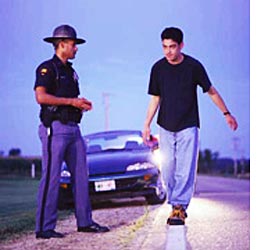
According to the National Highway Traffic Safety Administration (NHTSA) 17,013 people were killed last year (2003) in alcohol related crashes. That is approximately one death every half hour. 40% of all traffic fatalities are alcohool related. Drunk driving is an issue that has been at hand for years and years. Police have implemented numerous laws to attempt to reduce the number of fatalities. The legal limit for the amount of alcohol in your system has been reduced, the drinking age has been increased, and a law has been enforced which states that no person is allowed to have an open container of an alcoholic beverage in their possession (no drinking and driving). These are only some of the efforts that have been taken to reduce the number of fatalities. |
|
|
|
|
|
The police knew that in order to charge a person with drunk driving, they would first have to identify them. Although it is possible to conclude the sobriety of a person by watching them drive (if they are swerving etc.), asking them questions, or having them perform simple tasks (walking in a straight line), you cannot receive a definite answer from these trials. However, these inquiries leave a lot of room for flexibility in judgement and would not be 100% accurate or reliable. For this reason new tests were devised; ones that tested your chemical content. This allowed for accurate results which in turn permitted the police to have definite proof of a person's sobriety. Many new ways were proposed that could produce more clear results. It was suggested that urine or blood tests could be taken because both of these tests would identify the chemical reactions occuring in the body (including the consumtion of alcohol). However, this was quickly proved to be impractical and inifficient. It was not likely that you would be able to ask numerous drivers to let you have a blood or urine sample from them. It also did not allow them to have prompt results. This led to the invention of the Breathalyzer. Dr. Robert Borkenstein invented the Breathalyzer in 1954. A Breathalyzer is a device that allows you to discover the amount of alcohol in a persons system directly after it is used. |
|
|
|
WHY IT WORKS |
|
|
|
A Breathalyzer, when blown into, undergoes a chemical reaction. The chemical reaction than produces a color change. These color changes inform us as to the amount of alcohol in a person's system. This method works because alcohol is present in your breath. Thus, by creating a device that tests your breath, you are able to decipher whether or not that person has been drinking alcohol. When alcohol is consumed it is absorbed rather than digested or chemically changed in any way. It is absorbed into the bloodstream through the mouth, throat, stomach, and intestines. Alcohol is present in your breath because as it seeps through the lungs, it travels through the alveoli (air sacs) across from the membranes and evaporates into the air. When you breathe (exhale) into a Breathalyzer, the alveolar air is identified. From there you can determine the BAC (blood alcohol content) becaue the ratio of alcohol in alveoli air to alcohol in the bloodstream is 2,100 to 1 (2,100 ml to 1 ml). |
|
|
|
Return to Homepage |
|
|
HOW IT WORKS |
|
|
|
|