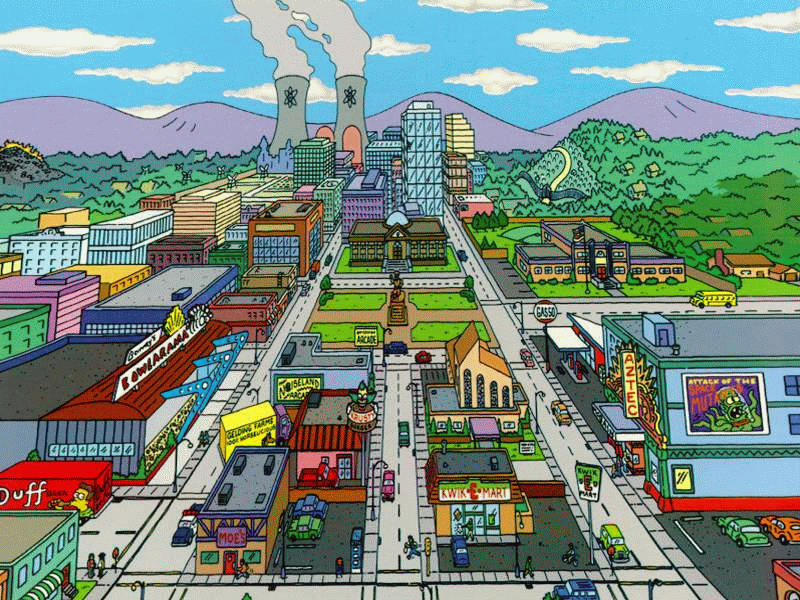
Creator Matt Groening has stated that Springfield has much in common with Portland, Oregon, the city he grew up in, and the name "Springfield" was chosen because virtually every state has a town or city with that name.
According to David Silverman, an animation director for the series, Springfield is in North Tacoma. This has not been confirmed officially.
Animation scholars and fans have noted that the series uses the medium of animation to its advantage, allowing the show to take place in many settings and feature a far greater cast of characters than a live-action sitcom. The cost of having an episode of The Simpsons take place in the mountains, Europe, the city park, or a cruise ship on the ocean (all of which simply use drawn and painted backgrounds) is hardly more than placing the family in the more conventional sitcom settings of a living room, a kitchen, and perhaps one or two related settings. This allows for far more flexibility in plot development than in a typical live-action sitcom constrained by physical limitations and logistics.
Residents of Eugene, Oregon suggest that Groening's Springfield is modeled after Oregon's Eugene-Springfield area. This theory is mostly unfounded, but has its roots in similarities like the Springfield Weyerhaeuser plant, which employed a sizeable portion of Springfield in the 1980s and is responsible for some of the area's pollution. Eugene/Springfield was founded by pioneer Eugene Skinner, whose statue, located on the University of Oregon campus, closely resembles the fictional Jebediah Springfield.
Theme
Race relations are also the subject of satire in the show, as the handful of African American characters are almost always portrayed as being more intelligent and rational than their "Yellow" counterparts. Some people interpret this as a satire of Hollywood and TV's portrayal of exaggerated 'reverse stereotypes' in which the computer genius is always a black actor. For instance, Dr. Hibbert, despite a tendency to laugh at the most inappropriate times, is arguably among the least dysfunctional characters in the series, and is certainly more professionally qualified for medical practice than Dr. Nick Riviera. Furthermore, Police Sergeant Lou is constantly lecturing Chief Wiggum on his inept law enforcement practices, and Homer's co-worker, Carl Carlson, who is also African American, while sometimes as idiotic as Lenny Leonard and Homer, but he also often insults their stupidity, and has a Master's Degree in Nuclear Physics.
During the more recent years of Simpsons production, some social conservatives have come to embrace the show. One of the main explanations of this shift is that The Simpsons portrays a traditional nuclear family among a lineup of television sitcoms that now portray less traditional families. The show has toyed with the possibility of extramarital affairs, such as when Homer falls for a female nuclear technician who shares his love of donuts, or when Marge's ex-boyfriend Artie Ziff tries to rekindle their old romance. Nevertheless, these affairs never occur, and by the end of every episode, Homer and Marge's marriage is strongly affirmed. Social conservatives and some evangelical Christians have also pointed to the positive role model of devout Christian Ned Flanders, whose fretfulness is occasionally ridiculed but whose decency never wavers despite constant provocation from Homer (except that time that he had pre-marital sex, or married a cocktail waitress in Las Vegas). In several episodes, God actually intervenes to protect the Flanders family, invoking such Protestant concepts as Predestination. As compared with the Simpson family, the Flanders family is relatively well-off and less dysfunctional, although it can be agreed that the Flanders family is quirky in its own way, with over-the-top devotion and their fundamentalist interpretations of the Holy Bible.