 |
|
|
|
|
|
 |
|
||||
 |
 |
 |
 |
 |
|
 |
 |
|
|||
|
|||||||||||||||||||||
DesignJeff Robbin headed the team which developed both the iPod firmware and the iTunes program at Apple. His team integrated the core firmware from PortalPlayer with the user interface library developed by Pixo. (The founder of Pixo had worked on the Apple Newton, a personal digital assistant formerly produced by Apple.) The Pixo libraries provide the user interface, though the iPod photo has incorporated some visual elements from Mac OS X, such as the animated Aqua style progress bar. More recent iPods, such as the iPod nano and fifth-generation iPod, also incorporate the "brushed-metal" effect, previously used in iTunes before version 5.0, in their stopwatch, screen lock and radio features. Until the release of iPod mini, the user interface of all iPods used "Chicago", the font used on the original Macintosh computer from 1984, designed by Susan Kare. The iPod mini uses the "Espy Sans" font (previously seen in eWorld, the Newton, and Copland), while the color fourth-generation iPods (previously known as iPod photo) and fifth-generation iPods use Myriad, Apple's current corporate typeface. This photograph shows
the internal view of a third-generation iPod: |
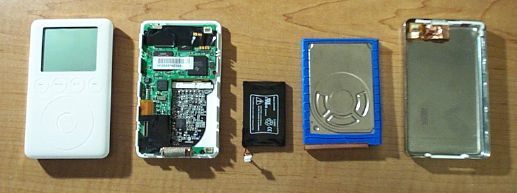 |
From left to right:
The unit's case snaps together, with no screws or adhesive involved (though the fourth generation has some adhesive holding the battery in place). The plastic front of the case has clips which lock under a ridge inside the rim of the metal case back. A servicer can pry the iPod open by carefully inserting a small non-metal screwdriver to pull the metal away from the clips. iPod contains a small internal speaker which generates the scroll-wheel clicks and alarm clock beep sound, but this internal speaker cannot play music. |