[Recipes] [Best Movie Monsters] [Fun Links] [Bibliography]
 The History of Halloween
History of Halloween, like any other festival's history is inspired
through traditions that have transpired through ages from one
generation to another. We follow them mostly as did our dads and
grandpas. And as this process goes on, much of their originality
get distorted with newer additions and alterations. It happens so
gradually, spanning over so many ages, that we hardly come to know
about these distortions. At one point of time it leaves us puzzled,
with its multicolored faces. Digging into its history helps sieve
out the facts from the fantasies which caught us unaware. Yet, doubts
still lurk deep in our soul, especially when the reality differs from
what has taken a deep seated root into our beliefs. The history of
Halloween Day, as culled from the net, is being depicted here in this
light. This is to help out those who are interested in washing off the
superficial hues to reach the core and know things as they truly are.
'Trick or treat' may be an innocent fun to relish on the Halloween Day.
But just think about a bunch of frightening fantasies and the scary
stories featuring ghosts, witches, monsters, evils, elves and animal
sacrifices associated with it. They are no more innocent. Are these
stories a myth or there is a blend of some reality? Come and plunge
into the halloween history to unfurl yourself the age-old veil of
mysticism draped around it.
 Behind the name... Halloween, or the Hallow E'en as they call it in
Ireland , means All Hallows Eve, or the night before the 'All Hallows',
also called 'All Hallowmas', or 'All Saints', or 'All Souls' Day,
observed on November 1. In old English the word 'Hallow' meant '
sanctify'. Roman Catholics, Episcopalians and Lutherians used to
observe All Hallows Day to honor all Saints in heaven, known or
unknown. They used to consider it with all solemnity as one of the
most significant observances of the Church year. And Catholics, all
and sundry, was obliged to attend Mass. The Romans observed the
holiday of Feralia, intended to give rest and peace to the departed.
Participants made sacrifices in honor of the dead, offered up prayers
for them, and made oblations to them. The festival was celebrated on
February 21, the end of the Roman year. In the 7th century, Pope
Boniface IV introduced All Saints' Day to replace the pagan festival
of the dead. It was observed on May 13. Later, Gregory III changed
the date to November 1. The Greek Orthodox Church observes it on
the first Sunday after Pentecost.
Despite this connection with the Roman Church, the American
version of Halloween Day celebration owes its origin to the ancient
(pre-Christian) Druidic fire festival called "Samhain", celebrated
by the Celts in Scotland, Wales and Ireland. Samhain is pronounced
"sow-in", with "sow" rhyming with cow. In Ireland the festival was
known as Samhein, or La Samon, the Feast of the Sun.
In Scotland, the celebration was known as Hallowe'en. In Welsh
it's Nos Galen-gaeof (that is, the Night of the Winter Calends.
According to the Irish English dictionary published by the Irish
Texts Society: "Samhain, All Hallowtide, the feast of the dead
in Pagan and Christian times, signalizing the close of harvest
and the initiation of the winter season, lasting till May,
during which troops (esp. the Fiann) were quartered. Faeries
were imagined as particularly active at this season. From it
the half year is reckoned. also called Feile Moingfinne
(Snow Goddess).
Behind the name... Halloween, or the Hallow E'en as they call it in
Ireland , means All Hallows Eve, or the night before the 'All Hallows',
also called 'All Hallowmas', or 'All Saints', or 'All Souls' Day,
observed on November 1. In old English the word 'Hallow' meant '
sanctify'. Roman Catholics, Episcopalians and Lutherians used to
observe All Hallows Day to honor all Saints in heaven, known or
unknown. They used to consider it with all solemnity as one of the
most significant observances of the Church year. And Catholics, all
and sundry, was obliged to attend Mass. The Romans observed the
holiday of Feralia, intended to give rest and peace to the departed.
Participants made sacrifices in honor of the dead, offered up prayers
for them, and made oblations to them. The festival was celebrated on
February 21, the end of the Roman year. In the 7th century, Pope
Boniface IV introduced All Saints' Day to replace the pagan festival
of the dead. It was observed on May 13. Later, Gregory III changed
the date to November 1. The Greek Orthodox Church observes it on
the first Sunday after Pentecost.
Despite this connection with the Roman Church, the American
version of Halloween Day celebration owes its origin to the ancient
(pre-Christian) Druidic fire festival called "Samhain", celebrated
by the Celts in Scotland, Wales and Ireland. Samhain is pronounced
"sow-in", with "sow" rhyming with cow. In Ireland the festival was
known as Samhein, or La Samon, the Feast of the Sun.
In Scotland, the celebration was known as Hallowe'en. In Welsh
it's Nos Galen-gaeof (that is, the Night of the Winter Calends.
According to the Irish English dictionary published by the Irish
Texts Society: "Samhain, All Hallowtide, the feast of the dead
in Pagan and Christian times, signalizing the close of harvest
and the initiation of the winter season, lasting till May,
during which troops (esp. the Fiann) were quartered. Faeries
were imagined as particularly active at this season. From it
the half year is reckoned. also called Feile Moingfinne
(Snow Goddess).
(1) The Scottish Gaelis Dictionary defines it as "Hallowtide. The
Feast of All Soula. Sam + Fuin = end of summer."
(2) Contrary to the information published by many organizations,
there is no archaeological or literary evidence to indicate that
Samhain was a deity. The Celtic Gods of the dead were Gwynn ap Nudd
for the British, and Arawn for the Welsh. The Irish did not have a
"lord of death" as such. Thus most of the customs connected with the
Day are remnants of the ancient religious beliefs and rituals, first
of the Druids and then transcended amongst the Roman Christians who
conquered them.
Top 10 Candy Brands
- Reese's Peanut Butter Cups
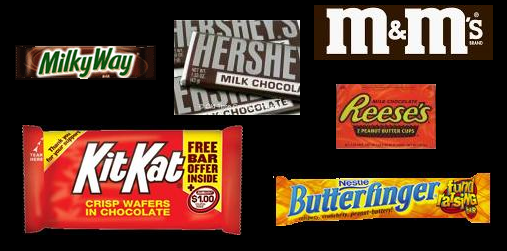
- Snickers
- Hershey's
- M&M's
- Kit Kat
- Milky Way
- Butterfinger
- 3 Musketeers
- Brach's
- Nestle's Crunch