 |
|
|
|
|
|
|
|
|
|
 |
|
||||||||
 |
 |
 |
 |
 |
 |
 |
 |
 |
|
 |
 |
 |
 |
|
|||||
Violations
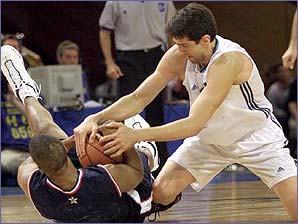
The ball may be advanced toward the basket by being shot, passed between
players, thrown, tapped, rolled or dribbled (bouncing the ball while running).
The ball must stay within the court; the last team to touch the ball before it travels out of bounds forfeits possession. The ball-handler may not move both feet without dribbling, known as traveling, nor may he dribble with both hands or catch the ball in between dribbles, a violation called double dribbling. A player's hand must remain on top of the ball while dribbling, failure to do so is known as carrying the ball. A team, once having established ball control in the front half of the court, may not return the ball to the backcourt. The ball may not be kicked nor struck with the fist. A violation of these rules results in loss of possession, or, if committed by the defense, a reset of the shot clock.
There are limits imposed on the time taken before progressing the ball past halfway (8 seconds in international and NBA), before attempting a shot (24 seconds), holding the ball while closely guarded (5 seconds), and remaining in the restricted area (the lane, or "key") (3 seconds). These rules are designed to promote more offense.
No player may interfere with
the basket or ball on its downward flight to the basket, or while it is
on the rim (or, in the NBA, while it is directly above the basket), a
violation known as goaltending. If a defensive player goaltends, the attempted
shot is considered to have been successful. If a teammate of the shooter
goaltends, the basket is cancelled and the team loses possession.
|
|
|
|
|
|
|
 |
|
|||||
 |
 |
 |
 |
 |
 |
|
 |
|
|||||