 |
|
|
|
|
|
|
|
|
|
 |
|
||||||||
 |
 |
 |
 |
 |
 |
 |
 |
 |
|
 |
 |
 |
 |
|
|||||
Passing
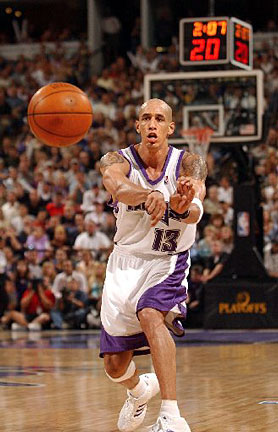 A
pass is a method of moving the ball between players. Most passes are accompanied
by a step forward to increase power and are followed through with the
hands to ensure accuracy.
A
pass is a method of moving the ball between players. Most passes are accompanied
by a step forward to increase power and are followed through with the
hands to ensure accuracy.
One of the most basic passes is the chest pass. The ball is passed directly from the passer's chest to the receiver's chest. A properly performed chest pass consists of an outward snap of the thumbs to add more velocity. This has the advantage that it takes the least time to complete, as the passer tries to pass as directly straight as possible.
Another type of pass is the bounce pass. In this pass, the ball bounces about two-thirds of the way from the passer. Like the chest pass, it is passed from the passer's chest to the receiver's chest, and it is passed as directly as possible, for example, there should be no downward motion of the ball between the bounce and the time the receiver catches it. In this way, it is completed in the smallest amount of time possible for this pass. It does take longer to complete than the chest pass, but it is more difficult for the opposing team to intercept (kicking the ball deliberately is a violation). Thus, in crowded moments, or to pass the ball around a defender, this pass is often used.
The overhead pass is used to pass the ball over a defender. The ball is passed with the ball beginning behind the passer's head and being released as it passes above the passer's head.
The most important aspect of
a good pass is that it is difficult for the defense to intercept. Good
passers can pass the ball with great accuracy and velocity and choose
their targets well.
|
|
|
|
|
|
|
 |
|
|||||
 |
 |
 |
 |
 |
 |
|
 |
|
|||||